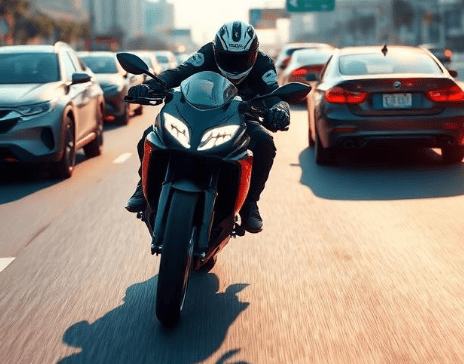
In 2025 and into 2026, the landscape of motorcycle-related traffic laws across the United States continues to evolve — but not via a sweeping federal mandate. Rather, meaningful changes come state-by-state. Several themes dominate: expanded or clarified lane‐splitting / filtering codified in more states, changes to helmet requirements, especially for younger riders, and evolving regulation around electric bikes / motor-driven cycles, including reclassification, licensing, registration, and insurance. Below is a detailed, state-by-state breakdown of where things are shifting (or where long-standing rules remain firmly in place).
State-by-State Highlights
Minnesota
One of the most significant 2025 updates: starting July 1, 2025, Minnesota legalizes motorcycle lane splitting and filtering under carefully constrained conditions.
- Motorcyclists may “split” (ride between lanes) when traffic is moving, but only if their speed does not exceed 25 mph, and they are no more than 15 mph faster than the surrounding traffic.
- When traffic is stopped (i.e., lane filtering), similar constraints apply: riders can move between or ahead of vehicles but must remain within the speed differential limit.
- These rules aim to strike a balance: giving motorcyclists a safer way to avoid being boxed in or rear-ended, while limiting unsafe high-speed weaving. The Minnesota Motorcycle Safety Center and Office of Traffic Safety are pushing education for both riders and drivers.
- Importantly, this is not a free-for-all: the legislation codifies “prudent operation,” merging back when traffic resumes, and speed control.
California
California remains the most permissive state regarding lane splitting, but 2025 brings refinements:
- Lane splitting (i.e., riding between lanes, even while traffic is moving) has long been legal in California.
- Under updated CHP / law-enforcement guidance, speed differential recommendations are more clearly defined: splitting at speeds above 40 mph is discouraged, and riders should avoid going more than 15 mph faster than surrounding traffic.
- Helmet enforcement is stringent: all riders and passengers must wear DOT-compliant helmets, and “novelty” helmets that don’t meet DOT standards are illegal.
- These requirements reflect ongoing safety concerns, especially as lane splitting continues to be a point of tension between riders, drivers, and law enforcement.
Colorado
Colorado’s change is more modest but still noteworthy:
- A lane-filtering law (not full lane splitting) officially took effect on August 7, 2024, but remains very relevant in 2025 as the state continues its three-year trial program.
- Under the law (Senate Bill 24-079), filtering is allowed when traffic is stopped; however, motorcycles must not exceed 15 mph while doing so.
- There is a sunset provision: the law is set to expire on September 1, 2027, requiring the state to review safety data before renewing or adjusting the program.
- Safety caveats: riders must filter “in a safe manner,” in sufficient space, and not pass too aggressively.
- From a legal/liability perspective, filtering within the law’s bounds reduces risk of being automatically deemed negligent in a crash (though improper filtering remains dangerous).
Montana
- Montana allows limited lane filtering, as codified in earlier legislation, and this continues in 2025.
- Under state rules, motorcycles can overtake stopped or very slow vehicles (≤ 10 mph) in the same lane, but they must do so “safely.”
- High-speed splitting (weaving through moving traffic) remains illegal.
- This places Montana in a moderate position: more flexible than states with strict no-splitting rules, but far more restrictive than California.
Utah
- Utah has already had a lane filtering rule in previous years; in 2025, its status remains important.
- According to the model adopted in Utah: filtering is allowed when traffic is stopped, the speed limit of the road is 45 mph or less, and the motorcyclist does not exceed 15 mph while passing.
- This law is not about high-speed weaving; it’s more about giving riders a legal way to move through stopped or congested traffic.
Arizona
- Arizona allows lane filtering (not full “splitting”).
- Under Senate Bill 1273, motorcyclists can pass between stopped vehicles “if the movement may be made safely.”
- Restrictions include: only two-wheeled motorcycles (no sidecars, no three-wheelers), and filtering is limited to streets with certain lane configurations.
- Speed constraints apply: filtering must be done at a reasonably safe “filtering speed.”
Connecticut
Connecticut made some big changes effective October 1, 2025, especially around helmets and e-bikes / motor-driven cycles.
- Helmet Law: The age for mandatory helmet use on motorcycles is raised: now, all riders under 21 must wear helmets.
- The fine for violations starts at $90 and increases for repeat offenders.
- E-bike Reclassification: Very powerful electric bikes are being redefined:
- E-bikes under 750 W remain standard.
- Vehicles up to 3,700 W (and meeting other criteria) are now “motor-driven cycles,” requiring a license.
- Even more powerful ones are classified as motorcycles and must carry insurance, be registered, and follow motorcycle licensing rules.
- Sales / Modification: Sellers must properly label what type of vehicle is being sold (e-bike vs motor-driven cycle), or face fines.
Other States / Broader Trends
- According to the National Conference of State Legislatures (NCSL), at least eight states passed motorcyclist-safety legislation in 2024 (which is relevant for 2025), including lanes, equipment, and helmet education.
- Lane splitting remains rare: According to legal summaries, only a handful of states explicitly permit splitting or filtering; many more prohibit it or are silent.
- On e-bike laws: electricbikeexplorer.com provides a 2025 snapshot showing how states treat e-bikes, including 3-class systems, registration or license needs, helmet rules, and age limits.
- In Virginia, local rules (e.g., Henrico County) show that electric motorcycles (or high-powered e-bikes) are regulated like traditional motorcycles: requiring helmet, license, inspection, registration, and insurance.
Analysis: What These Changes Mean for Riders
- More acceptance of filtering
- With Minnesota legalizing lane splitting/filtering (under strict conditions) and Colorado continuing its filtering pilot, filtering is becoming more mainstream. Riders in these states now have legal tools to avoid being trapped in traffic.
- But because speed and differential limits are tight, the risk of reckless “weaving” is curtailed — legislators want to give benefits without encouraging dangerous behavior.
- Helmet laws are tightening
- In some states (like Connecticut), helmet laws have been expanded in both age and application. Younger riders are especially targeted for safety.
- Ensuring helmets meet DOT standards (or equivalent) is a continued focus — not just any helmet is acceptable in states like California.
- Regulation of electric-powered two-wheelers is evolving fast
- E-bikes with very high power are no longer just “bikes” in some states; they are being reclassified as motor-driven cycles or even motorcycles, triggering stricter requirements (license, registration, insurance).
- This has big implications for both manufacturers and consumers: what used to be a “bicycle” purchase could now require full vehicle compliance depending on wattage and state.
- Sales and marketing are also under more scrutiny: states are making sure that sellers label vehicles accurately so that consumers don’t buy something thinking it’s a benign e-bike when it legally counts as a “motorcycle.”
- Legal variation is broad
- There is no single federal overhaul — this is very much a patchwork of state laws. For riders who travel or cross state lines, the rules can change dramatically when you enter a new state.
- Some state laws are trial-based (like Colorado’s filtering law), meaning they may expire or be revised based on safety data collected during the program.
Risks & Advisories for Riders
- Know your state law: Because the rules vary so much, riders should check their own state’s DMV or legislative site to confirm what’s legal where they ride.
- Be cautious when filtering/splitting: Even in states where it’s legal, the speed limits and “safe operation” requirements are real. Overstepping them could lead to citations or worse.
- E-bike buyers beware: If you’re buying a high-powered e-bike, make sure you know its classification under state law — failing to do so might mean you’re committing to registration, licensing, or insurance.
- Helmet compliance matters: Wearing a “novelty” helmet that doesn’t meet safety standards may not just be unsafe — it could also be illegal in some states.
The major takeaway for 2025–2026 is that motorcycle law in the U.S. is evolving, but unevenly. Rather than one big federal shift, we’re seeing incremental, state-level adjustments that reflect both new safety research (especially around e-bikes) and the persistent tension around lane splitting / filtering. For riders, staying informed matters now more than ever.