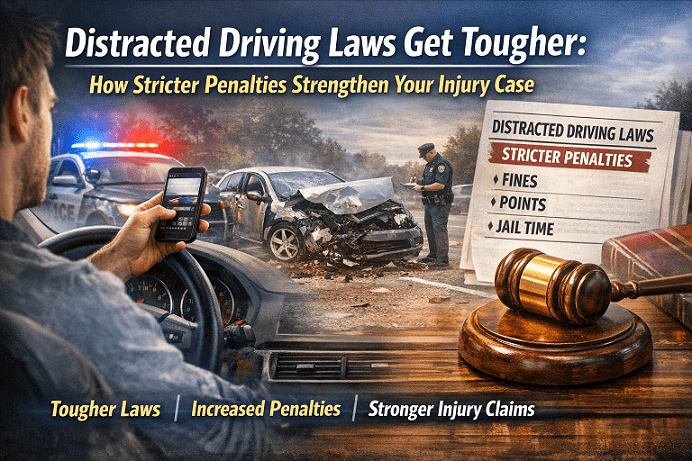
How Stricter Penalties Strengthen Your Injury Case
Distracted driving has emerged as one of the most dangerous behaviors on American roads, claiming thousands of lives annually and causing hundreds of thousands of injuries. In response to this epidemic, states across the nation have dramatically toughened their distracted driving laws over the past decade, implementing stricter penalties, enhanced enforcement mechanisms, and more comprehensive definitions of what constitutes distracted driving. These legislative changes have not only made roads safer but have also fundamentally altered the landscape of personal injury litigation, providing accident victims with more robust legal tools to prove negligence and recover compensation.
The Evolution of Distracted Driving Legislation
The first generation of distracted driving laws focused primarily on texting while driving, with many states implementing texting bans in the late 2000s and early 2010s. These early laws often carried minimal penalties, typically small fines that did little to deter the behavior. Enforcement was challenging, as officers had difficulty proving that a driver was texting rather than performing some other permissible function on their phone.
Today’s distracted driving laws represent a significant evolution. Many states have moved toward comprehensive hands-free requirements that prohibit drivers from holding phones for any reason while operating a vehicle. These laws eliminate the enforcement ambiguity that plagued earlier legislation. If an officer observes a driver holding a phone, a violation has occurred regardless of what the driver claims they were doing with the device.
The penalties associated with these violations have escalated dramatically. What once carried fines of fifty to one hundred dollars now frequently results in fines of several hundred dollars for first offenses, with subsequent violations bringing even steeper penalties. Many jurisdictions have added license points to distracted driving citations, meaning that repeat offenders face not just financial consequences but also the potential loss of driving privileges. Some states have created enhanced penalties when distracted driving occurs in school zones, construction areas, or results in an accident causing injury or death.
Enhanced Enforcement Mechanisms
Modern distracted driving laws incorporate enforcement mechanisms that were largely absent from earlier legislation. Many states have eliminated the requirement that distracted driving be a secondary offense, meaning officers can now pull over drivers solely for phone use without needing to observe another traffic violation first. This primary enforcement authority has significantly increased the number of citations issued and created a more robust deterrent effect.
Technology has also transformed enforcement capabilities. Some jurisdictions have begun implementing or piloting programs that use automated cameras capable of detecting phone use by drivers. While these programs remain controversial and face legal challenges in some areas, they represent a growing trend toward technological solutions for enforcement challenges.
Police departments in many communities have increased their focus on distracted driving through dedicated enforcement periods and public awareness campaigns. Officers receive specialized training in identifying distracted driving behaviors and documenting evidence that will hold up in both traffic court and civil litigation. Some departments use unmarked vehicles or position officers in elevated locations where they can more easily observe drivers engaged in phone use or other distracting activities.
How Stricter Laws Create Stronger Evidence of Negligence
The strengthening of distracted driving laws has profound implications for personal injury cases. In civil litigation, a plaintiff injured by a distracted driver must prove that the defendant was negligent and that this negligence caused the accident and resulting injuries. This requires establishing four elements: duty of care, breach of that duty, causation, and damages.
Stricter distracted driving laws make proving breach of duty significantly easier. When a driver violates a traffic law, this violation can establish negligence per se in many jurisdictions. Negligence per se is a legal doctrine that treats the violation of a statute or regulation as conclusive proof that the defendant breached their duty of care, provided the violated law was designed to prevent the type of harm that occurred and the plaintiff was among the class of persons the law was intended to protect.
For example, if a driver was cited for using a handheld phone at the time of an accident, and that jurisdiction has a hands-free law prohibiting such use, the citation becomes powerful evidence that the driver was negligent. The plaintiff no longer needs to rely solely on witness testimony about what they saw or expert reconstruction of events. The citation itself, backed by the officer’s observations and documentation, provides concrete proof of a legal violation that directly relates to the driver’s attention and ability to operate their vehicle safely.
The comprehensiveness of modern distracted driving laws also closes loopholes that defendants previously exploited. Under older, narrower laws that only prohibited texting, a defendant might claim they were using their phone for navigation, making a call, or checking email rather than texting, arguing that their behavior was therefore legal and not negligent. Current hands-free laws eliminate these distinctions. If the driver was holding or manipulating the phone in any way that violated the statute, negligence can be established regardless of the specific task being performed.
Phone Records as Corroborating Evidence
Stricter enforcement of distracted driving laws has been accompanied by greater willingness on the part of courts to allow discovery of phone records in personal injury cases. When a plaintiff alleges that a defendant was distracted by phone use at the time of an accident, attorneys can subpoena the defendant’s phone records to determine whether calls, texts, or data usage occurred during the relevant timeframe.
The existence of tough distracted driving laws strengthens the argument for allowing such discovery. Courts recognize that phone use while driving is not just dangerous but illegal, making phone records highly relevant to determining fault. The records can confirm or refute claims about whether a driver was using their phone, providing objective data that is difficult to dispute.
Modern smartphones generate extensive metadata that can be particularly valuable in litigation. Beyond just showing that a text was sent or call was made at a particular time, records can sometimes reveal app usage, internet browsing, and other activities. This granular data can paint a detailed picture of exactly what a driver was doing in the moments before and during a collision.
When phone records show usage coinciding with the time of an accident, combined with a citation for distracted driving, the evidence of negligence becomes exceptionally strong. Even when no citation was issued at the scene, phone records demonstrating usage at the time of the crash can support a negligence claim, especially in jurisdictions where violating the distracted driving statute establishes negligence per se.
Impact on Settlement Negotiations
The strengthening of distracted driving laws and the enhanced evidence they provide have significantly impacted settlement negotiations in personal injury cases. Insurance companies are generally more willing to offer reasonable settlements when faced with strong evidence of clear legal violations by their insured drivers.
A distracted driving citation, particularly under modern comprehensive laws, represents a major liability concern for defendants and their insurers. The citation not only provides evidence of negligence but also creates reputational risks if the case proceeds to trial. Juries tend to react strongly to evidence that a defendant was using their phone illegally at the time they caused an accident, viewing such behavior as particularly reckless and deserving of significant consequences.
This dynamic often leads to earlier and more generous settlement offers in cases involving documented distracted driving violations. Insurers recognize that the combination of a citation, phone records, and testimony about the accident creates a compelling narrative that is likely to resonate with a jury. Rather than risk a large verdict and the costs associated with taking a case to trial, insurers frequently prefer to negotiate reasonable settlements.
The enhanced penalties associated with modern distracted driving laws also affect settlement calculations. In some jurisdictions, evidence of particularly egregious distracted driving can support claims for punitive damages, which are designed to punish especially reckless behavior rather than simply compensate for injuries. The threat of punitive damages can substantially increase settlement values, as insurers seek to avoid the unpredictability of jury determinations on such awards.
Challenges and Limitations
While stricter distracted driving laws provide significant advantages for injury victims, they are not without limitations. Enforcement remains inconsistent across jurisdictions, and many distracted driving violations go undetected and uncited. When an officer does not observe the distracted behavior or issue a citation at the scene, proving that distraction occurred can still be challenging, even with strong laws on the books.
Privacy concerns sometimes limit access to phone records, particularly when the records might reveal sensitive personal information beyond just the fact of phone usage. Courts must balance the relevance of such evidence against privacy interests, and in some cases may limit the scope of discovery or impose protective orders on how records can be used.
Defendants and their attorneys have also developed strategies to challenge distracted driving evidence. They may argue that phone use, even if it occurred, was not the cause of the accident. They might present evidence suggesting that even an attentive driver could not have avoided the collision under the circumstances, or that the plaintiff’s own actions contributed to causing the crash. The existence of a distracted driving violation, while powerful evidence, does not automatically guarantee success in litigation.
Additionally, some distracted driving laws include exceptions that defendants may invoke. Many hands-free laws allow phone use when a vehicle is stopped or parked, when calling emergency services, or in other specific circumstances. Defendants may claim their phone use fell within one of these exceptions, potentially complicating the question of whether a legal violation occurred.
The Broader Impact on Road Safety
The toughening of distracted driving laws serves purposes beyond facilitating personal injury litigation. The primary goal of these laws is deterrence, preventing distracted driving before it causes harm. Research suggests that comprehensive hands-free laws, when properly enforced and publicized, do reduce distracted driving behaviors and associated crashes.
This broader safety impact ultimately benefits potential injury victims by reducing the likelihood they will be involved in a distracted driving crash in the first place. The combination of tougher laws, enhanced enforcement, and public awareness campaigns has helped shift social norms around phone use while driving, making the behavior less socially acceptable and more clearly understood as dangerous and irresponsible.
As laws continue to evolve, some jurisdictions are expanding the definition of distracted driving beyond just phone use to encompass other attention-diverting behaviors such as eating, grooming, or attending to passengers or pets in ways that compromise driving safety. These broader approaches to distracted driving regulation may further strengthen injury claims by providing additional bases for establishing negligence when crashes occur.
Practical Implications for Accident Victims
For individuals injured in accidents they believe were caused by distracted driving, the current legal landscape offers important opportunities. Reporting suspected distracted driving to responding officers at the accident scene is crucial, as this may prompt officers to cite the at-fault driver or document observations relevant to distraction in their reports.
Accident victims should also be aware that evidence of distracted driving may exist even when not immediately apparent. Phone records, vehicle data recorders, witness statements, and surveillance footage from nearby businesses or traffic cameras can all potentially provide evidence of distraction. An experienced personal injury attorney can identify and pursue these sources of evidence, building a case even when distracted driving was not cited at the scene.
The timing of evidence preservation is critical. Phone records may be routinely deleted after certain periods, and surveillance footage is often recorded over quickly. Prompt legal action to preserve evidence through formal preservation letters or court orders can make the difference between having strong proof of distracted driving and having no evidence at all.
Understanding how distracted driving violations affect insurance claims is also important. In some cases, evidence of illegal distracted driving may allow accident victims to pursue claims beyond the at-fault driver’s insurance policy limits by establishing grounds for bad faith claims or by supporting arguments that policy exclusions should not apply.
The dramatic strengthening of distracted driving laws across the United States represents one of the most significant developments in traffic safety regulation in recent decades. These tougher laws, combined with enhanced enforcement mechanisms and increased public awareness of the dangers of distracted driving, have created a legal environment that better protects accident victims and provides stronger tools for establishing negligence in personal injury cases.
For individuals injured by distracted drivers, these legal developments offer meaningful advantages. Citations issued under comprehensive hands-free laws provide powerful evidence of negligence that can establish liability and strengthen settlement negotiations. The ability to obtain phone records and other documentation of distracted behavior, supported by legal recognition of distraction as serious misconduct, helps accident victims prove their cases and recover fair compensation for their injuries.
As technology continues to evolve and new forms of distraction emerge, distracted driving laws will likely continue to develop and strengthen. This ongoing evolution promises to provide even greater protection for road users and more robust mechanisms for holding negligent drivers accountable when their distracted behavior causes harm. For now, accident victims and their attorneys should be aware of how current laws can be leveraged to build strong injury cases and should work diligently to document and preserve evidence of distracted driving in the aftermath of crashes.