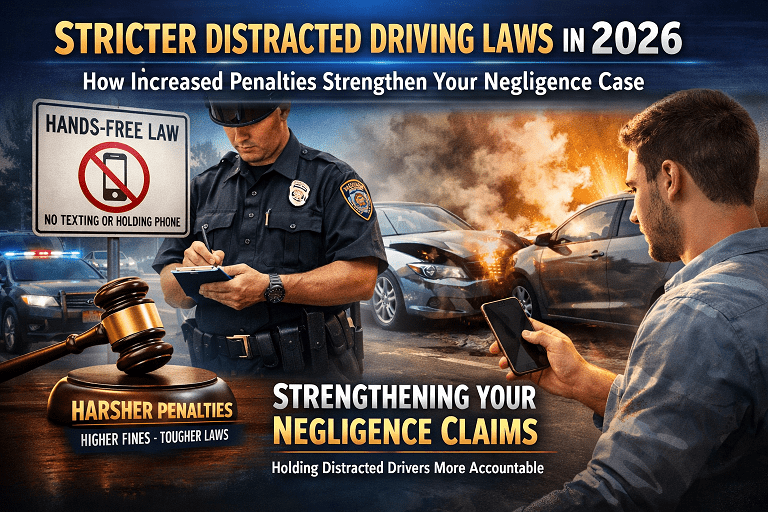
The landscape of distracted driving legislation has undergone significant transformation in 2026, with multiple states implementing comprehensive hands-free laws and substantially increasing penalties for violations. These legislative changes represent more than just tougher enforcement—they fundamentally strengthen the position of victims seeking compensation after distracted driving accidents. Understanding how these new laws function and their impact on negligence cases is essential for anyone injured by a distracted driver.
The Evolution of Distracted Driving Laws in 2026
Distracted driving has plagued American roadways for years, contributing to thousands of deaths and injuries annually. In 2023, 3,275 people died and another 324,819 were injured in distraction-related crashes, representing an average of nine deaths and 890 injuries every single day from distracted driving alone.
As we move through 2026, legislators have responded to this crisis with unprecedented action. Currently, 49 states, the District of Columbia, Puerto Rico, Guam, the Northern Mariana Islands, and the U.S. Virgin Islands ban text messaging for all drivers, with the majority enforcing these bans as primary offenses. However, the laws passed in 2025 and taking full effect in 2026 go far beyond simple texting prohibitions.
Pennsylvania’s Paul Miller’s Law: A Case Study in Comprehensive Reform
One of the most significant legislative developments is Pennsylvania’s Paul Miller’s Law, named after a young man whose life was tragically ended by a distracted tractor-trailer driver in 2010. This comprehensive legislation, which took effect on June 5, 2025, represents the new standard for distracted driving enforcement.
Effective June 5, 2025, the law prohibits as a primary offense any driver from using an interactive mobile device while driving a motor vehicle. The law defines an interactive mobile device broadly to include smartphones, tablets, personal digital assistants, portable computers, and any similar device used for voice communication, texting, emailing, internet browsing, gaming, taking images, recording videos, or social media engagement.
Critically, driving is defined as operating a motor vehicle on a highway, including anytime the motor vehicle is temporarily stationary because of traffic, a traffic control device, or other momentary delay. This means drivers cannot claim they were “not driving” simply because they were stopped at a red light or sitting in traffic.
The enforcement structure of Paul Miller’s Law follows a graduated approach. From June 5, 2025, through June 4, 2026, violators received written warnings as an educational period. However, effective June 5, 2026, the penalty is a summary offense with a $50 fine, plus court costs and other fees. While this base penalty may seem modest, the law includes severe escalations for distracted driving that results in serious harm.
If a driver is convicted of homicide by vehicle and driving while distracted, they may be sentenced up to an additional five years in prison. This enhancement demonstrates the seriousness with which Pennsylvania now treats distracted driving fatalities.
South Carolina Follows Suit
Pennsylvania is not alone in this legislative push. South Carolina implemented its own comprehensive hands-free law on September 1, 2025. The law took effect on September 1, 2025, with a first offense resulting in a $100 fine and one point on the driving record, while second and subsequent offenses within a three-year period carry a $200 fine and two points on the driving record.
For commercial drivers, the consequences are even more severe. Violations of the Hands-Free Law count as serious offenses, where two convictions within a three-year period while operating a commercial motor vehicle will disqualify drivers from operating for 60 days.
The Broader National Trend
Research demonstrates the effectiveness of these comprehensive laws. In 2024, a report detailed how distracted driving has fallen in states like Ohio, Alabama, Michigan, and Missouri after they implemented hands-free laws, underscoring the effectiveness of legal frameworks in enhancing road safety.
The shift toward primary enforcement is particularly significant. Under primary enforcement laws, police officers can stop and cite drivers solely for using handheld devices without needing to observe any other traffic violation first. This stands in contrast to secondary enforcement, where an officer must witness another infraction before citing a driver for phone use.
Understanding the Legal Concept of Negligence Per Se
The strengthening of distracted driving laws in 2026 has profound implications for personal injury cases through the legal doctrine of “negligence per se.” This concept fundamentally alters how plaintiffs can prove fault in distracted driving accidents.
Traditional Negligence vs. Negligence Per Se
In typical negligence cases, injured parties must establish four elements: duty, breach of duty, causation, and damages. Proving breach of duty often requires demonstrating that a reasonable person would not have acted as the defendant did under similar circumstances. This can be subjective and challenging to prove.
Negligence per se is a doctrine that may apply in some states when an at-fault driver violated a law prohibiting texting or using a handheld cell phone while driving, meaning their violation can serve as proof of their negligence.
Under negligence per se, when a driver violates a statute designed to protect public safety—such as a hands-free driving law—and that violation causes injury to someone the statute was meant to protect, the driver is automatically considered to have breached their duty of care. The plaintiff no longer needs to prove the driver acted unreasonably; the statutory violation itself establishes the breach.
Attorneys can argue negligence per se, meaning the driver automatically acted unreasonably by violating a safety statute. This dramatically simplifies the plaintiff’s burden of proof and strengthens their negotiating position.
The Practical Impact on Case Outcomes
Once distraction is proven, it changes everything, shifting the case from a “he-said-she-said” argument to hard evidence of negligence, which can lead to higher settlement values, punitive damages in extreme cases, and stronger negotiation leverage.
Insurance companies understand this dynamic well. When faced with clear evidence of a statutory violation, they recognize that their chances of prevailing at trial diminish significantly. This recognition often translates into more favorable settlement offers for injured plaintiffs.
The Expanded Range of Prohibited Activities
One of the most significant aspects of the 2026 laws is their comprehensive definition of prohibited device use. Unlike earlier texting bans that focused narrowly on text-based communication, the new statutes address the full range of smartphone functionality.
What Activities Are Now Prohibited?
Under laws like Pennsylvania’s Paul Miller’s Law, drivers cannot:
- Hold or support a phone or device with any part of their body
- Make or receive phone calls while holding the device
- Send, read, or write text messages or emails
- Browse the internet or engage with social media
- Play games or create/share content, including photos and videos
- Manually dial with more than one button press
- Reach for a device in a way that requires unbuckling or leaving their seat
- Use any manual or visual interaction with a handheld device
This comprehensive list addresses the reality that modern smartphones offer countless distracting features beyond simple texting. An interactive mobile device is defined as a handheld wireless telephone, personal digital assistant, smartphone, portable computer, or similar device which can be used for voice communication, texting, emailing, browsing the Internet, instant messaging, playing games, taking or transmitting images, recording or broadcasting videos, creating or sharing social media, or otherwise sending or receiving electronic data.
Exceptions That Prove the Rule
The new laws do include specific exceptions that are carefully circumscribed:
Emergency Communications: Drivers may use devices if necessary to communicate with law enforcement or emergency services to prevent injury to persons or property. This exception recognizes legitimate safety needs while maintaining the general prohibition.
Hands-Free Technology: Properly mounted devices using voice-activated or hands-free systems remain permissible. The key requirement is that the device cannot be held or manually operated.
Properly Parked Vehicles: A driver may use an interactive mobile device if the driver moves the vehicle to the side of or off a highway and halts in a location where the vehicle can safely remain stationary.
Integrated Vehicle Systems: GPS devices, systems physically or electronically integrated into the vehicle, or communications devices affixed to mass transit vehicles, buses, or school buses are generally exempt from the prohibition.
These exceptions are significant for legal cases because they establish that the legislature has already balanced convenience against safety. Drivers who violate the law cannot claim ignorance or necessity except in the narrow circumstances specified.
Proving Distracted Driving in Your Case
The stricter laws of 2026 provide multiple avenues for establishing liability in personal injury cases, but victims and their attorneys must still gather compelling evidence.
The Role of Cell Phone Records
The most important information in proving distracted driving by a negligent defendant is actual timestamped records of their cell phone use while behind the wheel. These records can show exactly when calls were made, texts were sent, or apps were accessed.
Attorneys must subpoena the driver’s cell phone records and other electronic records to prove whether or not the driver was actively using the device at the time of the accident, which might include call records, text message records, and social media activity.
The evidentiary value of phone records has increased significantly with the new laws. Previously, a defense attorney might argue that talking on a phone, while perhaps unwise, was not illegal. Under comprehensive hands-free laws, any manual phone use—including making calls—establishes a statutory violation.
Police Reports and Citations
Law enforcement documentation takes on enhanced significance under the new legal framework. Police reports often include officer observations of the scene, reckless driving behaviors, or signs of distraction, and citations issued for violations such as texting while driving.
When an officer issues a citation for violating a hands-free law, that citation becomes powerful evidence in a civil case. The criminal or traffic violation, even if it results in only a minor fine, establishes the foundation for negligence per se in the civil context.
Eyewitness Testimony
Eyewitness accounts from individuals who observed the at-fault party engaging in distracted behavior while driving can provide critical evidence to support the claim of negligence, and witness testimony can corroborate the distracted driving behavior.
Witnesses might observe a driver looking down at their lap, holding a phone to their ear, or appearing not to watch the road. In the immediate aftermath of an accident, these observations should be documented through signed statements with complete contact information.
Video Evidence
Modern technology provides unprecedented opportunities to capture distracted driving. Video footage from traffic cameras, dashcams, or surveillance cameras can serve as powerful evidence, capturing the at-fault party’s distracted behavior.
Dashboard cameras have become increasingly common in vehicles, and many businesses maintain security cameras that might capture traffic. This footage can provide irrefutable proof that a driver was holding or manipulating a device at the time of collision.
Physical Evidence at the Scene
Immediate documentation of the accident scene can reveal signs of distraction. An unlocked phone visible in the vehicle, open apps on a screen, food wrappers, or other items suggesting divided attention all serve as circumstantial evidence supporting a distraction claim.
Items found in the vehicle, such as headphones or fast food, can prove that the driver was distracted, and these should be photographed as evidence found at the scene.
Vehicle Data Recorders
Modern vehicles often contain event data recorders or “black boxes” that track driving metrics. Modern vehicles are equipped with “black box” technology that tracks key driving metrics, and erratic or sudden changes could indicate distraction, such as delayed braking or no attempts to steer away from a collision.
This data can reveal whether a driver was maintaining speed, when they applied brakes, and whether they attempted to avoid the collision—all factors that help establish whether the driver’s attention was on the road.
How Stricter Penalties Strengthen Your Case
The enhanced penalties in 2026 legislation serve multiple functions that benefit injury victims beyond simply punishing violators.
Establishing Severity and Recklessness
When legislatures impose serious penalties, including potential prison time for fatalities caused by distracted driving, they make a statement about the severity of the conduct. This legislative judgment helps establish that distracted driving is not a minor indiscretion but serious misconduct.
Distracted driving can significantly impact the outcome of a personal injury claim, as proving the other driver was distracted can strengthen the case and increase the likelihood of receiving a favorable settlement or judgment, with reckless behavior like typing text messages potentially being characterized as more than just negligent.
When a case involves particularly egregious behavior—such as texting through multiple intersections or browsing social media while driving—the severity of potential criminal penalties helps establish that the conduct crossed the line into recklessness.
Deterrent Effect and Jury Perception
Juries are drawn from the community and reflect prevailing attitudes about acceptable behavior. As comprehensive distracted driving laws become the norm and enforcement increases, jury pools increasingly view handheld device use while driving as unacceptable.
The existence of strict penalties signals to potential jurors that the conduct is serious enough to warrant criminal sanctions, not merely a civil remedy. This context can influence jury verdicts in ways favorable to plaintiffs.
Punitive Damages Considerations
In cases of extreme recklessness, a court may award punitive damages to punish the at-fault driver and deter similar conduct. Punitive damages go beyond compensating the victim for their losses and instead aim to punish the defendant and deter others from similar conduct.
The existence of criminal penalties for distracted driving can support punitive damages claims in civil cases. If a driver not only violated a safety statute but did so in a manner that showed conscious disregard for safety—such as repeatedly checking social media while driving at high speeds—a jury might conclude that compensation alone is insufficient.
Impact on Insurance Negotiations
Insurance adjusters have authority to settle claims up to certain limits without judicial involvement. Their settlement decisions are based partly on their assessment of trial risk. When a case involves a clear statutory violation under a comprehensive 2026 hands-free law, the trial risk to the insurance company increases substantially.
Higher settlement values result because insurers know they’ll lose in court if illegal or reckless phone use can be proven, and evidence of distraction forces insurers to settle faster and for more.
This dynamic can lead to faster resolutions and better outcomes for injury victims without the need for lengthy litigation.
The Interaction with Comparative Negligence
While stronger distracted driving laws benefit plaintiffs, victims must still be aware of how comparative negligence rules might affect their recovery.
Understanding Comparative Negligence Systems
Most states follow some form of comparative negligence, which allows for fault to be allocated among multiple parties. Under modified comparative negligence, compensation is reduced by the percentage of fault, and if found to be 50% or 51% or more at fault depending on the state, no damages can be recovered at all.
For example, if you were injured by a distracted driver but were also slightly speeding, a jury might allocate fault as 90% to the distracted driver and 10% to you. Your recovery would then be reduced by your percentage of fault.
How Distracted Driving Evidence Helps
Proving that the other driver violated a distracted driving statute can help minimize your share of comparative fault. Proving distraction helps minimize the victim’s share of fault and maximize recovery.
When there is clear evidence of a statutory violation by the defendant, insurance adjusters and juries are more likely to assign the majority of fault to that party, even if the plaintiff bears some responsibility for other factors.
The Commercial Driver Context
The 2026 laws include special provisions that are particularly relevant when commercial drivers cause injuries.
Enhanced Penalties for Commercial Drivers
Commercial drivers face heightened scrutiny under the new laws. For commercial drivers, violations will be recorded as a non-sanction violation, which could still affect their job or insurance.
Federal Motor Carrier Safety Administration regulations already prohibited texting and handheld device use by commercial drivers, but state laws now reinforce these prohibitions with their own penalties and enforcement mechanisms.
Employer Liability
An employer may be liable for a distracted driving accident if the driver was working at the time of the crash, such as if they were driving for a delivery service, which is crucial because commercial insurance policies often provide much greater coverage than personal auto insurance.
This is significant for injury victims because commercial policies often carry substantially higher liability limits than personal auto policies, potentially providing greater compensation for serious injuries.
Time-Sensitive Considerations
Understanding the importance of timing in distracted driving cases cannot be overstated.
The Race to Preserve Evidence
Every minute counts after a crash, as video gets erased, phone data disappears, and memories fade, so if you wait, crucial evidence could vanish forever. An attorney can immediately launch an investigation, issue preservation orders, and contact witnesses before insurance adjusters start building their defense.
Phone carriers typically retain detailed usage records for limited periods. Surveillance footage is often deleted or overwritten within days. Witnesses’ memories fade and contact information can be lost. Immediate legal action can preserve this evidence through formal preservation demands and subpoenas.
Statute of Limitations
Every state has a statute of limitations that sets a deadline for filing personal injury lawsuits. If you fail to file your lawsuit within this time frame, you may lose your right to seek compensation forever, no matter how strong your case is.
While statutes of limitations vary by state, they typically range from one to three years for personal injury claims. The clock generally starts running from the date of the accident, though exceptions exist for cases involving minors or delayed discovery of injuries.
The Warning Period Strategy
Pennsylvania’s approach of implementing a one-year warning period before imposing fines represents an interesting strategic consideration for cases. Accidents that occurred during the warning period (June 5, 2025, through June 4, 2026) still involved statutory violations, even though only warnings were issued rather than fines.
From June 5, 2025, to June 4, 2026, violators received written warnings as a grace period to give drivers time to understand the law and change their habits without facing immediate financial penalties.
The existence of a warning rather than a fine does not eliminate the negligence per se argument—the conduct still violated the statute. However, defense attorneys might argue that the warning-only period suggests the legislature viewed violations less seriously during that time. Plaintiffs’ attorneys should be prepared to counter that the statute was in full effect and that the warning period was merely an accommodation to allow adjustment, not a statement that violations were acceptable.
Practical Steps for Accident Victims
If you have been injured in an accident caused by a distracted driver, taking the right steps can significantly strengthen your case under the new legal framework.
Immediate Actions at the Scene
If you are physically able and it is safe to do so, document everything at the accident scene. Take photographs of vehicle positions, damage patterns, road conditions, traffic signals, and any visible evidence of distraction in the other driver’s vehicle.
Note the exact time and location of the accident. Write down everything you remember about the driver’s behavior immediately before and after the collision. Did they appear startled? Did you see them holding a phone? Were they apologetic or did they make statements suggesting inattention?
Collecting Witness Information
Identify anyone who witnessed the accident and obtain their full contact information. Ask witnesses what they observed, particularly whether they saw the other driver using a phone or appearing distracted. Request that they provide written statements while their memories are fresh.
Seeking Medical Attention
Even if you feel fine immediately after an accident, seek medical evaluation promptly. Some injuries have delayed symptoms, and a gap between the accident and medical treatment can complicate your case. Insurance companies may argue that injuries sustained days after an accident were not caused by the collision.
Contacting an Attorney
The sooner you act, the stronger your case, as an attorney can immediately launch an investigation, issue preservation orders, and contact witnesses before insurance adjusters start building their defense.
An experienced personal injury attorney can issue preservation letters to phone carriers and other parties who may hold evidence, ensuring that critical records are not destroyed. They can also conduct interviews while witnesses’ memories are fresh and identify all available sources of compensation.
What to Avoid
Do not discuss the accident on social media or make public statements about your injuries or the case. Insurance companies regularly monitor social media and may use your posts against you.
Do not accept early settlement offers from insurance companies without consulting an attorney. Early offers are often substantially less than the full value of your claim, and accepting such an offer typically waives your right to pursue additional compensation.
The Future of Distracted Driving Law
The comprehensive laws enacted in 2025 and taking full effect in 2026 represent a watershed moment in traffic safety legislation, but the evolution continues.
Technological Solutions
As laws become stricter, technology companies are developing features to reduce distraction. Smartphone manufacturers have implemented driving modes that limit notifications and functionality while the device detects movement. Some states are considering requiring such features to be enabled by default.
Increased Enforcement
Pennsylvania State Police indicated they will enforce the new law to its full extent, with Commissioner Colonel Christopher Paris stating that distracted driving is not a minor offense and that just one second of inattention can result in irreversible consequences.
Enforcement campaigns often follow the implementation of new laws, with police departments conducting targeted enforcement efforts to raise awareness and establish a deterrent effect.
Potential for Federal Legislation
While distracted driving laws have traditionally been matters of state jurisdiction, the demonstrated effectiveness of comprehensive hands-free laws may eventually prompt federal action, particularly regarding interstate commercial traffic.
The strengthened distracted driving laws of 2026 represent a significant shift in how society and the legal system address this preventable cause of accidents. For victims of distracted driving accidents, these laws provide multiple advantages in pursuing compensation:
The doctrine of negligence per se simplifies the burden of proving fault when a driver violated a hands-free statute. The comprehensive nature of modern bans eliminates many defense arguments that previously allowed drivers to claim their conduct was not prohibited. Enhanced penalties signal the serious nature of the offense, supporting claims for punitive damages in appropriate cases. Stronger laws create pressure on insurance companies to settle cases more favorably when statutory violations are clear.
However, taking advantage of these legal developments requires prompt action to preserve evidence and experienced legal representation to navigate the complex interplay between traffic laws and personal injury claims. The time-sensitive nature of evidence preservation cannot be overstated—phone records, video footage, and witness memories are perishable assets in building a strong case.
If you or a loved one has been injured by a distracted driver, understanding how the 2026 legal framework strengthens your position is the first step. The next step is consulting with an experienced personal injury attorney who can leverage these laws to secure the compensation you deserve. The combination of stricter laws, enhanced penalties, and the negligence per se doctrine has fundamentally improved the legal landscape for victims of distracted driving accidents.
As enforcement of these laws continues and cultural attitudes continue shifting toward zero tolerance for distracted driving, the roads should become safer for everyone. In the meantime, victims of those who choose to violate these laws now have stronger legal tools to hold them accountable and recover compensation for their injuries.