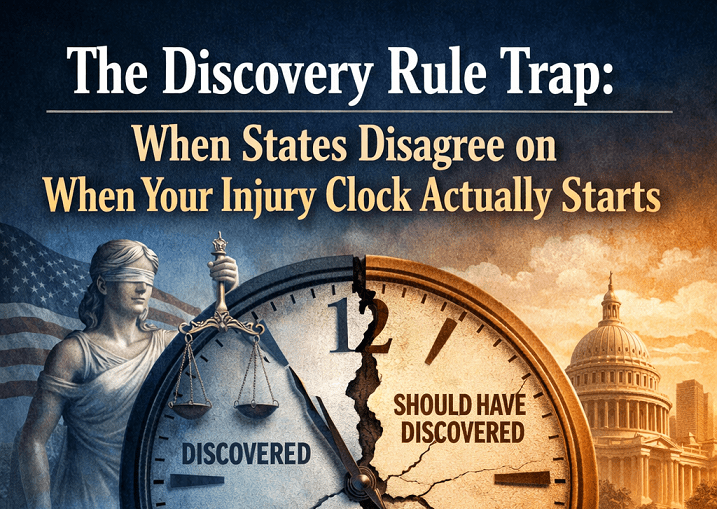
When States Disagree on When Your Injury Clock Actually Starts
The discovery rule represents one of the most critical yet misunderstood doctrines in personal injury law. While statutes of limitations provide clear deadlines for filing lawsuits, the discovery rule operates as an exception that can either extend or contract these deadlines depending on how courts interpret when an injury was or should have been discovered. This variation across jurisdictions creates a complex landscape where identical injuries might face dramatically different procedural outcomes based solely on geography and judicial interpretation.
Understanding the Discovery Rule Framework
At its core, the discovery rule postpones the commencement of the statute of limitations until the plaintiff discovers, or reasonably should have discovered, the injury and its cause. This doctrine emerged from the recognition that traditional accrual rules—which start the limitations clock at the moment of injury—work fundamental injustice in cases where injuries remain hidden or their causes obscure.
The traditional rule, still applied in some jurisdictions for certain claims, starts the statute of limitations when the wrongful act occurs or when the injury happens, regardless of the plaintiff’s knowledge. Under this approach, a patient whose surgeon left a sponge inside their body during surgery in 2020 would have their limitations period begin running in 2020, even if they didn’t discover the retained foreign object until 2024. The discovery rule corrects this harsh result.
However, the devil resides in the details. States diverge significantly on three fundamental questions: what constitutes “discovery” of an injury, when a plaintiff “should have known” of an injury, and whether the rule applies to particular types of claims.
The “Actually Knew” vs. “Should Have Known” Divide
The most consequential split among jurisdictions concerns whether the limitations period begins when the plaintiff actually discovered the injury or when a reasonable person in their position should have discovered it. This distinction can mean years of difference in when a claim becomes time-barred.
Actual Knowledge Standard
Some states apply a purely subjective standard requiring proof that the plaintiff actually knew of the injury and its causal connection to the defendant’s conduct. California exemplifies this approach in many contexts. In Jolly v. Eli Lilly & Co., the California Supreme Court held that the statute of limitations begins to run when the plaintiff actually suspects, or should suspect, that the injury was caused by wrongdoing. The court emphasized that suspicion—not certainty—triggers the limitations period, but that suspicion must be actual, not constructive.
This subjective approach offers greater protection to plaintiffs but requires courts to engage in fact-intensive inquiries about what individual plaintiffs actually knew and when they knew it. It also creates opportunities for gamesmanship, as defendants argue that plaintiffs must have suspected wrongdoing earlier than they claim.
Reasonable Person Standard
Other jurisdictions employ an objective “reasonable person” standard. Under this approach, the limitations period begins when a reasonable person in the plaintiff’s position, exercising reasonable diligence, would have discovered the injury and its cause. New York follows this framework in medical malpractice cases, holding that the statute begins to run when the plaintiff discovers the injury “or reasonably should have discovered” it through reasonable diligence.
The objective standard protects defendants from indefinite exposure to liability and encourages plaintiffs to investigate suspicious circumstances promptly. However, it can also produce harsh results when plaintiffs, despite subjectively lacking knowledge, are charged with constructive notice of their injuries.
The Hybrid Approach
Many states have adopted hybrid standards that blend subjective and objective elements. Pennsylvania, for instance, requires that the discovery rule clock starts when the plaintiff knows or reasonably should know that they have been injured and that their injury has been caused by another party’s conduct. Courts applying this standard often emphasize that general awareness of an injury is insufficient; the plaintiff must also have reason to believe the injury resulted from wrongful conduct rather than natural causes or unavoidable complications.
Interpreting “Should Have Known”: The Inquiry Notice Problem
Perhaps no aspect of the discovery rule generates more litigation than determining when a plaintiff “should have known” of their injury. Courts have developed various tests, each emphasizing different factors.
The Inquiry Notice Doctrine
Many jurisdictions apply the doctrine of “inquiry notice,” which starts the limitations clock when the plaintiff possesses sufficient information to excite attention and put a reasonable person on inquiry. Under this doctrine, plaintiffs need not know all the details of their legal claim; they need only be aware of facts that would prompt a reasonable person to investigate further.
The Pennsylvania Supreme Court’s decision in Fine v. Checcio illustrates this doctrine’s application. The court held that the statute of limitations begins to run when the plaintiff knows or reasonably should know that he has been injured and that his injury has been caused by another party’s conduct, even if he does not know the full extent of the injury or the specific legal theory supporting his claim.
In toxic exposure cases, inquiry notice often becomes particularly contentious. If a plaintiff develops respiratory symptoms after working with asbestos but doesn’t immediately connect those symptoms to occupational exposure, when should the limitations period begin? Courts have reached different conclusions depending on factors including the severity of symptoms, the obviousness of the connection between exposure and injury, and the plaintiff’s educational background and sophistication.
The “Storm Warning” Test
Some courts apply a “storm warning” test, asking whether the plaintiff received sufficient warning signals to prompt investigation. In Lopez v. Swyer, a New Jersey court explained that the discovery rule does not postpone the limitations period until the plaintiff has actual knowledge of all facts necessary to establish a cause of action; rather, the period begins when the plaintiff has notice or information of circumstances to put a reasonable person on inquiry.
This test effectively asks: would a reasonable person in the plaintiff’s position, having observed these symptoms or circumstances, believe something was wrong and investigate further? The answer depends heavily on the specific facts of each case.
Latent Injury Cases: Toxic Exposure and Chemical Harm
Toxic exposure cases present unique discovery rule challenges because injuries often manifest years or decades after exposure, and causation frequently remains obscure even after symptoms appear.
Asbestos Litigation
Asbestos litigation has generated extensive case law on the discovery rule. Mesothelioma, the cancer most strongly associated with asbestos exposure, typically develops 20 to 50 years after exposure. Courts have generally held that the limitations period does not begin until the disease is diagnosed, not when exposure occurred.
However, jurisdictions disagree on whether the clock starts at the first symptom, at diagnosis of a benign condition that might progress to cancer, or only upon definitive cancer diagnosis. Some courts have held that the statute begins running when the plaintiff develops asbestosis or pleural plaques, even though these conditions are distinct from mesothelioma. Others hold that each disease constitutes a separate injury with its own limitations period.
The question of causation adds further complexity. A plaintiff who develops lung cancer after asbestos exposure might reasonably attribute the cancer to smoking, family history, or other causes. Courts have held that the limitations period doesn’t begin until the plaintiff has reason to connect the cancer to asbestos exposure, but they disagree on how much information the plaintiff needs before that connection becomes reasonable.
Environmental Contamination
Environmental contamination cases raise similar issues. In cases involving contaminated drinking water, courts must determine when residents knew or should have known that their health problems resulted from contamination rather than other causes.
In Ayers v. Township of Jackson, the New Jersey Supreme Court addressed claims by residents exposed to contaminated water from a landfill. The court held that the discovery rule applied, and that the statute of limitations did not begin until residents knew or should have known of both their injuries and the causal connection to the contamination. The court emphasized that residents could not reasonably be expected to connect their various ailments to water contamination without expert analysis or public disclosure of the contamination.
Other courts have been less generous. Some have held that widespread media coverage of contamination starts the limitations clock for all potential plaintiffs, even those who didn’t see the coverage or didn’t realize it applied to their situation. This approach prioritizes finality over individual justice.
Medical Device Failures: The Implant Problem
Medical device cases present a distinctive discovery rule challenge: the injury-causing device is literally inside the plaintiff’s body, making discovery impossible without medical imaging or device failure symptoms.
The Dalkon Shield Litigation
The Dalkon Shield litigation of the 1980s and 1990s produced important discovery rule precedents. The Dalkon Shield, an intrauterine contraceptive device, caused infections, infertility, and other serious injuries, but many injuries didn’t manifest until years after implantation.
Courts generally held that the statute of limitations didn’t begin until women experienced symptoms that would prompt medical investigation, not at the time of implantation. However, courts disagreed on whether the clock started at first symptom, at diagnosis of a specific condition, or only when the plaintiff learned that the device (rather than some other cause) caused the injury.
In Ryan v. Eli Lilly & Co., a case involving DES (diethylstilbestrol), the court held that the statute of limitations was tolled until the plaintiff knew or had reason to know of the causal connection between her injuries and the drug her mother took during pregnancy. The court emphasized that discovery requires knowledge of both injury and causation.
Modern Implant Cases: Hip Replacements and Surgical Mesh
Recent litigation involving defective hip replacements and surgical mesh products continues to test discovery rule boundaries. These cases often involve devices that initially function properly but deteriorate over time, causing metallosis (metal poisoning), tissue damage, or organ perforation.
Courts have held that the statute begins running when the plaintiff experiences symptoms suggesting device malfunction, not when the device was implanted or when it began deteriorating microscopically. However, they disagree on how severe or specific symptoms must be before they trigger the duty to investigate.
For example, if a plaintiff with a hip replacement experiences gradually increasing pain, when should they suspect a defective device rather than normal post-surgical recovery challenges or aging? Some courts start the clock at first symptom; others require symptoms serious enough that a reasonable person would seek medical evaluation specifically for device problems.
The FDA recall question adds another layer. If the FDA recalls a device, does that automatically start the statute of limitations for all patients with that device, even asymptomatic ones? Courts have divided on this issue, with some holding that public recalls trigger inquiry notice and others holding that asymptomatic patients have no reason to investigate until they experience problems.
Fraudulent Concealment: The Discovery Rule’s Cousin
Related to the discovery rule is the doctrine of fraudulent concealment, which tolls the statute of limitations when defendants actively hide wrongdoing. While technically distinct from the discovery rule, fraudulent concealment interacts with discovery principles in important ways.
Most states recognize that statutes of limitations are tolled when defendants fraudulently conceal facts that would give rise to a cause of action. However, jurisdictions differ on what constitutes actionable concealment and whether mere silence suffices or whether active misrepresentation is required.
In pharmaceutical and medical device cases, fraudulent concealment claims often allege that manufacturers knew of dangers but concealed them from doctors and patients. If a manufacturer knew that its drug caused heart attacks but didn’t disclose this risk, the discovery rule might not start running until the manufacturer’s knowledge becomes public, even if plaintiffs experienced heart attacks years earlier.
However, proving fraudulent concealment requires showing that the defendant took affirmative steps to hide the truth, not merely that they failed to volunteer information. This standard can be difficult to meet, particularly when dealing with corporate defendants who maintain careful documentation.
Cross-Jurisdictional Complications
The discovery rule’s variation across states creates substantial complications in cases involving multiple jurisdictions. In mass tort litigation involving plaintiffs from many states, each plaintiff’s claim may be subject to different discovery rule principles depending on their residence and where the injury occurred.
Choice of law principles determine which state’s discovery rule applies, but these principles themselves vary by jurisdiction and can be manipulated through forum shopping. In federal diversity cases, courts apply the forum state’s choice of law rules, which may point to the plaintiff’s domicile, the place of injury, the place of the wrongful act, or some combination of factors.
The result is that similarly situated plaintiffs may face vastly different statutes of limitations depending on where they file suit. A plaintiff in a state with a generous discovery rule and long limitations period enjoys substantial advantages over a plaintiff in a state with a restrictive discovery rule and short limitations period, even if they were injured by the same product at the same time.
Practical Implications and Strategic Considerations
The discovery rule’s complexity has significant practical implications for both plaintiffs and defendants. Plaintiffs must carefully investigate when their limitations period began and whether the discovery rule extends it. This often requires retaining experts to establish when symptoms should have prompted investigation and when causation should have become apparent.
Defendants frequently move for summary judgment based on statute of limitations defenses, arguing that plaintiffs knew or should have known of their injuries earlier than claimed. These motions can succeed or fail based on subtle distinctions in how courts interpret “should have known.”
The stakes are enormous. A successful statute of limitations defense ends the case without reaching the merits, denying the plaintiff any recovery regardless of how strong their substantive claim might be. This creates pressure on plaintiffs to file suit early, sometimes before they fully understand their injuries or can identify all responsible parties.
Conversely, the discovery rule’s potential to extend limitations periods indefinitely creates uncertainty for defendants, particularly in latent injury cases. A manufacturer might face claims decades after producing a product, when witnesses have died, records have been destroyed, and memories have faded.
The discovery rule, despite its equitable origins, has become a trap for the unwary. Its variation across jurisdictions, combined with courts’ inconsistent interpretation of “should have known,” creates a procedural minefield where meritorious claims can be time-barred based on fine distinctions and where defendants face uncertain exposure periods.
Reform proposals have included standardizing discovery rule application across jurisdictions, creating bright-line rules for when limitations periods begin in specific contexts, and extending limitations periods generally to reduce the need for discovery rule litigation. However, tensions between finality and fairness ensure that the discovery rule will remain contested terrain for the foreseeable future.
For plaintiffs, the lesson is clear: investigate suspicious circumstances promptly and consult attorneys early. For defendants, the discovery rule’s unpredictability counsels thorough documentation and careful product safety monitoring. For courts, the challenge remains balancing the need for repose against the injustice of barring claims before plaintiffs can reasonably discover them.
The discovery rule trap will continue catching unwary litigants until courts and legislatures develop more consistent, predictable approaches to determining when injury clocks actually start ticking.