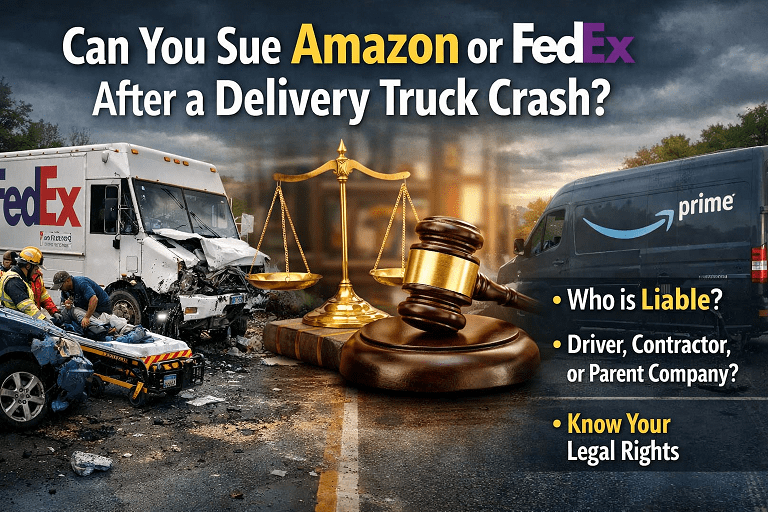
Every day, tens of thousands of delivery trucks operated by Amazon Logistics, FedEx, UPS, and other carriers share public roads with ordinary drivers. With the explosive growth of e-commerce, delivery vehicle crashes have become an increasingly serious public safety problem. If you or a loved one has been injured in a collision with a delivery truck, one of the first questions your attorney will ask is: who can be held legally responsible?
The answer is rarely straightforward. Delivery companies use a web of employment arrangements, independent contractor relationships, and corporate structures that are deliberately designed — sometimes, courts have found, to insulate the parent company from liability. Understanding how the law cuts through those structures is essential to recovering the compensation you deserve.
Negligence: The Foundation of Every Delivery Truck Crash Claim
Personal injury claims arising from truck accidents are governed by the law of negligence. To succeed, an injured plaintiff must prove four elements: (1) the defendant owed a duty of care, (2) the defendant breached that duty, (3) the breach caused the plaintiff’s injuries, and (4) the plaintiff suffered compensable damages. See Palsgraf v. Long Island R.R. Co., 248 N.Y. 339 (1928), the landmark case that first articulated the duty-of-care framework still applied in negligence actions today.
In the truck crash context, duty is almost never in dispute — all drivers owe a duty of reasonable care to others on the road. The fight is typically over breach, causation, and the identity of the responsible party or parties.
The Employer–Employee Distinction and Respondeat Superior
Under the doctrine of respondeat superior (“let the master answer”), an employer is vicariously liable for the negligent acts of its employees committed within the scope of their employment. This principle is codified in the Restatement (Third) of Agency § 2.04, and has been applied by courts in all fifty states. If a FedEx Express driver in a company-owned truck runs a red light and strikes your vehicle while out making deliveries, FedEx is directly on the hook for that driver’s negligence — the analysis is relatively clean.
The situation becomes more complicated — and more aggressively litigated — when the delivery driver is classified as an independent contractor rather than an employee.
Amazon’s Delivery Service Partner Program and the Independent Contractor Problem
Amazon does not employ most of its last-mile delivery drivers directly. Instead, it uses a Delivery Service Partner (DSP) program in which small, nominally independent companies hire and manage drivers who wear Amazon uniforms, drive Amazon-branded vans, and deliver Amazon packages under Amazon’s operational control. Amazon has argued in litigation that because DSP drivers are employed by third-party companies, Amazon bears no liability for crashes those drivers cause.
Courts have increasingly rejected that argument. In Cornejo v. Seed to Table, Inc. (S.D. Fla. 2021), the court found sufficient grounds to deny summary judgment to Amazon on vicarious liability claims, noting the extent to which Amazon dictated route planning, delivery quotas, and driver conduct through its technology platform. Similarly, in Waithaka v. Amazon.com, Inc., 966 F.3d 10 (1st Cir. 2020), the First Circuit recognized that delivery service partners could be considered agents of Amazon for purposes of certain legal obligations, given Amazon’s extensive control over their day-to-day operations.
The key legal test in most states is the “right to control” test. Courts look not at what the contract says but at how the working relationship actually functions. Factors include whether Amazon controls the manner and means of the work (not just the result), whether drivers use Amazon-supplied equipment, whether Amazon sets schedules and performance metrics, and whether the driver is economically dependent on Amazon. Where these factors favor control, courts have been willing to look past the independent contractor label.
California’s ABC Test and Dynamex
California goes further than most states. Under Dynamex Operations West, Inc. v. Superior Court, 4 Cal. 5th 903 (2018), California adopted the “ABC test” for classifying workers. Under this test, a worker is presumed to be an employee unless the hiring entity proves all three of the following: (A) the worker is free from the control and direction of the company in performing work, (B) the worker performs work outside the usual course of the company’s business, and (C) the worker is customarily engaged in an independently established trade or occupation. The California legislature subsequently codified Dynamex through Assembly Bill 5 (AB 5), enacted in 2019. For delivery crash claims in California, this framework makes it significantly harder for Amazon or other carriers to escape vicarious liability by pointing to independent contractor agreements.
FedEx’s Contractor Model and the Ground Driver Cases
FedEx Ground has long relied on independent contractor drivers and faced extensive litigation over that model. In Alexander v. FedEx Ground Package System, Inc., 765 F.3d 981 (9th Cir. 2014), the Ninth Circuit affirmed that FedEx Ground drivers were employees under California law, not independent contractors, based on FedEx’s pervasive control over their work. Although that case centered on employment rights rather than tort liability, the reasoning directly informs vicarious liability analysis in personal injury cases. If a court finds that FedEx Ground exercised the level of control described in Alexander, plaintiffs have a strong argument that FedEx bears respondeat superior liability for driver negligence.
Direct Negligence: Negligent Hiring, Retention, and Entrustment
Even when vicarious liability is unavailable, injured plaintiffs may pursue Amazon or FedEx directly on theories of negligent hiring, negligent retention, and negligent entrustment. These are independent torts requiring proof that the company knew or should have known that a particular driver posed an unreasonable risk.
- Negligent Hiring: Did the company conduct adequate background and driving record checks before putting the driver on the road?
- Negligent Retention: Did the company keep a driver on active duty after learning of prior accidents, traffic violations, or substance abuse issues?
- Negligent Entrustment: Did the company allow an incompetent or unqualified driver to operate its vehicles? Under the Restatement (Second) of Torts § 308, negligent entrustment liability arises when one supplies a chattel for use by another whom the supplier knows or should know will use it in a manner involving unreasonable risk.
These claims can be particularly powerful in cases involving drivers with prior DUI convictions, suspended licenses, or documented histories of reckless driving that the delivery company ignored in its rush to meet demand.
Federal Motor Carrier Safety Regulations
Commercial delivery vehicles — particularly those with a gross vehicle weight rating (GVWR) over 10,001 pounds — are subject to Federal Motor Carrier Safety Regulations (FMCSRs) issued by the Federal Motor Carrier Safety Administration (FMCSA) under 49 C.F.R. Parts 390–399. Violations of these regulations are powerful evidence of negligence, and in some jurisdictions, a violation constitutes negligence per se.
Key FMCSR provisions relevant to delivery truck crashes include:
- 49 C.F.R. § 391.11 — Minimum driver qualification standards, including age, licensing, and medical fitness requirements.
- 49 C.F.R. § 395.3 — Hours-of-service limits for property-carrying drivers, restricting consecutive driving time and mandating rest breaks to prevent fatigue-related crashes.
- 49 C.F.R. § 396.3 — Mandatory vehicle inspection, repair, and maintenance obligations. A carrier that puts a truck with defective brakes or worn tires on the road may face direct liability under this provision.
- 49 C.F.R. § 392.14 — Requirements that drivers exercise extreme caution in hazardous driving conditions, including rain, fog, and ice.
When an FMCSA violation contributed to a crash, plaintiffs can often request FMCSA inspection records, logbooks, electronic logging device (ELD) data, and carrier safety ratings through discovery.
The Graves Amendment and Vehicle Leasing
One statutory complication worth noting is the Graves Amendment, codified at 49 U.S.C. § 30106. Enacted in 2005, the Graves Amendment generally preempts state-law vicarious liability claims against companies in the business of renting or leasing motor vehicles, provided the lessor was not otherwise negligent. If Amazon or a logistics company leased vehicles to drivers through a fleet arrangement, defense attorneys may invoke the Graves Amendment to block vicarious liability. However, courts have narrowly construed this statute, and it does not bar direct negligence claims or apply where the defendant is not in the trade or business of vehicle rental.
Insurance Requirements and What They Mean for Your Claim
Under 49 C.F.R. § 387.9, commercial motor carriers operating vehicles with a GVWR over 10,001 pounds must maintain minimum public liability insurance of $750,000 per occurrence for general freight (the limit is higher for hazardous materials). Many large carriers maintain policies far in excess of these minimums. Amazon and FedEx are self-insured or carry umbrella policies in the hundreds of millions of dollars. This matters for victims because it means the money to compensate serious injuries exists — the fight is entirely about establishing legal liability.
Practical Steps After a Delivery Truck Crash
Preserving evidence is critical. Delivery trucks operated under commercial contracts are often equipped with dashcams, GPS tracking, and telematics data that can prove speed, braking, and route deviations at the moment of impact. This data is routinely overwritten on a rolling 30- to 90-day cycle. An attorney should send a spoliation letter — a written demand to preserve evidence — to Amazon, FedEx, and the DSP company as quickly as possible after a crash. Courts have imposed sanctions, including adverse inference instructions, against parties that destroy relevant evidence after receiving such notice. See Zubulake v. UBS Warburg LLC, 220 F.R.D. 212 (S.D.N.Y. 2003), which established key spoliation standards that federal and state courts continue to follow.
In addition to telematics, valuable evidence in delivery truck crash cases includes: the driver’s commercial driver’s license (CDL) and motor vehicle record, pre-trip inspection reports, drug and alcohol test results, the carrier’s safety audit history with FMCSA, and any prior complaints or accidents involving the same driver.
Suing Amazon or FedEx after a delivery truck crash is entirely possible — but it requires cutting through complex corporate and contractual structures to reach the companies that profit from and exercise control over the drivers who cause harm. Whether the path runs through vicarious liability under respondeat superior, direct negligence theories, FMCSR violations, or a combination of all three depends on the specific facts of your case. Given the resources these corporations deploy to fight such claims, retaining an attorney with experience in commercial motor vehicle litigation and federal trucking regulations is essential from day one.