Personal Injury Information, Guides, News, Tools & Resources
Delivery Robot Accidents
Published by
Personal Injury Insights
on
The Growing Concern of Sidewalk Bots and Pedestrian Safety
The rise of autonomous delivery robots has transformed urban logistics, promising convenience and efficiency in last-mile delivery services. These small, wheeled robots navigate sidewalks and crosswalks to deliver food, groceries, and packages directly to consumers’ doorsteps. However, as their presence increases in cities worldwide, so do concerns about pedestrian safety and the potential for accidents. The intersection of autonomous technology and crowded urban environments has created new challenges that cities, manufacturers, and regulators are still learning to address.
The Expansion of Delivery Robot Technology
Delivery robots have proliferated rapidly across urban and suburban landscapes since their introduction in the mid-2010s. Companies like Starship Technologies, Kiwibot, Serve Robotics, and Amazon Scout have deployed thousands of these autonomous devices across multiple continents. These robots typically stand between one and two feet tall, weigh anywhere from 20 to 100 pounds when loaded, and travel at speeds of up to 4 miles per hour on sidewalks.
The technology relies on a combination of sensors, cameras, GPS, and machine learning algorithms to navigate urban environments. Most delivery robots use LiDAR, ultrasonic sensors, and computer vision to detect obstacles, pedestrians, and other hazards. Despite these sophisticated systems, the robots operate in complex, unpredictable environments where human behavior, weather conditions, and infrastructure variations present constant challenges.
The COVID-19 pandemic accelerated adoption of contactless delivery options, leading to expanded deployment of these robots in college campuses, residential neighborhoods, and commercial districts. Cities including San Francisco, Los Angeles, Pittsburgh, Washington D.C., Miami, and numerous others have authorized pilot programs or permanent operations for delivery robots.
Documented Incidents and Safety Concerns
While catastrophic accidents involving delivery robots remain relatively rare compared to vehicle-related incidents, reported collisions and near-misses have raised legitimate safety concerns. Pedestrians, particularly those with disabilities, elderly individuals, and children, face unique vulnerabilities when sharing sidewalk space with autonomous machines.
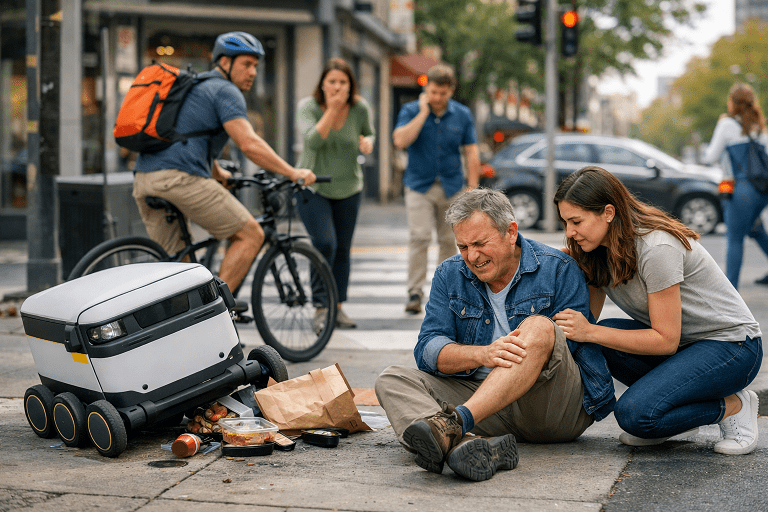
Several types of incidents have been documented. Collision incidents occur when robots fail to detect or properly respond to pedestrians in their path. Though these robots travel slowly, their weight can cause injuries when they strike individuals, particularly those who are frail or have mobility challenges. Trip and fall accidents happen when pedestrians encounter robots unexpectedly or attempt to avoid them on crowded sidewalks. Navigation failures have led to robots blocking sidewalks, ramps, and crosswalks, creating obstacles for wheelchair users and others requiring clear pathways.
In 2022, a delivery robot in Los Angeles struck and knocked down a woman who was crossing a street, an incident captured on video and widely circulated on social media. Similar incidents have been reported in Pittsburgh, where Kiwibot robots have occasionally collided with pedestrians on university campuses. These events, while not resulting in severe injuries in most cases, highlight the technology’s current limitations.
Accessibility advocates have raised particular concerns about how delivery robots affect people with visual impairments. Guide dogs may react unpredictably to the robots, and individuals using white canes or who rely on auditory cues may not detect these relatively quiet machines until a collision is imminent. The robots’ small size and low profile make them difficult to see for people with limited vision, and their autonomous nature means they may appear suddenly from around corners or behind obstacles.
Technical Limitations and Failure Modes
Understanding why delivery robot accidents occur requires examining the technical limitations inherent in current autonomous navigation systems. These robots must process vast amounts of sensory data in real-time while making split-second decisions about path planning and obstacle avoidance.
Sensor limitations represent a fundamental challenge. LiDAR and camera systems can struggle in adverse weather conditions including heavy rain, snow, fog, and extreme brightness or darkness. Reflective surfaces, glass doors, and certain materials may not register properly on sensors, potentially causing the robot to fail to detect obstacles. Sensor occlusion, where one object blocks the robot’s view of another, can create dangerous blind spots.
Algorithm challenges also contribute to accidents. Machine learning models are only as good as their training data, and unusual or unexpected situations may cause inappropriate responses. A delivery robot’s programming might successfully navigate standard pedestrian encounters but fail when someone moves erratically, stops suddenly, or behaves in unpredictable ways. Children playing, pets, cyclists, and crowds create complex scenarios that challenge even sophisticated algorithms.
Environmental factors compound these technical issues. Uneven sidewalks, construction zones, temporary obstacles, and changing urban landscapes require constant adaptation. Sidewalk conditions vary enormously even within a single city block, with cracks, slopes, curb cuts, and surface materials all affecting robot navigation. Weather-related hazards like ice, puddles, and fallen leaves can impair both traction and sensor functionality.
Communication failures between robots and human pedestrians also create risks. Unlike human delivery workers who can make eye contact, gesture, or verbally communicate their intentions, robots rely on limited indicators like lights or sounds that pedestrians may not understand or notice. This lack of intuitive communication makes it difficult for people to predict a robot’s next move or coordinate safe passage on crowded sidewalks.
Impact on Vulnerable Populations
The deployment of delivery robots has disproportionate effects on certain population groups. People with disabilities face perhaps the greatest challenges, as these robots can create significant accessibility barriers. The Americans with Disabilities Act requires that sidewalks and public pathways remain accessible, but delivery robots can obstruct these routes, particularly when they malfunction or park inappropriately.
Wheelchair users have reported being blocked by stationary delivery robots, forcing them into streets or requiring lengthy detours. The robots’ autonomous parking behavior may not account for maintaining adequate clearance for mobility devices. Even when robots are moving, their unpredictable navigation patterns can create anxiety and hazards for people with mobility limitations who cannot quickly change direction or speed.
Elderly individuals, who may have slower reaction times, reduced mobility, and vision or hearing impairments, are particularly vulnerable to collision injuries. A collision that might cause minor bruising in a younger person could result in serious injury, including fractures, for someone with osteoporosis or balance issues.
Children present both a vulnerable population and a unique challenge for robot navigation systems. Young children may not understand that the robots are autonomous and might interact with them inappropriately, potentially causing the robot to respond unpredictably. Conversely, children’s smaller size, quick movements, and unpredictable behavior make them harder for robots to track and avoid.
Regulatory Responses and Policy Challenges
The rapid deployment of delivery robots has outpaced regulatory frameworks in many jurisdictions, forcing cities and states to develop rules reactively rather than proactively. The regulatory landscape remains highly fragmented, with different cities adopting vastly different approaches to managing this technology.
Some jurisdictions have embraced delivery robots with minimal restrictions. Virginia was among the first states to pass comprehensive legislation in 2017 explicitly allowing delivery robots on sidewalks, defining them legally and setting basic operational standards. Other early adopters included Idaho, Wisconsin, and Florida, each establishing frameworks that balanced innovation with safety concerns.
Conversely, some cities have imposed strict limitations or outright bans. San Francisco initially limited the number of companies that could operate delivery robots and restricted the areas where they could deploy. The city requires permits, insurance, and compliance with specific safety standards. New York City has been more restrictive, with limited authorization for delivery robot operations.
Common regulatory elements include weight limits (typically 80-100 pounds), speed limits (usually 3-6 mph), insurance requirements, remote monitoring capabilities, and requirements for human oversight. Many jurisdictions require that robots yield to pedestrians, maintain certain distances from individuals, and include safety features like emergency stop capabilities.
However, enforcement remains challenging. Municipal authorities often lack the resources or expertise to effectively monitor compliance with delivery robot regulations. Determining liability when accidents occur involves complex questions about manufacturer responsibility, operator negligence, software failures, and infrastructure conditions.
Industry Safety Measures and Improvements
Delivery robot manufacturers have implemented various safety features and operational protocols in response to accident concerns and regulatory requirements. Most robots now include multiple redundant sensor systems, ensuring that failure of one sensor type doesn’t completely blind the robot to its environment. Emergency stop mechanisms allow remote operators to immediately halt robot movement when hazards are detected.
Geofencing technology restricts robots to approved operational areas and can slow or stop them in high-traffic zones, near schools, or in other sensitive locations. Many companies maintain remote monitoring operations centers where human supervisors can observe robot feeds, intervene when problems arise, and manually control robots through difficult situations.
Design improvements have focused on making robots more visible and predictable. Bright colors, lights, and reflective materials help pedestrians notice the robots. Some models include speakers that emit sounds to alert nearby pedestrians, though this must be balanced against noise pollution concerns. More intuitive indicator lights communicate the robot’s operational status and intended movements.
Companies have also invested in improved machine learning models trained on more diverse datasets, including edge cases and unusual scenarios. Continuous learning systems allow robots to improve their navigation over time by analyzing encounters and near-misses. Some manufacturers have partnerships with accessibility organizations to better understand and address the needs of people with disabilities.
Starship Technologies reports that its robots have completed millions of deliveries with a strong safety record, emphasizing their slow speeds and constant monitoring. Serve Robotics highlights its partnership with Uber Eats and its focus on safety-first design principles. These companies point to their safety records as evidence that the technology can operate responsibly in urban environments.
The Path Forward: Balancing Innovation and Safety
The future of delivery robots depends on finding sustainable solutions that preserve their economic and environmental benefits while protecting pedestrian safety and accessibility. Several approaches show promise for improving this balance.
Infrastructure adaptation may be necessary in some areas. Designated robot lanes, similar to bike lanes, could separate autonomous devices from pedestrian traffic in high-volume areas. Some urban planners have proposed shared spaces with clear markings and protocols. However, such infrastructure changes require significant investment and may not be feasible in all communities.
Technological advancement will continue improving robot capabilities. Better sensors, more sophisticated algorithms, improved weather resistance, and enhanced communication systems will reduce accident risks. Integration with smart city infrastructure could allow robots to receive real-time data about traffic conditions, temporary obstacles, and optimal routing.
Standardized regulations at state or federal levels would create clearer expectations for manufacturers and operators while ensuring consistent safety standards across jurisdictions. The National Highway Traffic Safety Administration and other federal agencies may eventually develop comprehensive frameworks for sidewalk autonomous devices, similar to regulations for autonomous vehicles.
Enhanced public education can help pedestrians understand how to interact safely with delivery robots. Clear communication about robot capabilities, limitations, and behavior patterns would reduce confusion and improve safety. Schools, community centers, and public information campaigns could familiarize residents with these devices.
Continued stakeholder dialogue between manufacturers, disability advocates, urban planners, regulators, and communities will be essential for developing solutions that work for everyone. The technology should adapt to serve human needs rather than requiring humans to adapt to technological limitations.
Delivery robot accidents represent a emerging public safety concern that requires thoughtful attention from multiple stakeholders. While these devices offer genuine benefits in terms of delivery efficiency, reduced emissions, and contactless service, their integration into shared pedestrian spaces creates real risks, particularly for vulnerable populations.
The relatively low severity and frequency of reported incidents to date should not breed complacency. As deployment scales up and robots become more prevalent in daily urban life, the absolute number of accidents will likely increase unless proactive measures are taken. The technology is still evolving, and current limitations in sensor capability, algorithmic decision-making, and environmental adaptation create ongoing risks.
Addressing these challenges requires balancing innovation with safety, efficiency with accessibility, and technological progress with human dignity. Delivery robots need not be eliminated, but their deployment must be managed responsibly with appropriate safeguards, regulations, and accountability mechanisms. Manufacturers must prioritize safety in design and operation, regulators must establish clear and enforceable standards, and communities must have meaningful input into how these technologies are deployed in their neighborhoods.
The question is not whether delivery robots can coexist with pedestrians, but rather how we can ensure that coexistence is safe, equitable, and beneficial for all members of the community. With continued vigilance, technological improvement, and thoughtful regulation, it may be possible to realize the benefits of autonomous delivery while minimizing risks to pedestrian safety.
Personal Injury Insights, is your trusted FREE resource for comprehensive, reliable, and easy-to-understand information on personal injury law.
Our mission is to empower individuals with the knowledge they need to make informed decisions about their personal injury cases and connect with the right legal support when necessary.
We cover a wide range of topics but this website does not provide legal advice and does not create an attorney-client relationship. The information provided is for general informational purposes only and should not be relied upon as legal advice. For specific legal guidance, please consult a qualified attorney in your jurisdiction.