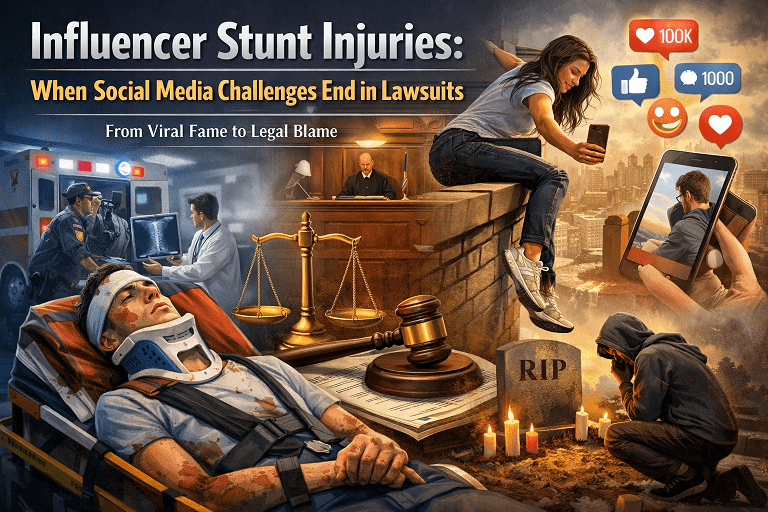
When Social Media Challenges End in Lawsuits
The intersection of social media, viral trends, and legal liability has created an entirely new landscape of personal injury litigation. What began as harmless dance challenges and lip-sync videos has evolved into a phenomenon where dangerous stunts undertaken for likes, shares, and followers are now regularly ending in emergency rooms, courtrooms, and even morgues. As influencers and everyday users push boundaries to capture attention in an increasingly saturated digital space, the legal system is grappling with questions of accountability, responsibility, and the true cost of viral fame.
Table Of Contents:
- The Rise of Dangerous Social Media Challenges
- The Legal Landscape: Who Bears Responsibility?
- Documented Cases: Real Tragedies with Legal Consequences
- The Broader Legal and Social Implications
- Platform Responses and Preventive Measures
- Insurance and Financial Protection for Influencers
- Prevention and Education
- The Future of Social Media Challenge Litigation
- Compensation and Damages in Challenge-Related Cases
- Ethical Considerations for Content Creators
- The Role of Mental Health in Challenge Participation
The Rise of Dangerous Social Media Challenges
Social media platforms have fundamentally transformed how people seek validation and social acceptance. The algorithmic nature of platforms like TikTok, Instagram, and YouTube creates an environment where shocking, extreme, or dangerous content often receives disproportionate engagement. This has led to a disturbing trend: users, particularly young people, attempting increasingly hazardous stunts in pursuit of digital recognition.
The psychology behind participation in these challenges is complex. Adolescents and young adults are particularly vulnerable due to their developing brains, which have not fully matured in regions related to risk evaluation, emotional regulation, and impulse control. Social validation through likes and shares creates powerful psychological reinforcement, while peer pressure amplifies the desire to participate. When an influencer with millions of followers attempts a challenge, it normalizes the behavior for their audience, creating a cascade effect that can spread dangerous activities across entire demographics within hours.
The dangerous stunts documented on social media range from reckless physical challenges to life-threatening medical experiments. Some challenges involve intentional self-harm, ingestion of toxic substances, or participation in activities with obvious fatal risks. Others may appear innocuous but carry hidden dangers that young participants fail to recognize until tragedy strikes.
The Legal Landscape: Who Bears Responsibility?
When a social media challenge results in injury or death, determining legal liability becomes extraordinarily complex. Multiple parties may potentially bear responsibility, including the content creator who originated the challenge, the platform that hosted and promoted the content, and in some cases, even third parties who failed to prevent foreseeable harm.
Platform Liability and Section 230
For decades, social media companies have operated under the protection of Section 230 of the Communications Decency Act, which generally shields internet platforms from liability for content posted by third parties. This legal framework was established in 1996, long before the current era of algorithmic content recommendation and viral challenges. However, recent court decisions have begun to chip away at what once seemed like impenetrable legal immunity.
A landmark case in this evolving legal landscape involves Tawainna Anderson, whose 10-year-old daughter Nylah died in 2021 after attempting the “Blackout Challenge” she encountered on TikTok. The challenge encouraged viewers to choke themselves until they passed out. In August 2024, the Third Circuit Court of Appeals ruled that TikTok could potentially be held liable for promoting the content through its algorithm, even though the company did not create the videos themselves.
Judge Patty Shwartz wrote in the opinion that TikTok makes choices about content recommended and promoted to specific users, engaging in its own first-party speech. This groundbreaking decision distinguished between hosting third-party content and actively curating and recommending that content to users. The court found that when TikTok’s algorithm determined that Nylah might watch the Blackout Challenge video and placed it on her “For You” page, the platform was engaging in editorial judgment that constituted its own expressive speech, not protected by Section 230.
This legal reasoning opens new avenues for holding platforms accountable when their algorithms actively direct dangerous content to vulnerable users, particularly children. The decision acknowledges that as the internet has grown in scope and sophistication beyond what Congress could have imagined in 1996, the question of what conduct deserves immunity has become increasingly complex.
Creator Liability and Negligence
Content creators who originate or promote dangerous challenges face their own set of legal exposures. When an influencer creates content encouraging risky behavior, they can potentially face claims of ordinary negligence, gross negligence, or negligent undertaking. These legal theories hold creators responsible for foreseeable harm that results from their content.
An influencer’s liability can extend beyond direct participation in challenges. For instance, if a creator stages a rooftop parkour livestream and invites fans to participate without implementing proper safety measures, they could face lawsuits for negligent planning, failure to warn, and inadequate safety protocols if someone gets injured. The legal analysis focuses on whether the creator took reasonable steps to prevent foreseeable harm and whether they adequately warned participants of known risks.
Increasingly, successful influencers are hiring legal and compliance staff to review contracts, protect intellectual property, and advise on liability for stunts or challenges. These professionals help ensure that sponsorships and disclosures follow Federal Trade Commission and Federal Communications Commission guidelines, and that safety considerations are properly addressed before content goes live.
The Role of Parental Oversight
Parents face their own legal and moral considerations in this landscape. While children and teenagers are the primary participants in many dangerous challenges, courts have also examined whether parents adequately supervised their children’s social media use and whether they should have been aware of the risks their children faced online.
Some lawsuits have explored theories of parental negligence when children were injured or killed attempting challenges, particularly when parents provided unrestricted access to social media platforms without monitoring or discussing the risks. However, courts have generally been sympathetic to parents, recognizing that the deceptive nature of platform algorithms and the private nature of social media consumption make it extraordinarily difficult for parents to monitor every piece of content their children encounter.
Documented Cases: Real Tragedies with Legal Consequences
The theoretical risks of social media challenges have manifested in numerous tragic real-world incidents, many of which have resulted in litigation seeking accountability and compensation for devastating losses.
The Blackout Challenge Deaths
The Blackout Challenge, also known as the choking game or pass-out challenge, has been implicated in multiple child deaths since gaining viral attention on TikTok in 2021. This challenge, which involves intentionally cutting off one’s oxygen supply to achieve a brief loss of consciousness, has a documented history stretching back decades. A 2008 Centers for Disease Control report identified 82 probable choking-game deaths among young people aged 6 to 19 between 1995 and 2007. However, the challenge experienced a deadly resurgence when it spread through social media platforms.
In February 2025, the Social Media Victims Law Center filed a wrongful death lawsuit against TikTok and ByteDance on behalf of four British families whose children died in 2022 while attempting the Blackout Challenge. The lawsuit claims that Isaac Kenevan (age 13), Archie Battersbee (age 12), Julian “Jools” Sweeney (age 14), and Maia Walsh (age 13) each died from injuries suffered during the challenge. Notably, three of these children lived in Essex County, and three died within 45 days of one another, though none of the four children knew each other.
The lawsuit alleges that TikTok’s algorithm selected and pushed dangerous prank and challenge videos to these minors, including the Blackout Challenge. According to the complaint, TikTok has told lawmakers around the world that the Blackout Challenge had never been on its platform and has worked to discount credible reports of children being exposed to and dying because of blackout and similar challenge videos.
Isaac Kenevan was described by his family as a curious and intelligent child who was interested in how things worked. He had no behavioral or mental health issues prior to using TikTok, which he started using in 2021. His parents initially believed TikTok was a fun, silly, and safe platform designed for kids and young people. It wasn’t until after Isaac’s death on March 9, 2022, that his mother Lisa was told by police that there were videos on his phone showing him trying the challenge.
Archie Battersbee, a confident and fearless 12-year-old who loved gymnastics, martial arts, and superheroes, was found unresponsive on April 7, 2022, with a ligature tied from a stairs banister around his neck. His mother Hollie had no idea that her son used TikTok until after his death. Archie spent four months on life support during a highly publicized legal battle where his mother fought to keep him alive. He was taken off life support and died on August 6, 2022. TikTok allegedly told authorities it has no data relating to Archie’s use of its platform, despite overwhelming evidence to the contrary, including TikTok data found on his device the day he died.
The Anderson case involving Nylah, the 10-year-old from Delaware County, Pennsylvania, has become particularly significant from a legal precedent standpoint. Nylah’s mother found her unresponsive in a closet using a purse strap in May 2021. The girl, described by her family as a fun-loving “butterfly,” died five days later. Her mother testified, “I cannot stop replaying that day in my head. It is time that these dangerous challenges come to an end so that other families don’t experience the heartbreak we live every day.”
Additional lawsuits have been filed over the deaths of Lalani Erika Walton (age 8) and Arriani Arroyo (age 9) in Los Angeles County Superior Court in July 2022. Both children were found hanging, having choked to death after attempting challenges. Police examined Lalani’s phone and tablet and found that she had been watching blackout challenge videos before her death.
These cases collectively represent a coordinated legal strategy by the Social Media Victims Law Center to hold platforms accountable for the algorithmic promotion of deadly content to minors. Ellen Roome, the mother of Julian “Jools” Sweeney, has become an advocate for “Jools’ Law,” a proposed legislation calling for automatic preservation of a child’s online data immediately following their death. The aim is to prevent the permanent loss of potentially critical evidence during the early stages of investigations and inquests.
Subway Surfing Tragedies
Subway surfing, the practice of riding on top of or hanging from the exterior of subway trains, has existed since at least the 1980s. However, the trend experienced a deadly resurgence beginning in 2021, driven by viral videos on TikTok and Instagram showing the dangerous activity. According to Metropolitan Transportation Authority data, there were more than 450 instances of people riding outside of trains in the first six months of 2023 alone, representing a more than 70 percent increase from 2019, when there were 262 such reports.
The statistics are devastating. There were five subway surfing deaths in New York City in 2023, compared to a total of five deaths over the entire four-year period between 2018 and 2022. The trend continued in 2024 with six deaths, and by July 2025, three additional people had died attempting the challenge.
The most prominent legal case involves Zackery Nazario, a 15-year-old from Manhattan who died on February 20, 2023, while subway surfing on a Brooklyn-bound J train on the Williamsburg Bridge. According to the lawsuit filed by his mother Norma Nazario, Zackery climbed to the top of the moving train after being exposed to subway surfing challenge videos on social media. While the train traveled along the bridge, Zackery was struck in the head by a steel beam and fell between the subway cars onto live electrical lines, where he was run over by another carriage.
The Social Media Victims Law Center and Belluck & Fox filed a wrongful death lawsuit on the one-year anniversary of Zackery’s death against Meta Platforms, ByteDance, TikTok, and the Metropolitan Transportation Authority. The lawsuit seeks to hold the social media companies responsible for promoting and profiting from the viral subway surfing challenge, alleging that they targeted, encouraged, and inspired Nazario to engage in this extremely dangerous trend. The complaint notes that the platforms encouraged him to buy ski masks, gloves, and other subway surfing “gear” through targeted advertisements.
Matthew Bergman, founding attorney of the Social Media Victims Law Center, stated, “When I was contacted by Norma, it became very clear—particularly when you looked at Zachary’s social media feeds—that he was being deluged with material promoting challenges.” The lawsuit alleges that social media companies exploit the fact that teenagers’ brains aren’t fully developed and that they don’t have the reasoning capacity that adults do.
In June 2025, Justice Paul Goetz ruled that Meta Platforms and ByteDance must face the wrongful death lawsuit, rejecting their motion to dismiss. This decision represents another significant step in eroding Section 230 protections when platforms actively promote dangerous content through algorithmic recommendation.
The lawsuit also names the MTA as a defendant, alleging the transit authority failed to address a serious and foreseeable risk of harm by not locking subway doors to prevent riders from moving between cars and not installing safety barriers to prevent access to train roofs.
New York Mayor Eric Adams has repeatedly blamed the “over proliferation” of daredevil posts on online platforms for driving this dangerous trend. In a 2024 press conference with the MTA, Adams stated, “Social media needs to be more responsible. They should not post any subway surfing video. That is helping to proliferate this problem—they get millions of views.”
The tragic reality continued in October 2025 when two teenage girls were found dead on top of a Brooklyn-bound train. While their exact ages were not immediately confirmed, the incident prompted NYC Transit President Demetrius Crichlow to issue a stark statement: “Parents, teachers, and friends need to be clear with loved ones: getting on top of a subway car isn’t ‘surfing’—it’s suicide.”
An NBC News review found that 18 people died in subway surfing incidents in New York City during 2023 and 2024 alone. Despite the NYPD deploying drones to monitor trains and Mayor Adams announcing that officials “rescued subway surfers from trains 52 times” in the first half of 2025 before tragedy struck, the trend has persisted.
The Benadryl Challenge
The Benadryl Challenge represents another category of social media-driven danger, involving the deliberate overconsumption of the antihistamine diphenhydramine to induce hallucinations. The challenge, which reportedly spread via TikTok in 2020, instructs participants to film themselves consuming large doses of Benadryl and documenting the effects of tripping or hallucinating.
Medical authorities have consistently warned that deliberate overconsumption of diphenhydramine can lead to adverse effects including confusion, delirium, psychosis, organ damage, hyperthermia, convulsions, coma, and death. The U.S. Food and Drug Administration issued a formal statement on September 24, 2020, advising parents and medical practitioners to be aware of the challenge’s prevalence and its risks.
The most publicized case involves Jacob Stevens, a 13-year-old from Greenfield, Ohio, who died in April 2023 after consuming 12 to 14 Benadryl tablets while his friends filmed him attempting the challenge. According to his father Justin Stevens, “When he did it all came at once and it was too much for his body.” Jacob began convulsing shortly after ingesting the pills and was rushed to intensive care, where doctors discovered he had suffered critical brain damage. After six days on mechanical ventilation, with no brain activity, the family made the agonizing decision to remove him from life support.
Jacob’s grandmother Dianna Stevens told media that Jacob was very curious and had recently started spending more time on his phone watching videos on YouTube and TikTok. She noted that he probably thought the Benadryl wasn’t going to hurt him because he had taken it before for allergies. “I think Jacob kind of thought the Benadryl wasn’t going to hurt him. He’s had it before,” she said.
Medical case reports document multiple hospitalizations from the challenge, including three teenagers admitted to Cook Children’s Medical Center after consuming at least 14 diphenhydramine tablets, and a 15-year-old Oklahoma teen who died from an overdose in 2020 after attempting to take part.
A postmortem examination in one documented case identified a lethal blood concentration of diphenhydramine at 49,658 ng/ml, demonstrating the extreme toxicity levels reached during these attempts. Medical literature emphasizes that physicians and healthcare providers need to be aware of social media trends that may pose public health threats, as teenagers are a particularly susceptible group.
Johnson & Johnson, the manufacturer of Benadryl, issued a warning about the challenge in August 2020, stating: “We understand that consumers may have heard about an online ‘challenge’ involving the misuse or abuse of diphenhydramine. The challenge, which involves ingestion of excessive quantities of diphenhydramine, is a dangerous trend and should be stopped immediately. Benadryl products and other diphenhydramine products should only be used as directed by the label.”
The FDA warned that it had contacted TikTok and strongly urged them to remove the videos from their platform and to be vigilant to remove additional videos that may be posted. TikTok responded by expressing that their “deepest sympathies go out to the family” and stating that they “strictly prohibit and remove content that promotes dangerous behavior with the safety of our community as a priority.”
However, Matthew Bergman of the Social Media Victims Law Center, which represents more than 1,700 parents whose children have been injured or died through social media addiction or abuse, told media that the Benadryl challenge is not uncommon based on what his clients have reported. “The challenge is part of the TikTok architecture. They actively promote challenges as a way to addict children to their products and keep them engaged. The challenges range from the inane to the deadly,” Bergman said.
While no major lawsuits specifically targeting the Benadryl Challenge have reached the same prominence as the Blackout Challenge or subway surfing cases, the deaths and injuries have contributed to broader litigation against social media platforms for youth harm and to the Social Media Addiction multidistrict litigation that now includes more than 2,000 pending lawsuits.
Other Dangerous Challenge Incidents
The landscape of dangerous social media challenges extends far beyond these prominent cases. In 2024, six New York City children died after riding on top of moving subway cars while being recorded for social media, with one victim being only 11 years old. Authorities have been actively removing these videos from social media platforms by the thousands, yet children continue to perform the stunts despite the undeniable dangers from fast-moving trains, electrified tracks, and unstable footing.
The “Hot Water Challenge” has resulted in severe burns and at least one death. In one documented incident, a 12-year-old Pennsylvania boy poured boiling water over his 9-year-old brother, resulting in hospitalization and criminal charges against the older child.
In August 2025, influencer and “mommy blogger” Mariana Barutkina attempted a kitchen balancing challenge just weeks after giving birth. The challenge involved balancing on a kitchen saucepan and a canister of baby formula stacked on a kitchen counter while wearing stilettos. Barutkina balanced for a couple of moments before toppling backward off the countertop, suffering a spinal fracture with Th9 compression bending that required emergency medical treatment.
Other challenges documented on TikTok and other platforms include the Fire Mirror Challenge, Skull Breaker Challenge, Nyquil Chicken Challenge, Face Wax Challenge, Coronavirus Challenge, and Fire Challenge. Each of these has resulted in documented injuries, and many have led to hospitalizations.
The Broader Legal and Social Implications
The proliferation of dangerous social media challenges has catalyzed significant legal developments beyond individual lawsuits. In October 2024, a bipartisan group of 14 attorneys general from across the United States, co-led by New York’s Letitia James and California’s Rob Bonta, filed lawsuits against TikTok and ByteDance. The suits allege that “TikTok challenges” encourage dangerous behavior among young users and that the platforms use addictive algorithms to maximize time spent on their platforms, often leading to harmful content being pushed to young users.
TikTok spokesperson Alex Haurek responded: “We strongly disagree with these claims, many of which we believe to be inaccurate and misleading. We’re proud of and remain deeply committed to the work we’ve done to protect teens and we will continue to update and improve our product. We provide robust safeguards, proactively remove suspected underage users, and have voluntarily launched safety features.”
In April 2025, Alabama Attorney General Steve Marshall filed a lawsuit against TikTok and ByteDance in Montgomery County, alleging that the company knowingly allowed underage users to create accounts and ignored legal safeguards. This marked the first enforcement action under Florida’s 2024 social media law, which a federal court upheld in March 2025.
The Social Media Addiction multidistrict litigation (MDL No. 3047) has become the central legal battleground for these issues. As of October 2025, there were 2,053 pending lawsuits in this MDL, with plaintiffs alleging that platforms intentionally designed addictive features that contributed to mental health concerns in young users.
In June 2025, Judge Yvonne Gonzalez Rogers selected six public school districts to serve as the first bellwether trials in the ongoing litigation. DeKalb County Schools in Georgia reported spending over $4.3 million addressing the mental health impacts of students linked to social media use. The district’s lawsuit alleges tech companies used addictive design tactics similar to tobacco and gambling industries.
Matthew Bergman, who has become one of the leading attorneys in this space, has promoted a pioneering legal strategy to circumvent Section 230. If platforms cannot be held responsible for the content they host, Bergman argues, they can instead be sued for alleged negligence in their design and for allegedly misleading the public about the safety of their products. This product-liability approach has formed the basis of thousands of lawsuits filed in state and federal courts around the country.
Professor Danielle Citron of the University of Virginia Law School and Vice President of the Cyber Civil Rights Initiative observed: “It was long thought that Section 230 was like this immovable beast. What we’ve seen is a chink in that armor.”
However, not everyone agrees with this legal approach. Eric Goldman, co-director of the High Tech Law Institute at the Santa Clara University School of Law, argues: “Product liability was designed to cover physical products that cause personal injury, like Coke bottles that explode and take people’s eyes out. Online harms are impossible for digital platforms to prevent.”
Platform Responses and Preventive Measures
Social media platforms have implemented various measures in response to dangerous challenges, though critics argue these efforts remain insufficient. TikTok claims it has blocked searches for the Blackout Challenge since 2020 and maintains it prohibits dangerous content or challenges, directing users who search for harmful hashtags to its safety center.
Meta told media outlets that on Instagram and Facebook, subway surfing videos can violate the Coordinating Harm and Promoting Crime policy. The platforms remove content that depicts, promotes, advocates for, or encourages participation in high-risk viral challenges except when content raises awareness of or condemns them; those posts receive labels as sensitive content.
Despite these policies, evidence suggests harmful content continues to circulate. While TikTok and Meta removed more than 3,000 subway surfing videos and photos in 2023, teenagers continue participating in the dangerous activity. News investigations have found that searches for dangerous challenges on these platforms often still yield results, though they may now include safety disclaimers or warnings.
The fundamental challenge is that platform algorithms are designed to maximize engagement, and shocking or extreme content often generates high engagement. Critics argue that as long as business models prioritize user engagement time above all else, platforms will continue recommending content that keeps users scrolling, even when that content poses risks.
Insurance and Financial Protection for Influencers
The rise in influencer-related lawsuits has created a new market for specialized insurance products. Influencer insurance has emerged to protect content creators from various legal exposures, including defamation claims, personal injury lawsuits, and regulatory compliance issues.
The most significant risks social media influencers face include defamation (both libel and slander), personal injuries or advertising injuries that impact business or personal reputations, and regulatory compliance failures. The Federal Trade Commission has extensive regulations requiring influencers to use hashtags like #sponsored or #ad to identify sponsored content, and violations can lead to significant penalties.
For influencers creating content involving stunts or challenges, liability coverage has become essential. Policies can cover claims arising from negligent planning, failure to warn participants of dangers, inadequate safety measures, and injuries to participants or bystanders. However, insurance companies are increasingly scrutinizing the nature of content creation activities, and policies may exclude coverage for inherently dangerous activities or gross negligence.
Prevention and Education
Addressing the dangerous challenge phenomenon requires multi-faceted approaches involving parents, educators, healthcare providers, platforms, and policymakers.
Parental Monitoring and Communication
Parents face the challenge of monitoring their children’s social media consumption without violating their privacy or damaging trust. Experts recommend:
- Establishing clear guidelines about social media use from an early age
- Maintaining open communication about what children encounter online
- Educating themselves about current viral trends and challenges
- Using parental control software while respecting appropriate age-related privacy
- Monitoring changes in behavior that might indicate risky online activity
- Creating family media plans that establish boundaries around device use
However, the private nature of social media consumption and the speed at which trends spread make it nearly impossible for parents to prevent exposure to all harmful content. This reality underscores why many argue that platforms themselves must take greater responsibility for what content their algorithms recommend to young users.
Healthcare Provider Awareness
Medical professionals increasingly need awareness of social media trends that pose public health threats. Pediatricians should screen for and discuss risks from viral challenges with patients, particularly those with pre-existing mental health conditions. Emergency department physicians need to recognize symptoms of participation in challenges like the Benadryl Challenge, where early recognition of antimuscarinic toxicity can be lifesaving.
Poison control centers have documented increasing calls related to social media challenges, and medical literature now regularly publishes case reports to educate the healthcare community about emerging dangers.
Educational Interventions
Schools have begun implementing digital literacy programs that address critical thinking about social media content, understanding algorithmic recommendation systems, recognizing manipulative design features, and resisting peer pressure to participate in dangerous activities.
Some districts have partnered with social media safety organizations to present assemblies and workshops for students. However, experts note that simply warning young people that activities are dangerous may be insufficient, as the danger itself is often part of the appeal.
Platform Accountability
Advocates argue that meaningful change requires fundamental alterations to how platforms operate:
- Modifying algorithms to deprioritize dangerous content, particularly for young users
- Implementing more robust age verification systems
- Creating parental oversight tools that don’t require jailbreaking privacy
- Preserving user data following deaths to enable investigation
- Increasing transparency about how algorithms recommend content
- Establishing independent safety audits of algorithmic systems
The Future of Social Media Challenge Litigation
The legal landscape surrounding social media challenges continues to evolve rapidly. Several key trends are likely to shape future litigation:
Erosion of Section 230 Immunity
The Anderson v. TikTok decision represents a potential turning point in how courts interpret Section 230. By distinguishing between hosting third-party content and actively curating content through algorithms, courts are creating space for platform liability when recommendation systems push harmful content to vulnerable users. Future cases will likely explore the boundaries of this distinction, examining questions like:
- At what point does algorithmic curation become the platform’s own speech?
- Does it matter if users can modify their algorithm preferences?
- Should different standards apply for child users versus adults?
- How should courts handle cases where users actively searched for dangerous content versus having it recommended?
Product Liability Theory Expansion
The application of product liability principles to social media platforms remains controversial but is gaining traction. This theory treats platforms as defective products when their design foreseeably causes harm. Key legal questions include:
- Can algorithms be considered “products” subject to traditional product liability standards?
- What constitutes a “design defect” in an algorithm?
- Should platforms have a duty to warn users about known dangers of their recommendation systems?
- How should courts allocate responsibility between platforms, creators, and users?
Bellwether Trial Outcomes
The bellwether trials selected in the Social Media Addiction MDL will likely establish important precedents. These initial trials, involving school districts rather than individual plaintiffs, will test whether plaintiffs can prove that platforms knowingly contributed to a youth mental health crisis through their design choices. The outcomes will influence settlement discussions and the viability of thousands of pending cases.
Legislative Responses
States and the federal government continue considering legislative responses. Proposed measures include:
- Age-appropriate design codes requiring platforms to consider child safety in product development
- Data preservation requirements following child deaths (like the proposed “Jools’ Law”)
- Restrictions on algorithmic amplification of content to minors
- Requirements for robust age verification systems
- Liability frameworks that explicitly address algorithmic recommendation
The effectiveness and constitutionality of these measures remain subjects of intense debate, with platforms arguing that some proposals violate First Amendment protections.
International Approaches
Other countries have implemented more aggressive regulatory frameworks. The European Union’s Digital Services Act imposes significant obligations on large platforms regarding content moderation and algorithmic transparency. The United Kingdom’s Online Safety Bill creates duties of care for platforms to protect users, particularly children, from harmful content. These international approaches may influence U.S. policy discussions and provide data about the effectiveness of different regulatory strategies.
Compensation and Damages in Challenge-Related Cases
When dangerous challenge cases proceed to trial or settlement, damages can be substantial. Potential compensation may include:
Economic Damages
- Medical expenses, including emergency treatment, hospitalization, rehabilitation, and ongoing care
- Funeral and burial expenses in wrongful death cases
- Lost future earning capacity if the victim survives with permanent disabilities
- Costs of psychiatric care for trauma survivors and family members
Non-Economic Damages
- Pain and suffering experienced by the victim
- Emotional distress of family members
- Loss of companionship and consortium in wrongful death cases
- Loss of enjoyment of life for survivors with permanent injuries
Punitive Damages
In cases involving gross negligence or willful misconduct, plaintiffs may seek punitive damages designed to punish defendants and deter similar conduct. These damages can be substantial, particularly when evidence shows that platforms knew about dangerous content and failed to take adequate action.
The challenge in many cases involves proving causation—establishing that the platform’s actions directly led to the harm. This often requires expert testimony about algorithmic systems, child psychology, and the relationship between social media exposure and behavior.
Ethical Considerations for Content Creators
Influencers and content creators face significant ethical responsibilities when creating content that might inspire imitation. Best practices include:
Risk Assessment
Before creating content involving physical activities or challenges, creators should carefully assess risks and consider whether the activity could be safely replicated by viewers, particularly younger audience members. Creators should avoid content that poses serious injury or death risks, even if the creator themselves can safely complete the activity.
Clear Safety Warnings
When creating content involving any risk, explicit warnings should be prominently displayed. However, creators should recognize that warnings may be insufficient to prevent harm, particularly when the target audience includes children or adolescents with underdeveloped risk assessment capabilities.
Age-Appropriate Content
Creators should consider their audience demographics and create content appropriate for those viewers. If significant portions of an audience are minors, content should meet higher safety standards than content targeting adults.
Professional Consultation
For activities involving significant physical risks, creators should consult safety professionals, obtain proper insurance, and in some cases, involve legal counsel to review potential liabilities before publication.
Community Responsibility
Influencers with large platforms have outsized influence on their audiences’ behavior. This influence carries ethical responsibilities to consider how content might be interpreted and replicated, particularly by vulnerable populations.
The Role of Mental Health in Challenge Participation
Research increasingly explores the psychological factors that drive participation in dangerous challenges. Key findings include:
Developmental Vulnerabilities
Adolescent brain development creates specific vulnerabilities. The prefrontal cortex, responsible for executive functions like risk assessment and impulse control, does not fully mature until the mid-20s. Meanwhile, the limbic system, which processes emotions and rewards, develops earlier, creating an imbalance where young people are highly responsive to peer approval and social rewards but less capable of accurately assessing risks.
Social Media Addiction Mechanics
Platforms employ sophisticated psychological techniques to create habit-forming behaviors. Variable reward schedules, similar to those used in gambling, keep users checking for new content. Social validation through likes and comments activates reward pathways in the brain. Fear of missing out drives compulsive checking behavior. These addictive qualities make it difficult for young users to disengage from content, even when they recognize its dangers.
Mental Health Comorbidities
Research suggests that young people with pre-existing mental health conditions may be particularly vulnerable to dangerous challenge participation. Depression, anxiety, and low self-esteem can increase susceptibility to peer pressure and the desire for social validation through viral participation. Some challenges may even attract young people experiencing suicidal ideation, blurring the line between accidental death and self-harm.
The convergence of social media platforms, viral challenges, and legal liability represents one of the most complex and rapidly evolving areas of personal injury law. As courts continue to grapple with questions of platform accountability and creator responsibility, the human cost of dangerous challenges continues to mount. Families who have lost children to these trends face devastating grief compounded by the knowledge that the content that killed their loved ones may still be circulating, potentially inspiring future tragedies.
The legal system’s response to this phenomenon will likely shape the future of social media regulation and online safety standards. Whether through expanded interpretation of existing laws, new legislative frameworks, or fundamental changes to platform business models, society faces critical decisions about how to balance innovation and free expression with the protection of vulnerable users, particularly children.
For now, the lawsuits continue to pile up, each representing not just a legal claim but a family’s loss and a warning about the real-world consequences of the relentless pursuit of digital engagement. As Matthew Bergman, who has represented more than 1,700 families affected by social media-related harm, observes: “Social media sites are addictive by design. They attain that addiction not by showing kids what they want to see, but what they can’t look away from.”
The ultimate resolution of these legal battles will determine whether platforms face meaningful accountability for the content their algorithms push to children, or whether the quest for viral fame will continue claiming young lives with legal impunity. For the families of Nylah Anderson, Zackery Nazario, Jacob Stevens, and countless others, no legal victory can restore what they have lost, but they hope their pursuit of justice might prevent other families from experiencing the same devastating heartbreak.