Why Truck Accidents Are Getting More Deadly in 2026
When a fully loaded commercial semi-truck rolls down an American highway, it can legally weigh up to 80,000 pounds under federal law. That is roughly 40 times the weight of a standard passenger car. When something goes wrong at highway speed, the physics are brutal and unforgiving — and the data increasingly shows that more things are going wrong.
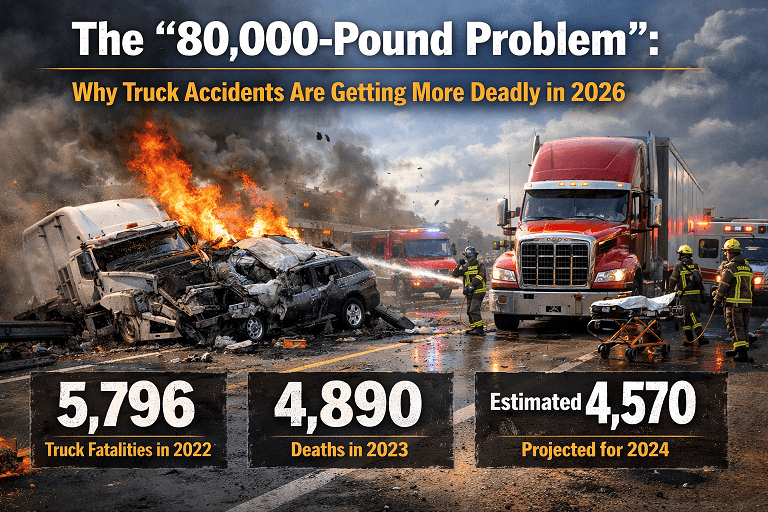
Truck accident fatalities in the United States hit a peak of 5,796 in 2022, according to NHTSA’s Fatality Analysis Reporting System (FARS). Though numbers have shown some improvement in recent years, with 4,890 deaths in 2023 and an estimated 4,570 in 2024, the underlying forces driving truck crash danger have not been corrected. Driver shortages, persistent hours of service violations, aging vehicle fleets, and an increasingly complex legal landscape mean that the threat posed by large commercial vehicles remains one of the most serious public safety crises on American roads today.
The Scale of the Problem
The Federal Motor Carrier Safety Administration (FMCSA) tracks large truck and bus crashes through its Motor Carrier Management Information System (MCMIS). According to the FMCSA’s own crash statistics data, from 2016 to 2022, fatal crashes involving large trucks and buses in the United States increased by 26.4%. That is not a statistical blip — it is a sustained directional trend covering six years and multiple administrations.
What makes these crashes so deadly is not just the size of the vehicles, but who dies in them. According to the FMCSA’s Large Truck and Bus Crash Facts report, in 2021, there were 5,788 total fatalities in crashes involving large trucks. Of those deaths, 73.4% — or 3,787 people — were occupants of passenger vehicles. Only 19.5% were the truck’s own occupants. The math is stark: when a big rig collides with a passenger car, it is almost always the car’s occupants who pay with their lives.
The NHTSA reports that large truck fatalities have remained near 5,500 deaths in recent reporting years, with more than 150,000 injuries annually. For 2025, NHTSA’s early estimates projected an 8.2% decline in overall roadway deaths, with an estimated 17,140 total highway fatalities in the first half of the year — down from 18,680 during the same period in 2024. The fatality rate per 100 million vehicle miles traveled reached 1.06, the lowest mid-year rate since 2014. While this general trend is encouraging, truck-specific crash data continues to lag other improvements in highway safety, and the structural causes of truck crashes have not been meaningfully addressed.
The Regulatory Framework: What the Law Requires
Federal law has long recognized that commercial trucks require stricter oversight than passenger vehicles. The Federal Motor Carrier Safety Regulations (FMCSRs), codified in Title 49 of the Code of Federal Regulations, establish the baseline rules for every commercial trucking operation in the country.
Driver Qualifications (49 CFR Part 391). Before a person can legally operate a commercial motor vehicle (CMV) in interstate commerce, they must satisfy the physical and professional qualifications outlined in 49 CFR Part 391. Under 49 CFR § 391.11, drivers must be at least 21 years of age, be physically qualified under § 391.41, pass a road test, and possess only one valid commercial driver’s license (CDL). Motor carriers must maintain a driver qualification file for each driver under 49 CFR § 391.51. These requirements exist because operating an 80,000-pound vehicle is not merely a driving task — it is an exercise in public safety management.
Commercial Driver’s License Requirements (49 CFR Part 383). Part 383 of Title 49 establishes the CDL standards applicable to all states and requires that no person who operates a CMV have more than one driver’s license, as stated in § 383.21. The purpose of Part 383, as stated in the regulations themselves, is to help reduce or prevent truck and bus accidents, fatalities, and injuries by requiring drivers to have a single CDL and by disqualifying unsafe drivers.
Hours of Service Rules (49 CFR Part 395). Perhaps no regulation is more central to truck safety than the hours of service rules found in 49 CFR Part 395. These rules limit when and how long drivers can operate. Under 49 CFR § 395.3(a)(1), a property-carrying driver may not drive without first taking 10 consecutive hours off duty. Under § 395.3(a)(2), a driver may not drive after 14 consecutive hours on duty following those 10 hours of rest. The daily driving cap is 11 hours, per § 395.3(a)(3). Drivers must also take a 30-minute break after 8 cumulative hours of driving, under § 395.3(a)(3)(ii). The regulations also impose a 60-hour/7-day or 70-hour/8-day cumulative weekly limit under § 395.3(b).
The FMCSA is explicit about why these rules exist: long daily and weekly working hours are associated with chronic driver fatigue and a high risk of crashes. Violations of HOS regulations can be grounds for both regulatory penalties under 49 CFR Part 386 and civil liability in a personal injury lawsuit.
Driver Fatigue: The Hidden Killer
Fatigue is consistently identified as a major contributing factor in large truck crashes. The NHTSA estimates it is a factor in approximately 13% of large-truck crashes. Yet fatigue is notoriously difficult to prove after the fact. Unlike alcohol intoxication, there is no roadside test for exhaustion. Unless a driver admits fatigue or the evidence is captured in Electronic Logging Device (ELD) data, it often goes unclassified in crash reports.
Texas crash data from 2023 reflects this problem clearly. Fatigue was cited in 21 fatal truck crashes in Texas that year, resulting in 24 deaths — a figure that appears as a decline from 43 fatigue-related fatal crashes in 2021. But that apparent improvement likely understates the problem. Fatigue is frequently not documented even when it played a central role, making officially reported figures unreliable as a measure of the true scope of the issue.
In 2025, FMCSA proposed two pilot programs — Docket FMCSA-2025-0194 and Docket FMCSA-2025-0193 — that would examine whether changes to the rigid 14-hour driving window and existing sleeper berth split rules could improve driver conditions without sacrificing safety. The Split Duty Period Pilot Program addresses the inflexibility of the 14-hour rule under 49 CFR § 395.3(a)(2), which some drivers argue forces them to drive at suboptimal times rather than waiting out traffic or fatigue. The Flexible Sleeper Berth Pilot Program would allow more flexibility in how drivers split their required rest periods beyond the current “7/3” or “8/2” formats under § 395.1(g)(1). Both programs were published in the Federal Register on September 17, 2025.
These pilot programs reflect a long-standing tension in trucking regulation: the rules designed to prevent fatigue can themselves create perverse incentives when drivers rush to complete a haul before the clock runs out, rather than resting when genuinely tired.
The Driver Shortage Crisis and Its Safety Implications
One of the most underappreciated drivers of truck crash risk in 2026 is the ongoing commercial driver shortage. The trucking industry has faced an estimated deficit of approximately 80,000 drivers, a gap that has pressured carriers to hire and deploy less-experienced drivers, cut training time, and push existing drivers harder.
The consequences of inexperienced drivers operating massive commercial vehicles appear directly in the crash data. FMCSA Safety Measurement System (SMS) data covering a 24-month period ending in late 2025 documented thousands of fatigue-related violations among major carriers. In Texas alone, at least 96 fatal truck crashes during 2025 occurred during overnight hours, resulting in more than 103 confirmed deaths and 200 or more serious injuries.
Under 49 CFR Part 391, motor carriers bear a legal obligation to verify driver qualifications before allowing anyone to operate a CMV. Under 49 CFR § 391.23, motor carriers must conduct background investigations of each driver’s safety performance history with prior employers. When carriers fail to do this — or when they knowingly place an unqualified driver behind the wheel — they expose themselves to claims of negligent hiring, negligent training, and negligent supervision.
How Courts Are Responding: From Nuclear Verdicts to Proximate Cause Limits
As truck crashes have increased in severity, so too have the verdicts against trucking companies. The industry has watched nervously as so-called “nuclear verdicts” — jury awards in the tens or hundreds of millions of dollars — have proliferated in trucking cases.
The legal theories underlying these verdicts typically involve respondeat superior (employer liability for employee actions taken in the scope of employment), as well as direct claims for negligent hiring, negligent training, and negligent supervision. These theories allow plaintiffs to put the company’s entire safety culture on trial, not just the conduct of the individual driver.
A landmark case illustrating the complexity of these issues is Werner Enterprises, Inc. and Shiraz A. Ali v. Blake, decided by the Texas Supreme Court on June 27, 2025 (Cause No. 23-0493). The case arose from a 2014 crash on Interstate 20 near Odessa, Texas, in which a pickup truck crossed a 42-foot median on an icy road and collided with a Werner Enterprises 18-wheeler. A seven-year-old child died, and a twelve-year-old was rendered a quadriplegic. A jury awarded over $100 million in damages, apportioning 70% fault to Werner, 14% to the driver (Shiraz Ali), and 16% to the operator of the pickup truck that crossed the median.
The Texas Supreme Court reversed the verdict in a majority opinion by Chief Justice Blacklock. The court held that Ali’s driving, while potentially negligent in some respects, was not a proximate cause of the crash as a matter of law. The court found that the crash occurred because an out-of-control vehicle crossed a wide median and struck the Werner truck before Ali had any meaningful ability to react — making his conduct a “mere happenstance of place and time,” citing Lear Siegler, Inc. v. Perez, 819 S.W.2d 470, 472 (Tex. 1991). Because Ali’s negligence was not the proximate cause of the injuries, the court further held that Werner could not be separately liable for derivative theories such as negligent training and supervision.
The Werner decision is significant, but it should not be read as a blanket limitation on trucking company liability. The court’s ruling turned on a specific and unusual fact pattern — a vehicle crossing a wide median with only two seconds of warning. In the vast majority of trucking cases, where driver error, fatigue, speeding, or distracted driving is a genuine proximate cause of a collision, the legal theories of respondeat superior and negligent entrustment remain viable and potent.
Indeed, the broader trend of nuclear verdicts in trucking cases continues. The American Trucking Association has repeatedly flagged this trend in amicus briefs and industry publications, warning that verdicts are increasingly untethered from the actual facts of individual cases. This concern reflects a broader reality: juries are responding to the perception that trucking companies put profits before safety, and courts — at least at the trial level — have largely allowed plaintiffs to pursue direct liability theories against carriers.
The Deadliest States and Routes
Truck crash risk is not evenly distributed across the country. According to the FMCSA’s crash data, the “deadliest dozen” states for truck crashes include Wyoming, New Mexico, Mississippi, North Dakota, Oklahoma, Idaho, Nebraska, Arkansas, Kansas, Montana, South Dakota, and Alabama. These states share common characteristics: large rural stretches, high truck traffic relative to total vehicle miles, and in some cases limited enforcement capacity.
Fatal truck crashes are most likely to occur in rural areas and on interstate highways, according to FMCSA data. Most crashes happen during weekday daytime hours — a fact that may seem counterintuitive but reflects the higher volume of trucks operating during those times. Overnight crashes, while fewer in absolute numbers, tend to involve higher fatigue factors and often prove more deadly on a per-crash basis.
What Victims and Their Families Should Know
When a truck accident occurs, the legal landscape is complex and time-sensitive. Evidence critical to establishing liability — including ELD records, driver qualification files maintained under 49 CFR § 391.51, vehicle maintenance logs, and black box data — can be lost, overwritten, or destroyed. Federal regulations under 49 CFR § 379.9 establish general retention requirements for carrier records, and attorneys typically send litigation hold letters immediately upon being retained to prevent spoliation.
Victims of truck accidents may have claims against multiple parties: the truck driver individually, the motor carrier under respondeat superior, the owner of the equipment if different from the carrier, cargo loading companies, and maintenance contractors. Under 49 CFR Part 390.5, the definition of a motor carrier is broad, and liability can attach to entities that control the operation of a CMV even if they do not directly employ the driver.
The road to recovery in a serious truck accident case is long, but the legal tools exist to hold responsible parties accountable. The regulations that govern commercial trucking are detailed, enforceable, and designed precisely for the purpose of preventing these crashes. When companies violate them — and when those violations cause injury and death — the law provides a framework for justice.
The 80,000-pound problem is not going away. Despite some recent improvement in overall highway fatality numbers, the structural forces that make truck crashes so deadly — driver shortages, fatigue, inadequate training, and the sheer physics of collisions between semi-trucks and passenger vehicles — remain embedded in the industry. Federal regulations under 49 CFR Parts 383, 391, and 395 establish clear standards of care. When those standards are met, crashes are prevented. When they are violated, people die.
Understanding the regulatory framework, the current data, and the evolving legal landscape is essential for victims, families, attorneys, and policymakers alike. The numbers behind these crashes are not abstract — each one represents a person who did not make it home.