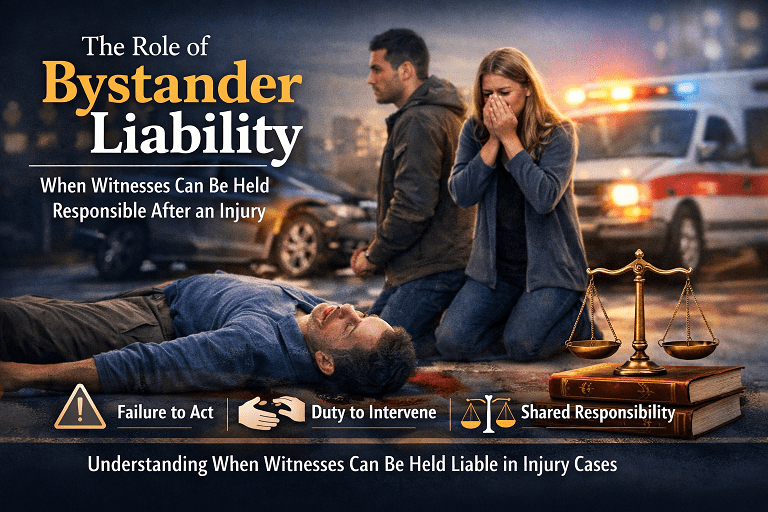
When Witnesses Can Be Held Responsible After an Injury
When an injury occurs, the immediate focus typically falls on the person who directly caused the harm. However, the legal landscape of personal injury law extends far beyond direct perpetrators. In many situations, individuals who witnessed an incident, had the power to prevent it, or failed to act appropriately can share responsibility for the damages that result. This concept, known as bystander liability or third-party liability, represents a crucial but often misunderstood aspect of injury law that can significantly impact the outcome of personal injury claims.
Understanding the Foundation of Bystander Liability
Bystander liability doesn’t mean that every person who witnesses an accident can be sued. Instead, it applies to specific third parties who had a legal duty to act, the ability to prevent harm, and failed to fulfill their responsibilities. The law recognizes that certain individuals, by virtue of their position, employment, or relationship to a property or event, assume obligations that extend beyond mere observation.
The legal principle underlying bystander liability is rooted in the concept of negligence. When a third party owes a duty of care to potential victims, breaches that duty through action or inaction, and that breach directly contributes to someone’s injury, liability can attach. This framework ensures that all parties who contribute to unsafe conditions share appropriate responsibility for the consequences.
Courts evaluate bystander liability cases by examining whether the third party had actual or constructive knowledge of dangerous conditions, whether they had the authority and opportunity to remedy the situation, and whether their failure to act was a substantial factor in causing the injury. These elements must be proven through evidence, witness testimony, and documentation of the third party’s role and responsibilities.
Security Guards: The Duty to Protect
Security personnel occupy a unique position in bystander liability cases because their very job description involves preventing harm and maintaining safety. When security guards fail to intervene during assaults, ignore hazardous conditions, or inadequately respond to emergencies, they and their employers can face liability for resulting injuries.
Consider a scenario where a security guard at a shopping mall observes an escalating confrontation between two individuals but chooses not to intervene or call for additional help. If the situation erupts into violence and a bystander is injured, both the direct attackers and potentially the security guard and the mall could share liability. The security guard’s duty extends beyond passive observation—they are expected to take reasonable steps to prevent foreseeable harm.
The scope of a security guard’s responsibility depends on several factors: their training, the specific instructions from their employer, industry standards, and the circumstances of the situation. A trained security professional at a nightclub, for example, would be expected to recognize signs of potential violence and act preventively. Their failure to do so, especially when violent incidents are foreseeable in such environments, can constitute a breach of their duty of care.
Employers of security personnel face vicarious liability for their employees’ actions or inactions while on duty. Additionally, if security companies fail to properly train their guards, provide inadequate staffing levels, or implement insufficient protocols for emergency response, they can be held directly liable for negligent hiring, training, or supervision practices.
Building Supervisors and Property Managers: Custodians of Safety
Property managers and building supervisors bear substantial responsibility for maintaining safe conditions on premises under their control. When they become aware of dangerous conditions—whether through direct observation, tenant complaints, or routine inspections—and fail to address them, they can be held liable when injuries occur.
The liability of building supervisors often hinges on the concept of notice. Actual notice exists when the supervisor directly observes a hazard or receives explicit information about it. Constructive notice applies when a condition has existed long enough that a reasonably diligent supervisor should have discovered it through proper maintenance and inspection protocols. Both types of notice can support liability claims.
A building supervisor who receives multiple complaints about inadequate lighting in a parking garage but fails to address the issue could face liability if someone is attacked in that poorly lit area. Similarly, a property manager who observes loose handrails on a staircase but postpones repairs indefinitely could be held responsible when a tenant falls and sustains injuries due to the defective railing.
The responsibility extends beyond passive awareness. Building supervisors have an affirmative duty to conduct regular inspections, respond promptly to known hazards, implement reasonable security measures appropriate to the property’s location and history, and maintain adequate records of maintenance activities. Documentation becomes crucial in these cases, as it demonstrates either diligence in addressing safety concerns or negligence in ignoring them.
Property management companies face organizational liability when systematic failures in their protocols contribute to injuries. Inadequate training of on-site personnel, insufficient budgets for necessary repairs, or policies that prioritize cost-cutting over safety can all support claims against the management entity itself, not just individual supervisors.
Event Organizers: Planning for Foreseeable Risks
Event organizers shoulder significant responsibility for the safety of attendees, performers, and staff. Whether coordinating a concert, sports event, festival, or conference, organizers must anticipate potential risks and implement appropriate safeguards. When they fail in this duty, and injuries result, they can face substantial liability.
The scope of an event organizer’s duty encompasses crowd control, adequate security presence, proper venue selection and setup, emergency medical services availability, and clear communication of safety information to attendees. Large events where alcohol is served, crowds are dense, or the activities themselves carry inherent risks require particularly careful planning and oversight.
Consider a music festival organizer who fails to provide adequate security despite knowing that previous similar events experienced violence. If attendees are assaulted and the inadequate security contributed to the harm, the organizer’s liability extends beyond the direct perpetrators. The organizer’s knowledge of foreseeable risks, combined with their failure to implement reasonable preventive measures, establishes the foundation for liability.
Event organizers must also address physical hazards on the premises. Uneven terrain, inadequate barriers near drop-offs, insufficient lighting, and obstructed emergency exits all present risks that organizers must identify and mitigate. When injuries occur due to these conditions, particularly if they were known or should have been obvious during event planning, organizers cannot escape responsibility by pointing solely to the injured party’s actions.
The relationship between event organizers and venue owners adds complexity to liability questions. Depending on contractual arrangements and the division of responsibilities, both parties might share liability for unsafe conditions. Clear contracts specifying who bears responsibility for various safety aspects become critical evidence in determining liability allocation.
Medical Personnel and Emergency Responders
In certain circumstances, medical personnel and emergency responders can face bystander liability, though this area involves additional legal protections and higher thresholds for establishing negligence. Good Samaritan laws in many jurisdictions protect individuals who voluntarily provide emergency assistance from liability, but these protections have limits.
Healthcare professionals who witness medical emergencies in non-professional settings may have ethical obligations to assist, but their legal duty depends on jurisdiction-specific laws and whether a doctor-patient relationship has been established. When medical professionals are present in their official capacity—such as event medical staff—they assume clearer duties to respond appropriately to medical emergencies.
Emergency responders face liability when their response falls below professional standards, causing additional harm or failing to prevent foreseeable injuries. Delayed response times, inadequate assessment of dangerous situations, or failure to follow established protocols can all support liability claims when injuries result from these failures.
Witnesses with Special Relationships
Beyond professional roles, certain personal relationships can create duties that give rise to bystander liability. Parents or guardians who fail to supervise children adequately, allowing them to engage in dangerous behavior that injures others, can face liability. Teachers and school administrators who ignore bullying or dangerous conditions on school grounds may be held responsible for resulting injuries.
Business owners who observe criminal activity on their premises but fail to warn customers or take reasonable protective measures can face liability under premises liability theories. The key factor is whether the relationship between the third party and the injured person created a duty of care that was breached through inaction.
Establishing Bystander Liability in Court
Proving bystander liability requires demonstrating several elements through compelling evidence. Plaintiffs must establish that the third party owed a legal duty to the injured person, that the third party knew or should have known about the dangerous condition or situation, that they had the ability to prevent or mitigate the harm, that they failed to take reasonable action, and that this failure was a substantial factor in causing the injury.
Evidence in bystander liability cases often includes incident reports, security footage, maintenance records, witness statements, employment contracts and job descriptions, training documentation, and expert testimony regarding industry standards. The strength of the evidence directly correlates with the likelihood of establishing liability.
Comparative negligence principles may apply, potentially reducing damages if the injured party shares some responsibility for their injuries. However, the existence of bystander liability doesn’t necessarily eliminate or reduce the liability of the direct actor—multiple parties can share proportional responsibility based on their respective contributions to the harm.
Defenses Against Bystander Liability Claims
Third parties facing liability claims typically raise several defenses. They may argue they had no actual or constructive notice of the dangerous condition, that the condition wasn’t actually dangerous or the risk wasn’t foreseeable, that they lacked authority or ability to prevent the harm, that their actions were reasonable under the circumstances, or that the injured party’s own actions were the sole cause of the injury.
The success of these defenses depends heavily on the specific facts of each case and the evidence available. Documentation of safety protocols, training records, and timely responses to known hazards strengthens defenses, while gaps in these areas undermine them.
The Broader Implications
Bystander liability serves important societal functions beyond compensating injured parties. It incentivizes property owners, employers, and event organizers to prioritize safety in their operations. It holds individuals in positions of authority accountable for fulfilling their protective responsibilities. It recognizes that preventing injuries often requires multiple parties to act responsibly, not just avoiding direct harmful acts.
Understanding bystander liability helps individuals recognize their potential legal exposure when they assume certain roles or positions. For security personnel, property managers, event organizers, and others in positions of responsibility, awareness of these duties encourages proactive risk management and safety planning.
When injuries occur through the combined failures of multiple parties, victims deserve legal recourse against all who contributed to their harm. Bystander liability ensures that the law reflects the reality that injury prevention is a shared responsibility, and that those who fail to fulfill their protective duties cannot hide behind claims of mere observation. Whether through professional obligations, property control, or special relationships, the law increasingly recognizes that with power comes responsibility—and with responsibility comes potential liability.