Understanding Strict Liability vs. One-Bite Rules
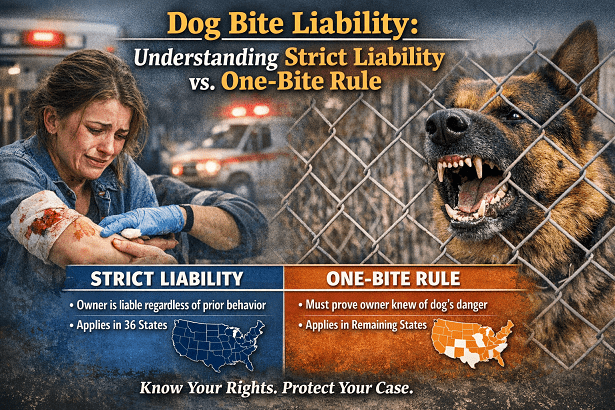
When a dog attacks, the aftermath extends far beyond the immediate physical injuries. Victims face mounting medical bills, emotional trauma, lost wages, and often permanent scarring. In these moments of crisis, understanding who bears legal responsibility becomes paramount. The legal framework governing dog bite liability in the United States operates under two fundamentally different philosophies, and the state where you live determines which rules apply to your case. Approximately 36 states have strict liability laws for dog bites, making owners financially responsible even if the dog never seemed dangerous before. The remaining states follow variations of the traditional “one-bite rule,” which requires proving the owner knew or should have known about their dog’s dangerous propensities.
This distinction isn’t merely legal semantics—it fundamentally shapes whether injured victims can recover compensation and how much effort they must expend to prove their case. For dog owners, it determines the scope of their potential liability and the importance of insurance coverage. Understanding these two approaches, how they work in practice, and which applies in your jurisdiction provides essential knowledge for both victims seeking justice and owners managing risk.
The Scope of the Problem: Dog Bites in America
Before examining the legal frameworks, it’s important to understand the magnitude of dog bite injuries in the United States. Approximately 4.5 million individuals in the United States are bitten by dogs each year, with 19 percent necessitating medical attention. Each day nearly 1,000 U.S. citizens require emergency care treatment for serious dog bite injuries, and annually, about 12,480 citizens are hospitalized due to dog bite injuries.
The financial impact is staggering. In 2024, homeowners’ insurance companies paid out a total of 1.56 billion dollars for dog-related injury claims. Settlement amounts have increased dramatically over the past decade, with the average cost per dog bite claim doubling from 32,100 dollars in 2014 to 69,300 dollars in 2024. These rising costs reflect not only inflation in medical expenses but also the severity of injuries and the legal system’s recognition that dog bite victims deserve comprehensive compensation.
Children bear a disproportionate burden of these attacks. Children between the ages of one and four are the most frequent victims, accounting for 29.4 percent of fatalities from dog attacks, with those under age seventeen accounting for 56.7 percent of all fatalities. The vulnerability of young victims and the lasting physical and psychological effects they endure make the legal questions surrounding dog bite liability particularly critical.
Understanding Strict Liability for Dog Bites
Strict liability laws hold dog owners automatically responsible for any injuries their pets cause, regardless of whether the dog has shown signs of aggression in the past or the owner had no prior knowledge of aggressive tendencies. This legal doctrine represents a significant departure from traditional negligence principles that require proving fault. Under strict liability, the focus shifts from what the owner knew or should have known to whether the bite occurred and whether it caused injury.
The policy rationale behind strict liability rests on several foundations. First, it recognizes that dog ownership is a voluntary choice that comes with inherent responsibilities. When someone decides to keep an animal capable of causing harm, they assume liability for that animal’s actions. Second, strict liability promotes responsible pet ownership by creating strong financial incentives for owners to control their animals. Third, it protects innocent victims who might otherwise struggle to prove what an owner knew about their dog’s temperament.
How Strict Liability Works in Practice
In order to win a strict liability claim, an injured party generally has to prove the following: the dog belonged to or was under the control of the defendant, the attack happened in a place open to the public or where the victim was legally allowed to be on private property, and the bite caused an injury. Notably absent from this list is any requirement to prove the owner was negligent or knew the dog was dangerous.
California’s Civil Code Section 3342 explicitly holds dog owners liable for damages when their dog bites a person in a public place or while the person is lawfully on private property, serving as a model strict liability statute. Unlike states that follow the one-bite rule, California law makes the owner liable from the very first incident. This eliminates the defense that the dog had never bitten anyone before and therefore the owner had no reason to anticipate danger.
States that have adopted strict liability include California, Florida, Illinois, Michigan, and numerous others. These laws help ensure victims get just compensation without the burden of proving the owner’s negligence. For victims, this creates a more straightforward path to recovery. They need not hire investigators to uncover prior incidents or behavioral problems—the bite itself establishes liability.
Limitations and Exceptions to Strict Liability
Despite its broad application, strict liability does not create absolute liability in all circumstances. Most statutes contain specific exceptions designed to protect owners from claims when the victim’s own conduct contributed to the incident or when special circumstances apply.
Trespassing represents the most common exception. Strict liability typically applies only when victims are in public spaces or lawfully on private property. If someone enters property without permission and a dog bites them, strict liability may not apply. However, the definition of “lawful presence” extends beyond mere property owners—postal workers, delivery personnel, meter readers, and social guests all qualify as lawfully present.
Provocation provides another common defense. If the victim teased, tormented, or abused the dog immediately before the bite, owners may argue the victim provoked the attack. Courts evaluate provocation based on whether a reasonable person would expect the conduct to trigger an aggressive response. Gentle petting or approaching a dog typically doesn’t constitute provocation, but pulling a dog’s tail, hitting it, or threatening it might.
Some states carve out exceptions for specific categories of dogs or owners. The statute creates a specific exception for governmental agencies using dogs in military or police work, where liability does not apply if the dog bites while defending itself from provocation or while assisting an employee. Veterinarians and kennel workers who are bitten while providing professional services may also face limited recovery under what’s sometimes called the “veterinarian’s rule,” though this defense succeeds only when the professional was warned of no specific danger beyond the normal risks of the profession.
The One-Bite Rule: Knowledge-Based Liability
In contrast to strict liability’s automatic responsibility, the one-bite rule creates a knowledge-based system where owners face liability only after they knew or should have known their dog posed a danger. Prior to the twentieth century, a dog owner was usually only held liable for injuries when their dog bit someone if the owner had reason to know the dog might bite. This common law principle, developed over centuries of case law, reflected the view that owners shouldn’t be punished for their dog’s first manifestation of dangerous behavior.
The name “one-bite rule” creates some confusion. The rule doesn’t literally mean dogs get a free bite; it’s more subtle than that. The dog might have also exhibited previous aggression—it had growled, it had snapped, it lunged. The central question isn’t whether the dog previously bit someone, but whether the owner had notice of dangerous propensities. A dog that has never bitten but consistently lunges at visitors, growls menacingly at children, or shows territorial aggression may trigger owner liability under the one-bite rule.
Proving Knowledge Under the One-Bite Rule
When a dog bite occurs in a one-bite rule state, the injured person faces a significant challenge—they must convince the court that the dog’s owner knew or should have known their pet posed a danger to others. This burden of proof requires victims to gather evidence demonstrating prior dangerous behavior and the owner’s awareness of that behavior.
Evidence in one-bite cases often includes previous bite incidents, complaints from neighbors, warnings from veterinarians or trainers, aggressive incidents witnessed by others, or the dog’s general behavior pattern. Animal control records proving prior complaints become particularly valuable, as do written warnings or citations issued to the owner. Witness testimony from neighbors, postal workers, or others who regularly encountered the dog can establish a pattern of aggression.
Modern courts consider a wide range of evidence beyond previous bites, including growling, lunging, breed characteristics, and even how the dog was trained. Some jurisdictions consider breed reputation as circumstantial evidence that an owner should anticipate danger, though this remains controversial and many courts reject breed-specific assumptions. Training for aggressive behavior or guard dog work may suggest an owner recognized the dog’s potential for violence.
States Following the One-Bite Rule
Texas and fifteen other states still maintain versions of the one-bite rule, though often with significant modifications through court decisions and statutes. These states include Virginia, Maryland, New York, Georgia, North Carolina, South Dakota, and others. The application varies significantly from state to state—New York applies the one-bite rule only to civil liability cases but handles criminal liability differently, while South Dakota requires that owners kept their dog under reasonable control as part of their standard.
Even within one-bite jurisdictions, statutory modifications often layer additional requirements onto the common law framework. Some states combine the one-bite rule with negligence principles, allowing recovery if an owner’s careless handling of even a non-dangerous dog led to injury. Others impose strict liability for certain types of damage while maintaining the one-bite rule for others.
Hybrid and Mixed Systems
Between the clear poles of strict liability and pure one-bite rules lie hybrid systems that blend elements of both approaches. Several states have incorporated the one-bite rule into their dog bite law in a significant way, despite having statutes that impose liability for dog bites—these states are referred to as mixed dog bite statute states, with Georgia, Tennessee, and New York as examples.
In New York, for instance, the dog bite statute provides that if a dog previously adjudicated as dangerous bites a person, the owner is responsible only for paying the victim’s medical bills; to collect the full range of damages such as loss of income if permanently disabled, the plaintiff must prove the dog previously behaved viciously toward a human being. This creates a two-tiered system where basic medical expenses fall under something resembling strict liability, while full compensation requires proving knowledge.
Other states apply strict liability specifically for bites but require proof of owner knowledge for other injuries caused by dogs, such as when a dog knocks someone down without biting. Some jurisdictions impose strict liability only when serious bodily injury results, while lesser injuries require negligence or knowledge. These variations create complexity and underscore why understanding your specific state’s approach matters enormously.
Practical Implications for Victims
The distinction between strict liability and one-bite rules dramatically affects victims’ ability to recover compensation. In strict liability states, victims focus their efforts on documenting that the bite occurred, that they were lawfully present, and the extent of their injuries. The question of what the owner knew becomes largely irrelevant, streamlining the case and often leading to faster settlements.
In one-bite states, victims must conduct more extensive investigations. They need to identify witnesses who can testify about the dog’s prior behavior, obtain animal control records, interview neighbors, and potentially hire experts to testify about breed characteristics or training methods. This additional burden means cases take longer to develop, require more resources, and face greater uncertainty about success.
The Value of Legal Representation
People with a personal injury lawyer end up with payouts nearly three times higher than those without representation, with 91 percent receiving settlements versus only 51 percent without lawyers. This striking disparity reflects multiple factors. Attorneys understand which evidence matters most in their jurisdiction, know how to value claims accurately considering all compensable damages, can effectively negotiate with insurance companies that routinely lowball unrepresented claimants, and possess the resources to litigate if settlement negotiations fail.
70 percent of people who held out for a better deal received settlements that were 30,700 dollars higher compared to those who accepted the insurance company’s first offer. Insurance adjusters make initial offers designed to close files quickly and cheaply, often before victims fully understand their injuries’ long-term impacts. Experienced attorneys recognize inadequate offers and advocate for compensation reflecting the true scope of damages.
Calculating Damages in Dog Bite Cases
Settlement amounts are typically calculated based on factors like medical expenses, lost wages, pain and suffering, and any long-term effects of the injury, using methods like the multiplier method where damages are multiplied by a factor usually between 1.5 and 5. Economic damages include all measurable financial losses—past and future medical treatment, surgeries, therapy, medication, medical equipment, lost wages during recovery, reduced earning capacity if permanent limitations result, and property damage such as torn clothing.
Non-economic damages compensate for intangible losses that don’t appear on billing statements. Physical pain and suffering from the injury itself, emotional distress including anxiety, depression, or post-traumatic stress disorder, disfigurement and scarring particularly affecting visible areas, loss of enjoyment of life when injuries prevent previously enjoyed activities, and the psychological trauma of being attacked all qualify for compensation.
The average dog bite settlement amount is 97,517.86 dollars, with cases often settling between 10,000 and 100,000 dollars but can be higher or lower depending on case factors. Severe cases involving significant facial scarring, permanent disability, or psychological trauma can result in settlements or verdicts exceeding several hundred thousand dollars. California’s average settlement of 68,000 dollars and New York’s highest average settlement at 110,500 dollars in 2024 demonstrate geographic variation in compensation levels.
Practical Implications for Dog Owners
Dog owners bear significant legal exposure regardless of which liability system applies in their state. The dramatic increase in settlement amounts over the past decade means even a single bite incident can result in financial devastation without proper insurance coverage.
Insurance Considerations
Homeowners’ insurance typically provides liability coverage for dog bites, with most policies offering 100,000 to 300,000 dollars in coverage. However, many insurers impose breed-specific exclusions or surcharges for dogs they deem high-risk. Some refuse coverage entirely if certain breeds are present in the household. Dog owners should carefully review their policies to ensure coverage exists and consider umbrella liability policies providing additional protection beyond standard homeowners’ limits.
In strict liability states, the importance of adequate insurance cannot be overstated. Since liability attaches automatically regardless of prior behavior, every dog poses potential exposure. Even typically gentle dogs can react unpredictably if startled, hurt, or protecting territory. Insurance provides the financial resources to compensate injured victims and protects owners’ personal assets from claims.
Risk Management Strategies
Responsible ownership practices reduce bite risk regardless of the legal framework. Proper socialization and training from an early age help dogs learn appropriate behavior around people. Secure fencing prevents dogs from escaping and encountering people unsupervised. Leashing in public spaces gives owners control and prevents unwanted interactions. Warning signs alert visitors to a dog’s presence. Neutering reduces aggression in male dogs. Avoiding known triggers and managing the dog’s environment around children, strangers, or situations that provoke anxiety all contribute to safety.
In one-bite states, these precautions carry additional legal significance. Documented training programs, routine veterinary care, and the absence of complaints help establish that an owner maintained reasonable control and had no reason to anticipate danger. Conversely, ignoring warning signs, failing to restrain a dog with known aggressive tendencies, or disregarding complaints from neighbors can establish the knowledge necessary to trigger liability.
Special Considerations and Emerging Issues
Several specific situations create additional complexity in dog bite liability cases, regardless of whether strict liability or the one-bite rule applies.
Landlord Liability
Property owners who rent to tenants with dogs may face liability under certain circumstances. Generally, landlords aren’t liable for tenant-owned dogs unless the landlord knew the dog was dangerous and had control over its presence (such as the right to remove it but failing to do so). Some courts impose liability when landlords know about dangerous dogs and take no action to protect other tenants or visitors. Lease provisions requiring pet deposits or limiting breeds may create additional exposure if landlords know prohibited dogs are present but don’t enforce lease terms.
Dog Bites in the Workplace
Employees bitten while performing job duties may pursue workers’ compensation claims for medical expenses and lost wages. If the victim sustained a dog bite while working as a postal carrier or delivery driver, they may be able to file a workers’ compensation claim with their employer and, depending on circumstances, may also pursue legal action against the animal’s owner. This dual recovery option allows injured workers to receive immediate workers’ compensation benefits while also seeking full damages from the dog owner, including pain and suffering not covered by workers’ compensation.
Dangerous Dog Ordinances
Many municipalities impose special requirements on dogs deemed dangerous based on prior aggressive behavior or specific incidents. These ordinances may require owners to maintain higher liability insurance, keep dogs in secure enclosures, use muzzles in public, or post warning signs. Violation of dangerous dog ordinances can strengthen negligence claims even in one-bite states, as the designation provides clear notice to owners that their dog poses a danger.
Statute of Limitations
Time limits for filing dog bite lawsuits vary by state but typically range from two to four years from the injury date. California’s statute of limitations for dog bite lawsuits is governed by the general personal injury statute, which sets the deadline at two years. Missing this deadline permanently bars recovery regardless of the claim’s merits. Some states toll (pause) the statute of limitations for minors, allowing them to file claims after reaching adulthood even if the bite occurred years earlier.
Medical and Psychological Impacts
Understanding the full scope of injuries caused by dog bites helps explain why settlements often reach substantial amounts even in seemingly straightforward cases. Dog bite injuries extend far beyond the immediate puncture wounds.
Physical Injuries
The bite was located in the upper extremity in 47.3 percent of cases, head and neck in 26.8 percent, lower extremity in 21.5 percent, and trunk in 4.4 percent. Bites to hands and arms often result in nerve damage, tendon injuries, and loss of function. Facial bites carry particular concern due to cosmetic disfigurement, damage to sensitive structures like eyes and nose, and the psychological impact of visible scarring. Hospital admission was rare at 1.7 percent, with higher occurrence in summer and on weekends, though the most serious cases requiring hospitalization face lengthy recovery periods and multiple surgeries.
Infection represents a significant complication in dog bite cases. Dogs’ mouths harbor numerous bacteria, and the puncture nature of bite wounds creates deep pockets where infection can develop. Rabies, though rare, remains a concern requiring immediate prophylactic treatment when the dog’s vaccination status is unknown. Crush injuries from powerful jaws can fracture bones, particularly in children whose bones are still developing.
Psychological Trauma
The emotional impact of dog attacks often proves more debilitating than physical injuries, particularly for children. Victims commonly develop post-traumatic stress disorder manifesting as nightmares, flashbacks, hypervigilance, and panic attacks. Cynophobia, the persistent and irrational fear of dogs, can severely limit daily activities given how commonly people encounter dogs. Children may refuse to play outside, visit friends with pets, or engage in normal childhood activities. Adults may struggle with work if their employment requires entering properties with dogs.
These psychological injuries deserve and receive recognition in settlement calculations. Therapy costs for months or years of treatment to address trauma, lost quality of life from avoiding previously enjoyed activities, and the permanent psychological scars that persist even after physical wounds heal all contribute to non-economic damages.
The Future of Dog Bite Liability Law
Dog bite liability law continues evolving as courts, legislatures, and society grapple with balancing several competing interests. The trend over the past century has moved toward strict liability, reflecting growing recognition that victims deserve protection and compensation regardless of what owners knew. However, resistance to this trend persists in some jurisdictions valuing traditional notions of fault-based liability.
Breed-specific legislation remains controversial. Some municipalities ban or heavily regulate specific breeds deemed inherently dangerous, while major veterinary organizations and scientific studies determined that breed does not determine aggression, with controlled studies not identifying any specific breeds as disproportionately dangerous. Since 2016, at least 83 different breeds and mixed breeds have been reported in fatal dog attacks in the U.S., suggesting the problem transcends specific breeds. Courts increasingly reject breed as relevant to liability questions, focusing instead on individual dog behavior and owner knowledge.
Insurance availability shapes liability law’s practical application. As payouts increase and insurers restrict coverage or exclude certain breeds, questions arise about whether the current liability framework adequately serves all stakeholders. Some advocate for mandatory dog liability insurance, while others resist additional regulatory burdens on responsible owners.
The distinction between strict liability and one-bite rule states fundamentally determines the landscape for dog bite cases. Approximately 36 states have strict liability laws for dog bites, creating automatic owner responsibility that protects victims and promotes responsible pet ownership. The remaining states require proving owner knowledge, placing greater burdens on victims but preserving traditional fault-based liability principles.
For victims of dog attacks, understanding your state’s legal framework provides the foundation for pursuing compensation. In strict liability states, the path forward emphasizes documenting the bite and injuries rather than investigating the dog’s history. In one-bite states, building a case requires gathering evidence of prior dangerous behavior and owner knowledge. Regardless of jurisdiction, with 4.5 million dog bites occurring annually in the United States and settlement amounts reaching record levels, the stakes for both victims and owners have never been higher.
For dog owners, the message transcends legal frameworks. Responsible ownership, proper training, adequate insurance coverage, and immediate response to any signs of aggression provide the best protection against liability while simultaneously reducing the risk of someone suffering serious injury. The law may differ from state to state, but the fundamental principle remains constant: those who choose to keep animals capable of causing harm bear responsibility for the consequences when those animals attack.
Whether you’re a victim seeking compensation or an owner managing risk, consulting with experienced attorneys familiar with your state’s specific rules and recent developments in the law provides essential guidance. Dog bite cases involve complex legal principles, significant potential damages, and life-altering consequences for all involved. Professional legal assistance ensures your rights are protected and your interests are properly represented in this challenging area of personal injury law.