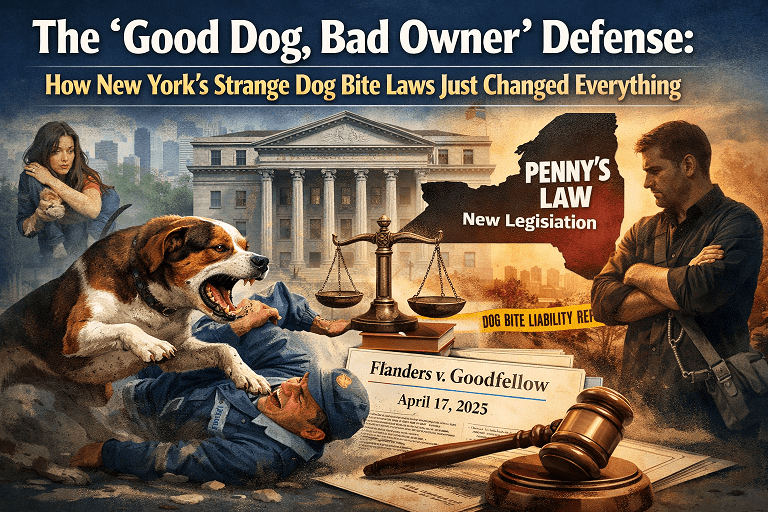
How New York’s Strange Dog Bite Laws Just Changed Everything
For nearly two decades, New York maintained one of the most unusual and restrictive dog bite liability systems in the United States. If a dog attacked you on the street, bit a postal worker delivering mail, or mauled another pet, victims faced an uphill battle in court—not because they couldn’t prove what happened, but because of an archaic legal framework that seemed to protect negligent dog owners more than the people and animals they harmed.
That all changed on April 17, 2025, when the New York Court of Appeals issued a landmark ruling in Flanders v. Goodfellow that fundamentally reshaped how the state handles dog bite cases. The decision represents a seismic shift in liability law, giving victims new pathways to justice and placing greater responsibility on dog owners to prevent foreseeable harm. Combined with proposed legislation known as “Penny’s Law,” New York is undergoing the most significant transformation of its dog bite laws in modern history.
The Old Rule: One Free Bite for Every Dog
New York’s historical approach to dog bite liability rested on what lawyers call the “one-bite rule,” a legal principle dating back centuries to English common law. Under this doctrine, dog owners could only be held strictly liable for injuries if they knew—or should have known—that their dog had “vicious propensities.” In practical terms, this meant a dog essentially got one free bite before its owner could face full legal consequences.
The rule placed an enormous burden on victims. To recover compensation for medical bills, lost wages, pain and suffering, and other damages, injured parties had to prove not only that the dog attacked them, but also that the animal had previously exhibited dangerous behavior and that the owner was aware of it. Evidence might include prior biting incidents, aggressive behavior toward strangers, or documented complaints about the dog’s conduct.
This standard created absurd outcomes. A dog could seriously injure someone on its first attack, and the owner might escape liability simply by claiming ignorance of any dangerous tendencies. The victim would be left with mounting medical bills and no legal recourse, while the owner faced minimal consequences.
In 2006, New York’s highest court made matters even worse. In Bard v. Jahnke, the Court of Appeals ruled that dog bite victims couldn’t pursue negligence claims at all when it came to domestic animals. This decision effectively eliminated one of the most common legal theories used in personal injury cases across the country. Under Bard, it didn’t matter if an owner acted carelessly—letting a large dog off-leash in a crowded area, failing to secure a gate, or ignoring obvious warning signs of aggression. Without proof of prior bad behavior by the animal itself, victims had virtually no path to compensation.
The Bard decision left New York as an outlier among American states. While nearly every other jurisdiction allowed negligence claims in dog bite cases, and roughly 30 states had adopted strict liability statutes making owners automatically responsible for attacks regardless of the dog’s history, New York clung to its restrictive 17th-century framework.
The Flanders Case: A Postal Worker Changes the Law
Rebecca Flanders was a postal carrier doing her job when her life changed forever. In December 2018, she arrived at the home of Stephen and Michelle Goodfellow to deliver a package. As Stephen opened the door to accept the delivery, their dog slipped past him and lunged toward Flanders, biting her shoulder and causing severe injuries that would require multiple surgeries and leave permanent scarring.
What seemed like a straightforward case of owner negligence—a dog escaping through an open door and attacking a mail carrier—ran headlong into New York’s peculiar legal landscape. Flanders sued the Goodfellows under two theories: strict liability, arguing they knew or should have known their dog was dangerous, and negligence, claiming they failed to take reasonable precautions to prevent the attack.
The evidence supporting Flanders’s claims was compelling. Two postal workers who had delivered mail to the Goodfellow residence over several years provided sworn testimony about the dog’s behavior. One stated that the animal would slam into windows, bare its teeth, and spray saliva against the glass while attempting to bite postal workers through the barrier. The postal worker described it as one of the most aggressive dogs he had encountered on his route. The second postal worker corroborated this account, noting that the dog’s behavior was so loud and violent that anyone inside the home would have been aware of it.
Additional evidence revealed that the dog had yanked Michelle Goodfellow to the ground during walks and had gotten into a fight with another dog during training. Despite this history, the Goodfellows maintained they had no knowledge of their dog’s aggressive tendencies.
The lower courts dismissed both of Flanders’s claims. They ruled there was insufficient evidence to prove the Goodfellows knew about their dog’s vicious propensities, rejecting the strict liability theory. The negligence claim was dismissed based on the Bard precedent, which barred such actions entirely.
Flanders appealed to the Court of Appeals, and on April 17, 2025, the state’s highest court delivered a decision that would reshape New York dog bite law.
The Ruling That Changed Everything
The Court of Appeals reversed the lower courts on both grounds, issuing a unanimous decision that expanded victim protections significantly.
First, the court found that the evidence did create factual questions about whether the Goodfellows had constructive knowledge of their dog’s dangerous propensities. The testimony from postal workers about the dog’s aggressive window-slamming behavior, combined with the dog’s history of pulling its owner to the ground and fighting with other dogs, was sufficient to let a jury decide whether the owners should have known their pet posed a danger. The court emphasized that proof of vicious propensities doesn’t require a prior bite—evidence of growling, baring teeth, or other aggressive behaviors can establish the necessary knowledge.
Second, and perhaps more importantly, the court directly overruled the Bard decision, bringing New York in line with virtually every other state in the nation. The court acknowledged that while precedent should generally be respected, there are times when “experience has shown that a rule is out of tune with the life about us, at variance with modern-day needs and with concepts of justice and fair dealing.”
The court explained that ordinary tort principles require people to act with reasonable care to prevent foreseeable harm to others. The Bard rule violated this fundamental principle by shielding negligent dog owners from liability, shifting the burden of injuries entirely onto innocent victims. The decision noted that 36 other states already recognized negligence as a valid legal theory in dog bite cases, and New York courts had already created numerous exceptions to Bard that had made the rule unworkable.
Writing for the court, Judge Halligan emphasized that tort law exists to incentivize people to be mindful of how their behavior might harm others. When someone keeps a dog, they should be required to take reasonable steps to prevent that animal from injuring people, regardless of whether the dog has bitten anyone before.
What the New Law Means for Victims and Owners
The Flanders decision fundamentally changes the landscape for dog bite victims in New York. Injured parties now have two potential legal theories to pursue compensation:
Strict Liability: Victims can still sue under the traditional one-bite rule by proving the owner knew or should have known about the dog’s vicious propensities. This theory provides the strongest path to recovery when evidence of prior dangerous behavior exists.
Negligence: Victims can now also pursue compensation by showing the owner failed to exercise reasonable care in handling their dog, even if the animal has no history of aggression. This might include violations of leash laws, failure to secure gates or doors, ignoring obvious risks, or allowing a dog to roam in situations where harm was foreseeable.
The negligence option removes what had been an insurmountable barrier for many victims. No longer must they prove the owner’s prior knowledge of dangerous tendencies—they need only show that the owner’s careless conduct caused their injuries.
For dog owners, the ruling brings greater accountability. The law now expects owners to recognize potential risks and take proactive measures to prevent harm, rather than waiting for an incident to occur before implementing safety measures. Owners who ignore basic precautions—such as securing their property, following leash laws, or properly supervising their animals—can face legal consequences even if their dog has never bitten anyone before.
The financial implications can be substantial. Victims may recover compensation for medical expenses, lost wages, scarring and disfigurement, emotional distress, pain and suffering, and other damages. Under existing New York Agriculture and Markets Law provisions, negligent owners can also face civil penalties ranging from $400 for causing physical injury to $1,500 for causing serious physical injury. If a dog previously declared dangerous causes serious injury due to owner negligence, the owner can face misdemeanor charges carrying up to 90 days in jail and a $3,000 fine.
Penny’s Law: The Push for Even Stronger Protections
As significant as the Flanders ruling is, many advocates argue that New York needs to go further. The catalyst for renewed legislative action came in May 2025, when a small Chihuahua mix named Penny was viciously attacked by two pit bulls on Manhattan’s Upper West Side.
Lauren Claus was walking her 16-pound dog when the attack occurred. The two larger dogs, which witnesses say were off-leash or not properly controlled, mauled Penny, causing multiple puncture wounds and lacerations that required extensive veterinary treatment and left Claus facing nearly $11,000 in medical bills. One of the attacking dogs also bit a woman who tried to rescue Penny. After the attack, the dogs’ owners allegedly fled the scene.
Making matters worse, the same two pit bulls were believed to have killed another dog, a 17-year-old Shih Tzu mix named Grover, in Central Park just months earlier while illegally off-leash. Once again, the owners reportedly left the scene without facing consequences.
The Penny case exposed significant gaps in New York’s ability to hold negligent dog owners accountable. Under state law, dogs are classified as property, meaning attacks on other animals are treated as property crimes rather than criminal matters. Police often cannot intervene unless a human is directly harmed or involved. Additionally, owners who fled the scene of dog attacks faced no specific criminal penalties for leaving.
The incident sparked outrage throughout New York City. A town hall meeting in May 2025 drew hundreds of concerned residents from across the city, all sharing stories of dangerous dogs and owners who faced no meaningful consequences for repeated incidents. The public outcry prompted swift legislative action.
State Assembly member Jenifer Rajkumar introduced “Penny’s Law” in May 2025, with companion legislation in the state Senate. The proposed law would create several new offenses and requirements:
Negligent Handling of a Dog: Owners who violate local leash laws or other dog-related ordinances on three or more occasions could face criminal charges.
Reckless Handling of a Dog: Owners who recklessly allow their dogs to cause harm would face more serious penalties.
Leaving the Scene: Making it a crime to flee after a dog attack, similar to hit-and-run laws for vehicle accidents, even when the victim is another animal.
Enhanced Park Signage: Requiring clear, conspicuous signs in parks throughout New York City reminding owners of leash requirements and penalties for violations.
Dangerous Dog Procedures: Providing authorities with additional tools for declaring dogs dangerous and transferring custody of dangerous animals to other individuals or jurisdictions when necessary.
The legislation reflects growing recognition that repeated violations by the same owners—often dismissed as dogs just “playing” or being “friendly”—create serious public safety risks. According to data from New York City’s 311 system, operators received over 1,300 complaints about off-leash dogs in just the first four months of 2025. Staten Island had the highest rate of dog bites in the city, with 124 incidents per 100,000 residents between 2022-2023, compared to 82 citywide.
As of late 2025, Penny’s Law remains pending in the state legislature. While it has gained significant public support and media attention, passage is not guaranteed. Dog bite law expert Kenneth Phillips has noted that such named legislation often generates favorable publicity but can stall in the legislative process or, if passed, may not be adequately enforced.
The Broader National Context
New York’s transformation puts it more in line with approaches taken by other states, though significant differences remain. Dog bite liability laws vary widely across the United States, generally falling into three categories:
Strict Liability States: Approximately 30 states have statutes making dog owners automatically liable when their dog bites someone, regardless of the animal’s history or the owner’s knowledge of dangerous propensities. These laws provide the strongest protections for victims.
One-Bite Rule States: Some states still follow the traditional rule requiring proof of prior knowledge of vicious tendencies.
Mixed Approach States: Several states, like New York after Flanders, allow victims to pursue both strict liability claims (when prior dangerous behavior can be proven) and negligence claims (based on the owner’s careless conduct).
New York now falls into the mixed approach category, offering victims two paths to compensation. However, it still lacks the comprehensive strict liability statute that advocates argue would provide the most complete protection.
What This Means for You
If you’re a dog bite victim in New York, the Flanders decision significantly improves your chances of recovering compensation. You no longer need to uncover evidence of prior biting incidents or complaints to pursue a claim. Instead, you can focus on demonstrating that the owner’s negligent conduct—failing to leash the dog, leaving gates unsecured, or allowing the animal to roam in dangerous situations—caused your injuries.
Steps to take after a dog bite include:
- Seek immediate medical attention, even for seemingly minor wounds, as dog bites carry serious infection risks
- Document everything: photograph your injuries, the location, and the dog if possible
- Gather contact information from witnesses
- Report the incident to police or animal control to create an official record
- Avoid speaking with insurance companies without legal representation, as they may try to minimize your claim
- Consult with a personal injury attorney experienced in dog bite cases to understand your rights under the new legal framework
For dog owners, the message is clear: you have a legal duty to exercise reasonable care in managing your animals. This includes following all local leash laws, properly securing your property, supervising your dog around strangers, and taking immediate action if your dog displays aggressive tendencies. The one-bite rule no longer protects owners who claim ignorance after their dog injures someone.
The Ongoing Debate
Not everyone views these changes as purely positive. Some dog owners and advocates worry that expanded liability could lead to increased insurance costs, breed-specific restrictions, or hasty decisions to euthanize dogs based on minor incidents. Critics of strict liability approaches argue they can punish responsible owners for unforeseeable accidents and fail to account for victim behavior that might provoke attacks.
Proponents counter that these concerns are outweighed by the need to protect public safety and ensure justice for victims. They note that breed-specific legislation is already largely prohibited in New York, and that the new negligence standard still requires proof that an owner’s conduct was unreasonable—it doesn’t impose automatic liability for every incident.
The debate also touches on deeper questions about how we view animals in society. The current legal classification of dogs as “property” strikes many as outdated and inconsistent with how most people actually regard their pets. Separate legislation proposed by Assembly member Linda Rosenthal would reclassify dogs as “sentient beings” rather than property, though what practical effect this might have remains unclear.
Looking Forward
The Flanders decision marks a watershed moment in New York dog bite law, but it’s unlikely to be the final word on the subject. Advocates continue pushing for a comprehensive strict liability statute that would match the protections available in states like California, New Jersey, and New Hampshire. Such a law would eliminate the need for victims to prove either prior knowledge of dangerous propensities or owner negligence, instead making owners automatically responsible for attacks in most circumstances.
The fate of Penny’s Law will test whether New York is ready to take additional steps beyond what the courts have mandated. If passed, it would signal a significant shift toward treating dog-related injuries as serious public safety matters worthy of criminal penalties, not just civil liability.
Meanwhile, the practical effects of Flanders are already being felt in courtrooms across the state. Cases that would have been dismissed under Bard are now proceeding to trial. Insurance companies are reassessing their liability exposure. And dog owners are being put on notice that careless conduct will no longer be shielded by archaic legal doctrines.
For Rebecca Flanders, the postal worker whose case changed the law, the victory came too late to prevent her injuries but not too late to help countless others who will benefit from the expanded legal protections. Her willingness to fight through multiple court defeats to reach the state’s highest court has fundamentally altered the legal landscape for dog bite victims throughout New York.
New York’s dog bite laws are experiencing their most dramatic transformation in generations. The Flanders v. Goodfellow decision eliminated the harsh Bard rule and brought the state in line with modern tort principles, while proposed legislation like Penny’s Law seeks to strengthen protections even further. Together, these developments represent a fundamental shift in how New York balances the rights of dog owners against the safety of the public.
The changes reflect evolving societal expectations about pet ownership responsibility. In an era when dogs are increasingly prevalent in urban environments, close contact between animals and strangers is inevitable. The law is finally catching up to the reality that owners must take reasonable precautions to prevent foreseeable harm, and that victims deserve fair compensation when those precautions aren’t taken.
Whether you’re a dog owner needing to understand your new legal obligations or a victim seeking justice after an attack, the message is clear: New York’s strange dog bite laws have changed everything. The “good dog, bad owner” defense—the claim that an irresponsible owner shouldn’t be held liable because their dog had never bitten anyone before—no longer works. In its place is a more balanced framework that holds owners accountable for negligent conduct while still providing recourse when dogs with known dangerous propensities cause harm.
As New York continues refining its approach through legislation and court decisions, one thing is certain: the days of the one free bite are over.