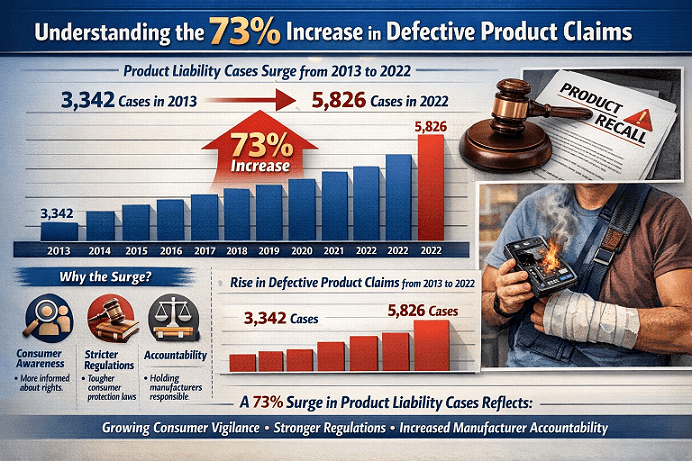
Understanding the 73% Increase in Defective Product Claims
The landscape of consumer safety and product accountability has undergone a dramatic transformation over the past decade. Between 2013 and 2022, product liability cases surged by an astounding 73%, reflecting a fundamental shift in how consumers, courts, and legal systems approach defective products. This significant increase—from approximately 3,342 cases filed in 2013 to 5,826 cases in 2022—signals more than just a numerical uptick. It represents a growing awareness among consumers about their rights, an evolving legal landscape that favors consumer protection, and an increased willingness to hold manufacturers accountable for the products they put into the marketplace.
Understanding the Foundation of Product Liability Law
Product liability law exists to protect consumers from harm caused by defective or dangerous products. At its core, this area of law holds manufacturers, distributors, retailers, and others in the supply chain responsible when their products cause injury or damage. Unlike traditional negligence claims that require proving fault, most product liability cases operate under strict liability principles. This means that a company can be held responsible for damages caused by its products regardless of how careful they were during manufacturing or how much attention they paid to quality control.
The fundamental premise is straightforward: when you purchase a product, you have a reasonable expectation that it will be safe for its intended use. When that expectation is violated and harm results, the law provides a pathway for compensation and accountability. This legal framework serves dual purposes—it compensates injured parties for their losses while simultaneously incentivizing manufacturers to prioritize safety in product design, manufacturing, and marketing.
The Three Categories of Product Defects
Product liability claims typically fall into three distinct categories, each addressing different points in a product’s lifecycle where things can go wrong.
Design Defects
Design defects are inherent flaws built into a product’s blueprint before manufacturing even begins. These defects affect every unit produced according to that design, making the entire product line potentially dangerous. A classic example would be a vehicle model with a high center of gravity that makes it prone to rollovers during normal driving conditions, or a children’s toy designed with small detachable parts that pose choking hazards.
In design defect cases, plaintiffs must typically demonstrate that the product was unreasonably dangerous due to its design and that a safer alternative design was both technologically and economically feasible at the time of manufacturing. Many states apply a risk-utility test, weighing whether the risks associated with the product’s design outweigh its benefits. If a safer design could have been implemented without significantly increasing costs or reducing functionality, manufacturers may be held liable.
Manufacturing Defects
Manufacturing defects occur during the production process when a product deviates from its intended design specifications. Unlike design defects that affect all units, manufacturing defects typically impact only specific items or batches. Perhaps a machine malfunctioned during assembly, or contamination occurred during production—these errors create products that don’t conform to the manufacturer’s own standards.
A pharmaceutical example illustrates this well: if a bottle of cough syrup accidentally contains cleaning solvent that dripped into it during manufacturing, that’s a clear manufacturing defect. The product wasn’t designed to be dangerous, but an error in the production process made it so. Manufacturing defect cases often require scrutinizing the production process, inspecting the specific item in question, and determining how it deviates from the intended design.
Marketing Defects and Failure to Warn
Marketing defects, also known as “failure to warn” claims, involve situations where a product is properly designed and correctly manufactured but lacks adequate warnings, instructions, or safety information. Manufacturers have a legal duty to warn consumers about known hazards associated with foreseeable uses of their products and to provide proper usage instructions.
These claims often involve dangers that aren’t obvious to users or products requiring special precautions. For instance, a powerful cleaning chemical sold without warnings that it releases toxic fumes when mixed with other common household products represents a marketing defect. Similarly, prescription drugs that don’t adequately warn consumers about serious side effects or contraindications can be subject to failure-to-warn claims.
The key legal question in these cases often centers on whether the danger was obvious to consumers, whether adequate warnings were provided, and whether those warnings were clear and prominently displayed. Manufacturers also have an ongoing duty to conduct research and testing to uncover product flaws, meaning they can be held responsible for failing to warn about defects that were unknown but should have been discovered.
Factors Driving the 73% Increase
Several interconnected factors have contributed to the dramatic rise in product liability cases over the past decade.
Heightened Consumer Awareness
Modern consumers are far more informed about their rights than ever before. The proliferation of online information, consumer advocacy groups, and media coverage of high-profile product defect cases has educated the public about when they might have valid claims. Social media platforms allow injured consumers to quickly share their experiences, often leading to the discovery that others have suffered similar harm from the same product. This collective awareness frequently translates into legal action.
Evolving Regulatory Standards
Safety regulations have become more stringent across numerous industries. The Consumer Product Safety Commission and other regulatory agencies have enhanced their oversight, issued more frequent recalls, and established stricter safety requirements. When products fail to meet these heightened standards and cause harm, the regulatory violations often strengthen product liability claims. Companies are increasingly held to higher benchmarks, and failure to meet them carries greater legal consequences.
Advances in Medical and Scientific Understanding
Our growing understanding of how products can cause long-term health effects has opened new avenues for litigation. Conditions once attributed to natural causes or unknown factors can now be linked to specific product exposures. The connection between certain chemicals and cancer, between pharmaceutical drugs and unexpected side effects, between medical devices and systemic health problems—these scientific advances enable plaintiffs to establish causation more effectively than in previous decades.
Litigation Funding and Legal Resources
The rise of litigation funding has made it financially feasible for more consumers to pursue product liability claims. Third-party funding allows plaintiffs to afford expert witnesses, extensive discovery, and prolonged litigation against well-funded corporate defendants. In 2021 alone, 2.8 billion dollars was spent on litigation funding, and that figure has continued to grow. This financial backing levels the playing field, enabling injured consumers to pursue legitimate claims they might otherwise have abandoned due to cost concerns.
Mass Tort and Class Action Mechanisms
The legal system has become more efficient at handling large-scale product defect cases through multidistrict litigation and class action lawsuits. When thousands of people suffer similar injuries from the same defective product, consolidating their claims reduces duplication, streamlines proceedings, and allows victims to pool resources. These mechanisms have proven particularly effective in cases involving pharmaceutical drugs, medical devices, and consumer products with widespread distribution.
Recent High-Profile Cases Shaping the Landscape
The past few years have witnessed several landmark product liability cases that demonstrate both the scale of the problem and the legal system’s response.
Real Water Toxic Contamination
In one of the most staggering verdicts of 2025, a Las Vegas jury returned a 3 billion dollar punitive damages verdict against Real Water, a now-defunct bottled water company. The water, marketed as “the healthiest drinking water available,” was later found to contain a toxic chemical used in rocket fuel. This verdict, which adds to previous multibillion-dollar judgments against the company, brought total liability to over 11 billion dollars. Thirteen plaintiffs received over 70 million dollars in compensatory damages, with injuries ranging from severe liver damage to devastating autoimmune conditions.
Monsanto PCB Exposure Cases
Monsanto has faced continuous litigation over polychlorinated biphenyls contamination, with one 2025 trial resulting in substantial damages after a jury found the company knowingly sold dangerous products without adequate warnings. Nearly 200 individuals have linked health conditions to chemical exposure at a single contaminated site, with additional trials scheduled through 2026. The company’s existing liability has exceeded 1.1 billion dollars, and that figure continues to climb.
Ford Roof Crush Litigation
A 1.7 billion dollar punitive verdict against Ford in 2022, followed by subsequent judgments, has highlighted the automotive industry’s struggles with design defects. The cases centered on allegations that Ford knew about weak roofs on its Super Duty trucks for decades but failed to implement improvements until 2017. The litigation revealed that the company allegedly resisted stronger roof designs and lobbied against stricter safety regulations, underscoring how corporate decision-making can prioritize profits over consumer safety.
Social Media Adolescent Addiction Cases
A rapidly growing multidistrict litigation has consolidated claims that major social media platforms designed their products to be addictive and failed to adequately warn about mental health risks to minors. As of mid-2025, nearly 2,000 actions were pending, with bellwether trials selected to shape potential settlements. These cases represent an emerging category of product liability that extends beyond physical products to digital platforms and services.
GLP-1 Receptor Agonist Medications
Litigation surrounding medications like Ozempic and Wegovy has exploded, with over 2,000 pending actions as of mid-2025. These cases involve allegations of inadequate warnings about serious side effects, particularly vision loss and gastrointestinal complications. The litigation demonstrates how quickly cases can accumulate when a widely-used product’s hidden dangers become apparent.
Economic Impact and Settlement Trends
The financial stakes in product liability cases have reached unprecedented levels. According to data from recent cases, average personal injury settlements have climbed to approximately 55,000 dollars, but that figure masks the enormous variation across case types. Medical malpractice claims average around 242,000 dollars, while catastrophic injury cases involving defective products can result in multimillion-dollar settlements or jury awards.
The US Chamber of Commerce reports that from 2013 to 2022, product, automotive, and medical liability cases accounted for two-thirds of all nuclear verdicts—awards exceeding 10 million dollars—with median verdicts reaching 21 million dollars. For product liability cases specifically, there was a 50 percent increase in such massive awards during this period.
Several factors contribute to rising settlement values. Inflation has driven up medical costs, lost wages, and other economic damages. Juries have become more willing to award substantial compensation for pain and suffering. Expert witnesses can now more effectively quantify long-term care needs and future damages. Perhaps most significantly, the evidence of corporate knowledge about product defects—often revealed through discovery—has made juries more inclined to punish companies with large punitive damage awards.
Statistics reveal telling patterns about the value of legal representation in these cases. Individuals represented by attorneys receive settlements nearly three times higher than those without representation, with 91 percent of represented plaintiffs receiving settlements compared to only 51 percent of unrepresented individuals. Furthermore, 70 percent of people who rejected initial settlement offers ultimately received payouts that were 30,700 dollars higher than those first proposals.
Industry-Specific Trends
Different industries have experienced varying degrees of product liability pressure.
Pharmaceutical and Medical Device Sector
This sector consistently faces the highest average settlements, reflecting both the severity of injuries and the complexity of cases. The Zantac litigation, which GSK settled for billions of dollars, the ongoing talcum powder lawsuits against Johnson & Johnson, and the Depo-Provera meningioma brain tumor cases exemplify the scale of pharmaceutical product liability. Medical device cases, particularly involving hernia mesh implants with over 24,000 pending lawsuits, demonstrate how a single defective product can generate massive litigation.
Automotive Industry
Vehicle manufacturers face mounting pressure from safety advocates and regulators. Beyond the Ford roof crush cases, the industry grapples with recalls affecting millions of vehicles, from Takata airbag defects to Tesla Autopilot concerns. The automotive sector’s challenge lies in the complexity of modern vehicles—thousands of components from hundreds of suppliers—creating numerous potential failure points.
Consumer Products
Everyday items from lithium-ion batteries to household appliances have generated substantial litigation. A December 2024 recall affecting over 63,000 lithium-ion batteries sparked class action lawsuits highlighting the dangers of energy storage devices. Consumer product cases often result in both individual lawsuits and broader class actions when design or manufacturing defects affect large numbers of people.
Food and Beverage Industry
Contamination cases, allergen failures, and inadequate labeling have created a steady stream of food product liability claims. The Real Water case represents an extreme example, but more routine cases involving foodborne illness, undisclosed allergens, or contaminated products continue to populate court dockets.
What This Means for Injured Consumers
The surge in product liability cases has created both opportunities and challenges for injured consumers seeking accountability and compensation.
Understanding Your Rights
Consumers harmed by defective products have several fundamental rights. You have the right to expect that products will be reasonably safe for their intended use. You have the right to receive adequate warnings about potential dangers. You have the right to seek compensation for injuries caused by defective products, including medical expenses, lost wages, pain and suffering, and in some cases, punitive damages designed to punish particularly egregious corporate conduct.
Most states impose strict liability for product defects, meaning you don’t need to prove the manufacturer was negligent—only that the product was defective and that defect caused your injury. This legal framework significantly reduces the burden on injured consumers compared to traditional negligence claims.
Steps to Take After a Product-Related Injury
If you’ve been injured by a potentially defective product, several immediate actions can strengthen any future legal claim. First and foremost, seek medical attention. Your health takes priority, and medical records create essential documentation of your injuries and their severity.
Preserve the defective product and all related materials, including packaging, receipts, instructions, and warranty information. Do not repair, modify, or discard the product, as it serves as critical evidence. Take photographs of the product, your injuries, and the accident scene if applicable.
Document everything related to the incident. Write down what happened, when it occurred, who witnessed it, and what injuries resulted. Keep records of all medical treatments, expenses, and how the injury has affected your daily life and ability to work.
Report the incident to appropriate authorities. The Consumer Product Safety Commission maintains a database of consumer complaints and can investigate serious safety issues. Your report may contribute to recalls or regulatory action that protects others.
The Importance of Legal Representation
Product liability cases are among the most complex areas of personal injury law. They require extensive investigation, expert testimony, technical knowledge about products and manufacturing processes, and the resources to sustain litigation against large corporations with sophisticated legal teams. The statistics are clear: attorneys help their clients recover significantly more compensation and are far more likely to secure favorable outcomes.
Experienced product liability attorneys understand how to identify the type of defect involved, determine all potentially liable parties, gather and preserve critical evidence, retain appropriate expert witnesses, navigate complex procedural requirements, and counter the defense tactics commonly employed by manufacturers and their insurers.
Time Limitations Matter
Every state imposes statutes of limitations that restrict how long you have to file a product liability lawsuit. These deadlines vary by jurisdiction but typically range from two to four years from the date of injury or discovery of the defect. Some states have additional limitations based on the product’s “usual safe life.” Florida, for instance, recently shortened its statute of limitations to two years for most personal injury claims, leaving injured consumers with less time to evaluate their cases and file suit.
Missing these deadlines can permanently bar your claim, regardless of how serious your injuries or how clear the defect. Certain exceptions exist for injuries that weren’t immediately apparent, but the general rule emphasizes the importance of prompt action. Don’t delay consulting an attorney if you believe you’ve been injured by a defective product.
The Future of Product Liability
Several emerging trends will likely shape product liability litigation in coming years.
Technology and Complexity
As products become more technologically sophisticated—incorporating software, artificial intelligence, connectivity, and autonomous features—determining defects and assigning liability grows more challenging. Who is responsible when an autonomous vehicle’s algorithm makes a split-second decision that results in injury? How do courts evaluate whether medical devices utilizing machine learning met appropriate standards of care? These questions will generate novel legal theories and significant litigation.
Global Supply Chains
Modern products often involve components from dozens or hundreds of suppliers across multiple countries. Tracing defects to their source and identifying responsible parties becomes exponentially more difficult in this environment. Courts continue wrestling with questions of jurisdiction, particularly when manufacturers are based overseas.
Regulatory Evolution
Federal and state agencies regularly update safety standards and regulatory requirements. Companies must adapt to changing expectations while courts determine whether regulatory compliance shields manufacturers from liability or simply establishes a minimum standard. The interaction between regulatory frameworks and common law product liability will remain a dynamic area of legal development.
Data and Evidence
Modern products generate enormous amounts of data—from vehicle telematics to medical device monitoring to user behavior tracking. This data creates powerful evidence in product liability cases but also raises questions about access, privacy, and interpretation. Plaintiffs increasingly rely on forensic analysis of electronic data to prove defects and establish causation.
The 73 percent increase in product liability cases from 2013 to 2022 reflects far more than a litigation trend—it represents a fundamental shift in consumer empowerment, corporate accountability, and legal recognition that manufacturers bear responsibility for the safety of products they bring to market. This surge signals heightened awareness among consumers about their rights, improved access to legal resources, better scientific understanding of how products cause harm, and a legal system increasingly willing to hold corporations accountable for prioritizing profits over safety.
For consumers, this environment means greater protection and stronger legal remedies when defective products cause harm. The substantial verdicts and settlements achieved in recent years demonstrate that courts and juries take product safety seriously and are prepared to impose meaningful consequences on manufacturers who fail to meet their obligations.
However, these same trends underscore the critical importance of vigilance. Not every product that causes injury is legally defective, and not every injury entitles you to compensation. Product liability law involves complex legal standards, technical evidence, and sophisticated defense strategies. If you believe you’ve been injured by a defective product, consulting an experienced attorney promptly provides the best opportunity to protect your rights and pursue the compensation you deserve.
The landscape of product liability continues evolving, driven by technological advances, changing consumer expectations, and emerging understandings of product safety. What remains constant is the fundamental principle that when manufacturers place products in the marketplace, they accept responsibility for ensuring those products are reasonably safe—and when they fail in that duty, the law provides recourse for those harmed as a result.