Understanding the $10,000 to $500,000 Range
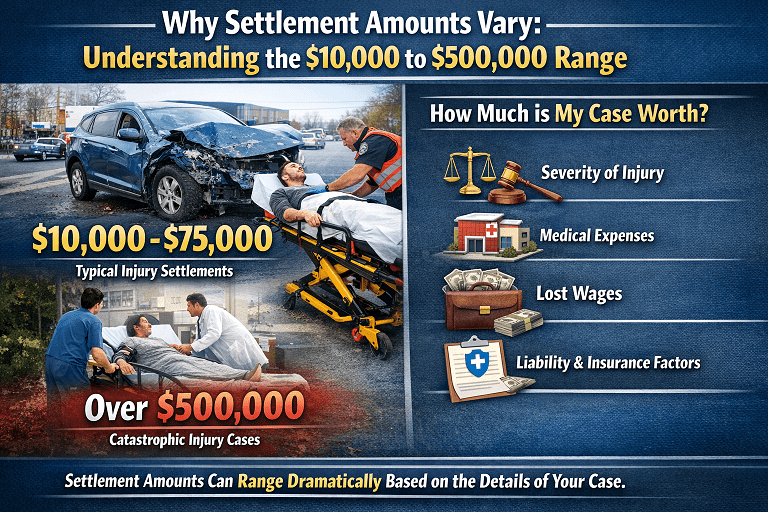
When someone suffers a personal injury due to another party’s negligence, one of the first questions that comes to mind is: “How much is my case worth?” The answer is rarely straightforward. Personal injury settlements typically range between $10,000 to over $75,000, with catastrophic injury cases resulting in significantly higher compensation that can reach or exceed $500,000. Understanding why these amounts vary so dramatically is essential for anyone navigating the personal injury claims process.
The Foundation: What Determines Settlement Value
Personal injury settlements aren’t arbitrary numbers pulled from thin air. They’re calculated based on a complex interplay of factors that reflect the true cost of an injury to the victim’s life. At the core of every settlement calculation are two primary categories of damages: economic and non-economic losses.
Economic damages represent the tangible, calculable costs associated with an injury. These include medical expenses, lost wages, future medical care, rehabilitation costs, and any modifications needed to a home or vehicle to accommodate a disability. These figures can be documented with bills, pay stubs, and expert testimony, making them relatively straightforward to quantify.
Non-economic damages, however, are more subjective. These encompass pain and suffering, emotional distress, loss of enjoyment of life, and the impact on personal relationships. A broken bone that heals completely in three months will generate a very different pain and suffering calculation than a spinal cord injury that leaves someone paralyzed for life. This is where settlement amounts begin to diverge significantly.
The Lower End: $10,000 to $25,000 Settlements
Cases that settle in the $10,000 to $25,000 range typically involve relatively minor injuries with complete recovery expected. These might include soft tissue injuries, minor fractures, or injuries requiring only emergency room treatment and follow-up care with a primary physician.
Consider a rear-end collision where the victim suffers whiplash. The injured party visits the emergency room, undergoes X-rays, receives a diagnosis of cervical strain, and completes six weeks of physical therapy. Their medical bills total $8,000, they miss one week of work losing $1,200 in wages, and they experience moderate pain that gradually subsides. A settlement in the $15,000 to $20,000 range would be reasonable, covering medical expenses, lost wages, and providing compensation for pain and suffering.
These cases settle relatively quickly because the damages are limited, the recovery is straightforward, and the insurance company recognizes that fighting the claim would cost more in legal fees than settling. The victim can return to their normal life without permanent limitations, and while the experience was certainly unpleasant and disruptive, the long-term impact is minimal.
The Middle Range: $25,000 to $100,000 Settlements
As we move into the $25,000 to $100,000 range, we encounter injuries that are more severe and have lasting consequences. These cases might involve broken bones requiring surgery, herniated discs, significant scarring, or injuries requiring months of recovery and rehabilitation.
Take the example of a pedestrian struck by a vehicle who suffers a fractured femur requiring surgical intervention with metal rods and screws. The victim undergoes surgery, spends several days hospitalized, requires extensive physical therapy over six months, and experiences permanent hardware in their leg. They miss three months of work, endure significant pain during recovery, and may have a permanent limp or ongoing discomfort.
The medical bills alone might reach $45,000 to $60,000 when accounting for emergency treatment, surgery, hospital stays, follow-up appointments, physical therapy, and medications. Lost wages could add another $15,000 to $25,000. The pain and suffering component increases substantially because the injury significantly disrupted the victim’s life for an extended period and left them with permanent changes to their body.
These cases also involve more complexity in terms of liability, medical causation, and future prognosis. Insurance companies scrutinize them more carefully, and settlement negotiations often require detailed medical records, expert opinions, and skilled legal representation to achieve fair compensation.
Factors That Elevate Settlement Values
Several critical factors can push a settlement from the middle range into six-figure territory, even for injuries that might not initially seem catastrophic. Understanding these factors helps explain why two seemingly similar injuries might settle for vastly different amounts.
Permanent Impairment and Disability: When an injury results in permanent limitations, the settlement must account for a lifetime of impact. A 30-year-old who loses full use of their dominant hand faces decades of reduced earning capacity, ongoing medical treatment, and daily challenges that a 65-year-old with the same injury might not face to the same degree. The younger victim’s settlement will reflect these extended consequences.
Future Medical Expenses: Some injuries require ongoing medical care for years or even a lifetime. Traumatic brain injuries might necessitate cognitive therapy, pain management, and monitoring for decades. Spinal injuries could require multiple future surgeries, regular pain management interventions, and assistive devices. Calculating these future costs requires expert testimony from medical professionals and life care planners, and these projections can add hundreds of thousands of dollars to a settlement demand.
Lost Earning Capacity: Beyond immediate lost wages, serious injuries can permanently affect someone’s ability to earn income. A construction worker who suffers a severe back injury might never return to manual labor, forcing a career change to lower-paying work. A surgeon who loses fine motor control in their hands might be unable to practice medicine. These losses extend throughout a person’s entire working life and retirement, representing substantial economic damages.
Severity of Defendant’s Conduct: When a defendant’s actions were particularly reckless or egregious, settlements increase. A drunk driver who causes an accident will likely face higher settlement demands than someone who made an honest mistake. In cases involving gross negligence, punitive damages might come into play, though these are more commonly awarded through verdicts than settlements.
The High End: $100,000 to $500,000+ Settlements
Catastrophic injury cases occupy the upper echelon of personal injury settlements. These involve life-altering injuries such as severe traumatic brain injuries, spinal cord injuries resulting in paralysis, amputations, severe burns covering large portions of the body, or injuries causing permanent disfigurement or disability.
Consider a motorcyclist struck by a distracted driver who runs a red light. The victim suffers a traumatic brain injury, multiple fractures, and internal injuries requiring months of hospitalization. After stabilization, they require inpatient rehabilitation for cognitive and physical therapy. Despite extensive treatment, they’re left with permanent cognitive deficits affecting memory and executive function, making it impossible to return to their previous career as an engineer.
The economic damages alone in such a case are staggering. Initial hospitalization and surgery might cost $200,000 to $300,000. Rehabilitation adds another $100,000. A life care plan projects future medical needs at $2 million over the victim’s lifetime. Lost earning capacity, calculated by comparing their engineering salary to what they can now earn in modified employment, might total $1.5 million to $2 million over their working life.
Non-economic damages in catastrophic cases reflect the profound impact on quality of life. The victim may struggle with basic daily activities, require assistance with personal care, experience chronic pain, suffer from depression and anxiety related to their injuries, and lose the ability to enjoy hobbies and activities that once defined their life. These losses are immeasurable but must be translated into compensation.
In cases with clear liability and catastrophic injuries, settlements can reach or exceed $500,000, and verdicts at trial can climb into the millions. Insurance policy limits often come into play, as even commercial policies might cap out at $1 million or $2 million, potentially leaving victims undercompensated unless multiple insurance policies or defendant assets can be accessed.
The Role of Insurance Policy Limits
One crucial factor that many people overlook when considering settlement ranges is insurance policy limits. No matter how severe your injuries or how clear the defendant’s liability, you generally cannot recover more than the available insurance coverage unless you can successfully pursue the defendant’s personal assets.
Most individual auto insurance policies carry liability limits of $25,000 to $100,000 per person, though some states require minimum coverage as low as $15,000. This means that even if your damages total $300,000, if the at-fault driver carries only the state minimum coverage of $25,000, that might be the maximum you can recover unless the driver has significant personal assets or you carry underinsured motorist coverage on your own policy.
Commercial vehicles, businesses, and property owners typically carry higher liability limits, ranging from $500,000 to several million dollars. This is one reason why cases involving commercial defendants often settle for higher amounts—the insurance coverage exists to compensate more severe injuries.
Savvy personal injury attorneys investigate all available insurance policies early in the claims process. Multiple policies might apply: the at-fault driver’s auto insurance, their umbrella policy, their homeowner’s insurance if the incident occurred on their property, and the victim’s underinsured or uninsured motorist coverage. Identifying all potential sources of recovery can mean the difference between a $50,000 settlement and a $200,000 settlement.
Medical Treatment and Documentation
The extent and quality of medical treatment significantly impact settlement values. Insurance companies are inherently skeptical; they look for reasons to minimize claims. Consistent, appropriate medical treatment from the time of injury through recovery provides the documentation needed to justify settlement demands.
Someone who delays seeking treatment, has gaps in their medical care, or fails to follow doctor’s recommendations gives the insurance company ammunition to argue that the injuries weren’t serious or weren’t caused by the accident. Conversely, someone who seeks immediate treatment, follows all medical advice, attends all therapy sessions, and thoroughly documents their symptoms and limitations builds a strong foundation for their claim.
The type of medical providers involved also matters. Treatment from specialists—orthopedic surgeons, neurologists, pain management physicians—carries more weight than treatment solely from a general practitioner. Diagnostic imaging showing objective evidence of injury (fractures, herniated discs, ligament tears) is more compelling than subjective complaints of pain without corresponding medical findings.
This doesn’t mean people should seek unnecessary treatment to inflate their settlements. Quite the opposite—insurance companies and their lawyers are skilled at identifying excessive or inappropriate treatment. The key is receiving the treatment you genuinely need and documenting how the injury has affected your life through consistent medical care and honest reporting of symptoms.
Geographic Variations in Settlement Values
Where an accident occurs significantly influences settlement values. Personal injury awards and settlements vary considerably across different jurisdictions due to differences in jury attitudes, cost of living, state laws, and local legal culture.
Urban areas with higher costs of living typically see higher settlement values than rural areas. A case worth $100,000 in Los Angeles might settle for $60,000 in a small town in rural America, reflecting differences in wage loss calculations, medical costs, and jury expectations. Some jurisdictions are known as plaintiff-friendly, where juries regularly award substantial damages, while others are more conservative in their awards.
State laws also create variations. Some states cap non-economic damages in personal injury cases, limiting pain and suffering awards to specific amounts regardless of injury severity. Others allow full compensation for all damages. Some states apply pure comparative negligence, where you can recover damages even if you’re 99 percent at fault, while others bar recovery if you’re more than 50 percent at fault.
These geographic and legal variations mean that identical injuries might settle for dramatically different amounts depending on where the accident occurred and where the case would be tried if it doesn’t settle.
The Negotiation Process and Timing
Settlement values aren’t static numbers determined at the outset of a case. They evolve through investigation, medical treatment, and negotiation. The timing of settlement attempts significantly affects the amount offered and accepted.
Early settlement offers are typically lower because the full extent of injuries and long-term prognosis aren’t yet known. Insurance companies make quick, low offers hoping injured parties will accept fast money rather than wait for full compensation. These initial offers rarely reflect fair value.
As medical treatment progresses and the injury’s full impact becomes clear, settlement values increase. Once the victim reaches maximum medical improvement—the point where further significant recovery is unlikely—attorneys can accurately calculate total damages and make comprehensive settlement demands.
Cases settled before litigation are typically filed often settle for less than cases where a lawsuit has been filed and discovery conducted. Once depositions occur, interrogatories are answered, and the insurance company faces the reality of trial, settlement values often increase. The company must weigh the cost of continued litigation and the risk of an unfavorable jury verdict against the cost of settling.
Strong legal representation makes a substantial difference in final settlement amounts. Studies consistently show that injured parties represented by experienced personal injury attorneys recover significantly more compensation than those who handle claims themselves, even after attorney fees are deducted.
Special Circumstances That Affect Settlements
Certain circumstances can either increase or decrease settlement values beyond the standard factors already discussed. Multiple parties being at fault can complicate settlements but might also increase total recovery if multiple insurance policies are available. Cases involving government entities face special procedural requirements and sometimes damage caps that limit recovery.
Injuries to children often result in higher settlements because courts scrutinize these cases carefully to protect the child’s interests, and the lifetime impact of an injury is magnified when the victim is young. Conversely, pre-existing injuries or conditions can reduce settlement values if the insurance company successfully argues that current symptoms relate to prior problems rather than the recent accident.
The victim’s credibility and likability also influence settlements. Insurance companies evaluate whether a plaintiff will make a sympathetic witness at trial. Someone with a criminal history, inconsistencies in their statements, or a history of previous injury claims might receive lower settlement offers than someone with a clean background and consistent story, even with identical injuries.
The Importance of Individual Case Evaluation
The vast range in personal injury settlement amounts—from $10,000 for minor injuries to $500,000 or more for catastrophic cases—reflects the equally vast range in how injuries affect people’s lives. No two cases are truly identical, even when the injuries appear similar on paper.
Understanding the factors that drive settlement values helps injured parties set realistic expectations and make informed decisions about their claims. Minor injuries with complete recovery naturally warrant lower compensation than life-altering injuries with permanent consequences. Economic losses that can be precisely calculated form the foundation of any settlement, while non-economic damages account for the human cost of injury that can’t be captured in medical bills and pay stubs.
For anyone navigating a personal injury claim, the key takeaway is that your case’s value depends on your specific circumstances: the severity and permanence of your injuries, how they’ve affected your life and earning capacity, the available insurance coverage, the strength of liability evidence, the quality of your medical documentation, and numerous other factors unique to your situation.
While this overview provides insight into how settlements are valued and why they vary so dramatically, nothing replaces a thorough evaluation by an experienced personal injury attorney who can assess your specific case, investigate all sources of recovery, and fight for the compensation you deserve. Whether your case falls at the lower end of the settlement spectrum or represents a catastrophic injury warranting maximum compensation, understanding these principles empowers you to make informed decisions about your path to recovery and justice.