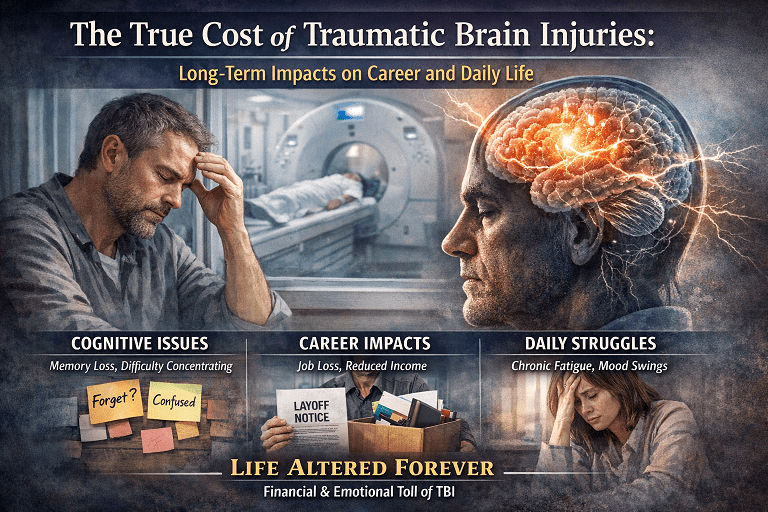
Long-Term Impacts on Career and Daily Life
Traumatic brain injuries represent one of the most devastating medical conditions a person can experience, not because of the immediate trauma alone, but because of the insidious ways they continue to affect victims long after the initial injury has healed. While broken bones mend and surgical wounds close, the brain often tells a different story. The true cost of a traumatic brain injury extends far beyond hospital bills and immediate medical expenses, reaching deep into every aspect of a person’s professional life, financial security, and daily functioning. Understanding these long-term impacts is crucial for anyone navigating the aftermath of a TBI, whether as a survivor, caregiver, or legal advocate.
The Hidden Nature of Brain Injury
Unlike visible injuries, traumatic brain injuries often leave no outward scars. A person who has suffered a TBI may look perfectly healthy, making it difficult for employers, colleagues, friends, and even family members to understand the profound changes occurring beneath the surface. This invisibility creates unique challenges in the workplace and throughout daily life, as survivors struggle to explain limitations that others cannot see.
The brain controls everything we do, from the most complex problem-solving tasks to the simplest automatic functions we take for granted. When the brain is injured, the ripple effects touch every aspect of human experience. Cognitive functions that once felt effortless become exhausting challenges. Processing information takes longer. Memory becomes unreliable. Concentration wavers. Emotional regulation becomes difficult. These changes don’t just affect a person’s ability to work—they fundamentally alter their relationship with themselves and the world around them.
Cognitive Impairments and Their Impact on Employment
The cognitive impairments resulting from traumatic brain injuries vary widely depending on the severity and location of the injury, but certain patterns emerge frequently among TBI survivors. These impairments create significant barriers to employment and career advancement, often forcing individuals to completely reimagine their professional futures.
Executive Function Deficits
Executive functions encompass the higher-order cognitive processes that allow us to plan, organize, prioritize, and execute complex tasks. After a TBI, many survivors find these abilities severely compromised. A project manager who once juggled multiple deadlines effortlessly may now struggle to create a simple task list. An accountant who processed financial data with ease might find themselves unable to move through multi-step calculations without losing track of their progress.
These deficits manifest in workplace scenarios in countless ways. Meetings become overwhelming as survivors struggle to follow rapid conversations involving multiple speakers. Written reports that once took an hour to complete now require an entire day, with frequent breaks needed to manage mental fatigue. Decision-making, especially under time pressure, becomes paralyzing rather than energizing.
Memory Impairment
Memory problems rank among the most common and most frustrating complications of traumatic brain injury. Short-term memory deficits mean that information shared in a morning meeting may completely disappear by afternoon. Survivors may need to write down every instruction, every deadline, every commitment, and even then may struggle to find their notes or remember that they made them.
For professionals whose careers depend on remembering client details, technical specifications, or procedural knowledge, these memory impairments can be career-ending. A salesperson who cannot remember customer preferences or conversation history loses credibility and effectiveness. A healthcare worker who struggles to retain new protocols puts patient safety at risk. The constant awareness of these memory failures also creates anxiety that further impairs performance, creating a vicious cycle of stress and cognitive difficulty.
Processing Speed Reduction
One of the most significant yet least understood impacts of TBI is the slowing of cognitive processing speed. Survivors often describe feeling like they’re “thinking through fog” or “moving in slow motion” mentally while the world around them continues at normal pace. This slowdown affects virtually every workplace task.
Reading comprehension suffers as the brain requires more time to process and integrate written information. Conversations become difficult to follow, especially in group settings where multiple people contribute rapidly. Tasks that involve switching between different types of activities or responding to interruptions become exponentially more challenging. For many TBI survivors, the gap between their pre-injury processing speed and their current abilities represents one of the most profound losses they experience.
Attention and Concentration Challenges
Sustained attention becomes remarkably difficult after a traumatic brain injury. The ability to focus on a single task for extended periods—a fundamental requirement in most professional settings—may be severely limited. Survivors might manage only 15 to 20 minutes of concentrated work before needing a break, compared to the hours of sustained focus they enjoyed pre-injury.
Distractions that others easily filter out become impossible to ignore. The hum of fluorescent lights, conversations in adjacent cubicles, or notifications from digital devices can completely derail a TBI survivor’s concentration. Open office environments, increasingly common in modern workplaces, can be particularly challenging for individuals with attention deficits following brain injury.
The Cascade Effect on Career Trajectory
The cognitive impairments caused by TBI don’t exist in isolation—they interact and compound to create overwhelming obstacles to career success and advancement. Many survivors find themselves facing difficult choices about their professional futures.
Some individuals can return to their previous positions but find themselves unable to advance. The promotions they once seemed destined for become unreachable as their performance reviews reflect new limitations. Others must accept demotions or lateral moves to positions with reduced cognitive demands and correspondingly reduced compensation. For some, remaining in their field becomes impossible, necessitating complete career changes into entirely different industries or roles.
The psychological impact of these career setbacks cannot be overstated. Professional identity forms a core component of how many people understand themselves. Engineers who can no longer engineer, teachers who can no longer teach, attorneys who can no longer practice law—these individuals face not just financial losses but profound identity crises. The grief associated with losing one’s career can be as devastating as the brain injury itself.
Young professionals face particularly challenging situations. A TBI sustained in one’s twenties or thirties doesn’t just affect current earning capacity—it eliminates decades of potential career growth, advancement, and increasing compensation. The ambitious young professional on track for leadership roles may instead face a lifetime of entry-level positions or unemployment.
The Critical Importance of Workplace Accommodations
The Americans with Disabilities Act recognizes traumatic brain injury as a qualifying disability, entitling survivors to reasonable workplace accommodations. However, securing these accommodations and ensuring they adequately address TBI-related limitations requires understanding, persistence, and often advocacy.
Essential Accommodations for TBI Survivors
Effective accommodations for traumatic brain injury survivors must address the specific cognitive deficits affecting their work performance. Flexible scheduling ranks among the most important accommodations, allowing survivors to work during their peak cognitive hours and take breaks as needed to manage fatigue. Many TBI survivors find their cognitive functioning deteriorates significantly as the day progresses, making traditional eight-hour workdays impossible to sustain.
Environmental modifications can dramatically improve a TBI survivor’s ability to function in the workplace. Private offices or cubicles with high walls reduce distracting stimuli. Noise-canceling headphones, adjusted lighting, and elimination of fluorescent bulbs can create an environment where concentration becomes possible. Some survivors benefit from working remotely, either full-time or partially, eliminating commute-related fatigue and providing complete control over their work environment.
Written communication accommodations prove essential for many survivors. Receiving instructions, assignments, and feedback in writing rather than verbally ensures that memory deficits don’t result in missed deadlines or misunderstood expectations. Additional time for assignments, projects, and responses recognizes the slower processing speed many survivors experience. Assistive technology, including speech-to-text software, organizational apps, and reminder systems, can help compensate for memory and executive function deficits.
The Challenge of Disclosure
One significant barrier many TBI survivors face regarding accommodations is the decision whether to disclose their injury and resulting limitations to employers. The invisible nature of brain injury creates a double bind: without disclosure, accommodations cannot be requested, but disclosure risks discrimination, stigma, and diminished career opportunities.
Some survivors worry that employers will question their competence or reliability if they reveal cognitive limitations. Others fear that disclosure will mark them as problems or liabilities, making them first in line for layoffs or last in consideration for advancement opportunities. These fears are not unfounded—disability discrimination remains a persistent problem despite legal protections.
The timing and manner of disclosure require careful consideration. Some survivors advocate for immediate transparency, believing that open communication allows for better problem-solving and reduces stress. Others prefer to establish their value and competence before disclosing, hoping that demonstrated performance will insulate them from discrimination. There is no universally correct approach, and survivors must weigh their specific circumstances, workplace culture, and the severity of their limitations.
Calculating Future Lost Earning Capacity
When traumatic brain injury results from another party’s negligence, calculating future lost earning capacity becomes crucial for ensuring adequate compensation. This calculation represents one of the most complex aspects of TBI litigation, requiring expertise from vocational experts, economists, and medical professionals.
Components of Lost Earning Capacity
Future lost earning capacity encompasses multiple elements beyond simple salary comparison. The most obvious component is the difference between what the survivor would have earned in their pre-injury career trajectory and what they can now earn given their limitations. This calculation must account for expected promotions, raises, bonuses, and other compensation increases that would have occurred absent the injury.
Benefits constitute another significant component often overlooked in simplistic calculations. Employer-provided health insurance, retirement contributions, stock options, and other benefits represent substantial value. A survivor who must accept a position with inferior benefits or none at all experiences losses that extend far beyond their base salary reduction.
Work-life expectancy factors into these calculations as well. Someone injured at age 30 faces decades of lost earning capacity compared to someone injured at age 60. However, TBI survivors often face shortened work-life expectancies due to their injuries. The cognitive demands of work combined with the fatigue and other symptoms of TBI may force earlier retirement than would otherwise have occurred.
Vocational Expert Assessments
Vocational experts play an essential role in quantifying lost earning capacity following traumatic brain injury. These professionals evaluate the survivor’s pre-injury employment history, education, skills, and career trajectory, then compare this baseline to their post-injury capabilities based on medical evidence, cognitive testing, and functional assessments.
The vocational expert considers transferable skills—abilities from the survivor’s previous career that might apply to alternative employment. However, TBI often impairs precisely the higher-order cognitive functions that enable skill transfer and adaptation to new roles. A survivor may possess technical knowledge but lack the cognitive flexibility to apply it in new contexts.
Labor market analysis forms another component of vocational assessment. The expert examines available positions the survivor could potentially perform given their limitations, evaluating factors like job availability in the survivor’s geographic area, typical compensation ranges, educational and experience requirements, and the competitive job market realities facing someone with cognitive impairments.
Economic Damage Calculations
Economists translate vocational assessments into concrete financial figures, calculating the present value of future lost earnings. These calculations account for multiple variables including expected wage growth, inflation, employment trends in relevant industries, and the time value of money.
The economist must also consider economic contingencies—factors that might have affected earnings independent of the injury. Would the survivor have faced layoffs in a declining industry? Might they have changed careers for personal reasons? While defense attorneys often emphasize these contingencies to reduce damage awards, plaintiffs’ economists demonstrate how traumatic brain injury eliminates flexibility and options, making career changes impossible rather than voluntary.
Fringe benefits require separate calculation, as their value extends beyond simple percentages of salary. Health insurance value varies based on family size and coverage quality. Retirement contributions compound over time, meaning losses in one year affect retirement security exponentially. These calculations quickly reveal that lost earning capacity represents far more than the difference between two salary figures.
Daily Life Beyond the Workplace
The impact of traumatic brain injury extends far beyond professional settings, affecting every aspect of daily life in ways that often prove more devastating than career losses. These impacts, while harder to quantify financially, significantly diminish quality of life and create ongoing costs that persist indefinitely.
Household management becomes exponentially more difficult for TBI survivors. Tasks like meal planning, grocery shopping, cooking, cleaning, and home maintenance—activities that once occurred almost automatically—now require conscious effort and careful planning. Many survivors require assistance with these activities, either from family members who sacrifice their own time and opportunities to provide care, or from paid professionals whose services represent ongoing expenses.
Social relationships suffer as cognitive and emotional changes make maintaining friendships and family connections more challenging. Fatigue limits social activities. Communication difficulties strain conversations. Emotional regulation problems can lead to conflicts and misunderstandings. Many TBI survivors experience profound loneliness as their social circles shrink, unable to understand why the person cannot just try harder or be more like their old self.
Leisure activities and hobbies that once provided joy and relaxation may become impossible. Reading, a simple pleasure for many, can become frustrating when concentration wavers and comprehension suffers. Hobbies requiring fine motor skills, complex reasoning, or sustained attention may be abandoned. The loss of these activities represents another dimension of diminished life quality that deserves recognition in understanding the true cost of traumatic brain injury.
The Reality of Living with Invisible Disability
Perhaps the most challenging aspect of life after traumatic brain injury is navigating a world that cannot see your limitations. TBI survivors frequently encounter skepticism, misunderstanding, and accusations of exaggeration or malingering. Well-meaning friends suggest they just need to think more positively. Employers question whether accommodations are truly necessary. Even family members may grow frustrated, unable to reconcile the person’s unchanged appearance with their dramatically altered abilities.
This invisibility creates constant stress as survivors must repeatedly explain and justify their limitations. The cognitive effort required for these explanations itself becomes exhausting, further depleting limited mental resources. Many survivors report that managing others’ perceptions and expectations becomes as challenging as managing their actual symptoms.
The true cost of traumatic brain injury encompasses immediate medical expenses, ongoing treatment costs, lost wages, and reduced earning capacity, but it also includes immeasurable losses in quality of life, relationships, independence, and sense of self. Recognizing these multidimensional impacts is essential for ensuring that TBI survivors receive adequate compensation and support to rebuild meaningful lives after injury. Only by understanding the full scope of these losses can we begin to address the true cost of traumatic brain injury.