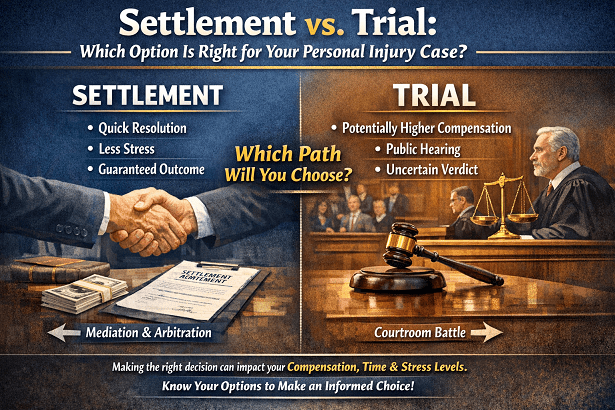
Which Option Is Right for Your Personal Injury Case?
When you’ve been injured due to someone else’s negligence, one of the most critical decisions you’ll face is whether to settle your personal injury claim or take it to trial. This choice can significantly impact not only the compensation you receive but also the time, stress, and resources you’ll invest in pursuing justice. Understanding the advantages and disadvantages of each path, including alternative dispute resolution methods like mediation and arbitration, is essential for making an informed decision that aligns with your specific circumstances and goals.
Understanding Personal Injury Settlements
A settlement occurs when the injured party (plaintiff) and the at-fault party or their insurance company (defendant) agree to resolve the claim without going to court. The plaintiff agrees to accept a specified amount of compensation in exchange for releasing the defendant from further liability related to the incident.
Settlements can occur at any stage of the legal process, from shortly after the injury occurs to even after a trial has begun. Most personal injury cases—approximately 95 percent according to various legal sources—are resolved through settlement rather than trial. This statistic alone suggests that settlement offers significant advantages in many situations.
Advantages of Settling Your Personal Injury Case
Faster Resolution and Quicker Compensation
Perhaps the most compelling advantage of settlement is speed. While timelines vary depending on case complexity, settlements typically resolve much faster than cases that go to trial. A straightforward settlement might conclude in a few months, whereas taking a case to trial can take one to three years or even longer when you factor in court schedules, motion practice, discovery, and potential appeals.
This expedited timeline means you receive compensation sooner, which can be crucial when you’re facing mounting medical bills, lost wages, and other financial pressures resulting from your injury. The ability to access funds quickly can provide immediate relief and help you move forward with your recovery and life.
Reduced Legal Costs and Expenses
Litigation is expensive. Taking a case to trial involves numerous costs beyond attorney fees, including expert witness fees, court filing fees, deposition costs, exhibit preparation, and other litigation expenses. These costs can accumulate to tens of thousands of dollars in complex cases.
When you settle, you avoid many of these expenses. While you’ll still incur costs related to investigating your claim and negotiating with the insurance company, these are generally far less than the full cost of trial preparation and courtroom proceedings. The money saved on litigation expenses means more of your settlement goes directly into your pocket.
Certainty and Reduced Risk
Settlements provide certainty. When you agree to a settlement amount, you know exactly what you’re getting. There’s no risk that a jury will award you less than expected or nothing at all. Trials, by their nature, are unpredictable. Even strong cases can result in disappointing verdicts due to factors like jury sympathy, presentation issues, or unexpected testimony.
This predictability allows you to plan your financial future with confidence. You can make decisions about medical treatment, living arrangements, or other major life choices knowing exactly what resources you’ll have available.
Privacy and Confidentiality
Settlement negotiations are private, and settlement agreements often include confidentiality clauses. This means the details of your injury, your financial compensation, and other personal information remain private. In contrast, trials are public proceedings. Court documents become part of the public record, and anyone can attend the trial to hear testimony about your injuries, medical conditions, and personal life.
For many plaintiffs, especially those dealing with sensitive injuries or circumstances, this privacy is invaluable and strongly influences their decision to settle.
Less Emotional Stress
The litigation process can be emotionally draining. Trials require you to testify publicly about traumatic events, undergo cross-examination by defense attorneys, and relive painful experiences. The uncertainty and stress of waiting for a verdict can take a significant psychological toll.
Settlement allows you to avoid this emotional ordeal. While negotiations can certainly be stressful, they’re generally far less traumatic than testifying in court and facing aggressive cross-examination.
Disadvantages of Settling Your Personal Injury Case
Potentially Lower Compensation
The most significant disadvantage of settlement is that you may receive less compensation than a jury might award at trial. Insurance companies and defendants typically offer settlements that are less than the full value of your claim because they’re avoiding their own risks and expenses associated with trial.
If your case is strong and involves significant damages, a jury might award substantially more than the settlement offer. You’re essentially trading the potential for a higher award for the certainty and other benefits that settlement provides.
No Admission of Wrongdoing
Settlements typically include language stating that the defendant doesn’t admit fault or liability. For some plaintiffs, particularly those whose injuries resulted from especially egregious conduct, the lack of public accountability and admission of wrongdoing can be dissatisfying. If holding the defendant publicly accountable is important to you beyond financial compensation, settlement may feel like an incomplete resolution.
Finality Without Appeal
Once you accept a settlement and sign a release, you cannot later change your mind if you discover your injuries are worse than initially believed or if additional damages arise. The settlement is final. While this finality provides closure, it also means you bear the risk of underestimating the long-term impact of your injuries.
This is why it’s crucial to reach maximum medical improvement—the point where your condition has stabilized and doctors can reasonably predict your long-term prognosis—before settling your claim.
Understanding Personal Injury Trials
A trial occurs when settlement negotiations fail or when a plaintiff chooses to pursue their case in court. At trial, both sides present evidence, call witnesses, and make legal arguments before a judge or jury, who then decides whether the defendant is liable and, if so, how much compensation the plaintiff should receive.
Advantages of Taking Your Case to Trial
Potential for Higher Compensation
The primary advantage of trial is the potential for a larger award. Juries, particularly in cases involving severe injuries or clear negligence, sometimes award substantial damages that exceed what insurance companies would offer in settlement. These awards can include not only economic damages like medical expenses and lost wages but also significant non-economic damages for pain and suffering.
In some cases involving particularly reckless or intentional conduct, juries may also award punitive damages designed to punish the defendant and deter similar conduct in the future. These damages are rarely available through settlement negotiations.
Public Accountability and Validation
Trial provides a public forum where the defendant’s conduct is examined, evidence is presented, and a neutral fact-finder determines fault. For many plaintiffs, having a judge or jury validate their claims and hold the defendant publicly accountable is personally important, regardless of the monetary outcome.
This public accountability can be especially meaningful in cases involving corporate negligence, defective products, or other situations where the plaintiff wants to bring attention to dangerous practices or prevent future harm to others.
Thorough Examination of Evidence
The trial process, including extensive discovery, depositions, and presentation of evidence in court, ensures that your case receives comprehensive attention. All relevant facts are examined, expert witnesses provide detailed testimony, and the full scope of your damages is presented. This thorough process can sometimes reveal additional evidence or damages that strengthen your case beyond what was initially apparent during settlement negotiations.
Precedent and Principle
Some plaintiffs pursue trials because they believe important legal principles are at stake. A favorable trial verdict can set legal precedent that helps future plaintiffs in similar situations. If you believe your case raises significant legal questions or could help others, the desire to establish precedent might outweigh the practical advantages of settlement.
Disadvantages of Taking Your Case to Trial
Time and Delay
Trials take time—often years from the initial filing to final verdict. Courts have crowded dockets, and personal injury cases often have lower priority than criminal cases. During this extended period, your life may feel like it’s on hold. You’ll need to participate in depositions, attend court hearings, and remain available for trial, which can be rescheduled multiple times.
This delay means you won’t receive compensation for your injuries and losses until the case concludes, creating financial strain if you’re unable to work or facing significant medical expenses.
High Costs
As mentioned earlier, taking a case to trial is expensive. Beyond attorney fees (which personal injury lawyers typically handle on a contingency basis), you’ll incur costs for expert witnesses who may charge thousands of dollars for their testimony, court reporters, filing fees, and exhibit preparation. These costs are typically deducted from any award you receive, reducing your net recovery.
If you lose at trial, you generally don’t recover these costs and may even be responsible for certain court costs.
Risk and Uncertainty
Trials are inherently unpredictable. Even cases that appear strong can result in unfavorable verdicts. Juries are composed of ordinary people who may misunderstand complex medical or technical evidence, be swayed by compelling defense arguments, or simply not award damages as generously as you hoped.
There’s always the possibility that you could lose entirely and receive nothing, despite the time, money, and emotional energy invested in the trial. This risk exists even in cases where liability seems clear, as juries sometimes reach unexpected conclusions.
Emotional and Psychological Toll
Testifying at trial requires you to publicly recount traumatic events, often in excruciating detail. Defense attorneys will cross-examine you, sometimes aggressively, attempting to undermine your credibility or minimize your injuries. This process can be humiliating, stressful, and emotionally exhausting.
The adversarial nature of trials can also strain relationships, particularly if family members or friends must testify. The extended duration of litigation can prevent emotional healing and closure, as you’re continually reminded of your injury throughout the process.
Even if you win at trial, the defendant can appeal the verdict, potentially adding years to the resolution of your case. During an appeal, you typically don’t receive your compensation, and there’s always the possibility that an appellate court could overturn the verdict or reduce the award, requiring a new trial or forcing you to accept less compensation than the jury awarded.
Alternative Dispute Resolution: Mediation and Arbitration
Between the extremes of settlement negotiation and full trial lie alternative dispute resolution methods, particularly mediation and arbitration. These options can provide middle-ground solutions that capture some benefits of both settlement and trial while minimizing certain disadvantages.
Mediation
Mediation involves a neutral third party—the mediator—who facilitates negotiations between you and the defendant or insurance company. The mediator doesn’t make decisions or impose outcomes but rather helps both sides communicate, understand each other’s positions, and work toward a mutually acceptable resolution.
Advantages of Mediation
Mediation is typically faster and less expensive than trial while being more structured than informal settlement negotiations. The process is confidential, allowing both sides to discuss the case candidly without fear that their statements will be used against them later. Many parties find that the mediator’s neutral perspective helps break impasses and leads to creative solutions that neither side would have proposed independently.
The voluntary nature of mediation means you retain control. If mediation doesn’t produce an acceptable agreement, you can still proceed to trial. This “no-risk” aspect makes mediation attractive—you have nothing to lose by attempting it.
Disadvantages of Mediation
Mediation requires cooperation from both sides. If the defendant or insurance company isn’t negotiating in good faith or makes unreasonable demands, mediation may be unsuccessful. Additionally, while mediators are often experienced attorneys or former judges, they’re facilitators, not decision-makers. If the parties are too far apart in their positions, even skilled mediation may not bridge the gap.
The non-binding nature of mediation, while protecting your right to trial, also means there’s no guarantee of resolution. You may invest time and the mediator’s fees without achieving settlement.
Arbitration
Arbitration is a more formal process where a neutral arbitrator (or panel of arbitrators) hears evidence and arguments from both sides and makes a binding or non-binding decision. Arbitration resembles a trial but is typically less formal, follows relaxed evidentiary rules, and occurs in a private setting rather than a courtroom.
Advantages of Arbitration
Arbitration is generally faster than trial and offers more scheduling flexibility. The process is private, avoiding the public exposure of trial. Arbitrators are often experts in relevant legal areas, potentially providing more sophisticated analysis than a jury might.
When arbitration is binding, it provides finality without the possibility of appeal (except in very limited circumstances), allowing you to receive compensation and move forward more quickly than trial would permit.
Disadvantages of Arbitration
The primary disadvantage is that binding arbitration eliminates your right to trial and limits appeals, even if you believe the arbitrator’s decision is incorrect. You’re essentially placing your case in the hands of a single person or small panel, which can feel risky.
Arbitration can also be expensive, as you typically share the cost of the arbitrator’s fees, which can run thousands of dollars per day. Additionally, arbitrators sometimes “split the baby,” awarding compensation somewhere between what each side sought rather than carefully analyzing the evidence to determine the appropriate amount.
If arbitration is required by a contract or agreement, you may have no choice but to arbitrate even if trial would be more favorable. Mandatory arbitration clauses have become controversial precisely because they can limit consumers’ and employees’ rights to pursue full legal remedies.
Making the Right Choice for Your Case
Determining whether to settle, go to trial, or pursue alternative dispute resolution depends on numerous factors specific to your situation.
Strength of Your Case
If liability is clear, your damages are well-documented, and the law strongly supports your position, you may be in a better position to demand a favorable settlement or to succeed at trial. Conversely, if liability is disputed or evidence is weak, settlement may be preferable to the risk of losing at trial.
Nature and Extent of Injuries
Severe, permanent injuries typically justify pursuing maximum compensation, potentially through trial if settlement offers are inadequate. Minor injuries with straightforward damages may be efficiently resolved through settlement without the expense and delay of trial.
Financial Circumstances
If you’re facing financial hardship due to medical bills or lost income, the quick resolution of settlement may be necessary regardless of whether trial might yield higher compensation. The ability to receive funds within months rather than years can be decisive.
Emotional Considerations
Consider honestly whether you’re prepared for the emotional demands of trial. Some individuals find testifying and confronting the defendant empowering; others find it traumatic. Your emotional wellbeing is a legitimate factor in your decision.
If the defendant’s insurance policy limits are insufficient to cover your damages, going to trial won’t result in higher compensation unless the defendant has significant personal assets. In such cases, accepting the policy limits through settlement may be practical.
Quality of Legal Representation
Your attorney’s experience and skill significantly impact trial success. An experienced trial attorney can better evaluate your case’s trial potential and effectively present your case to a jury.
The decision between settlement and trial is rarely simple. Settlement offers speed, certainty, lower costs, and reduced stress but may result in lower compensation and no public accountability. Trial offers the potential for higher awards and public validation but involves substantial risk, expense, time, and emotional toll. Alternative dispute resolution methods like mediation and arbitration can provide middle-ground solutions worth exploring.
Ultimately, this decision should be made collaboratively with your attorney, who can evaluate the specific facts of your case, the strength of available evidence, the defendant’s resources, and your personal circumstances and goals. The right choice for one person may be wrong for another, even with similar injuries.
What matters most is that you make an informed decision based on realistic expectations, thorough evaluation of your case’s strengths and weaknesses, and careful consideration of what outcome will best serve your needs—both financially and personally—as you move forward from your injury.