Special Legal Considerations
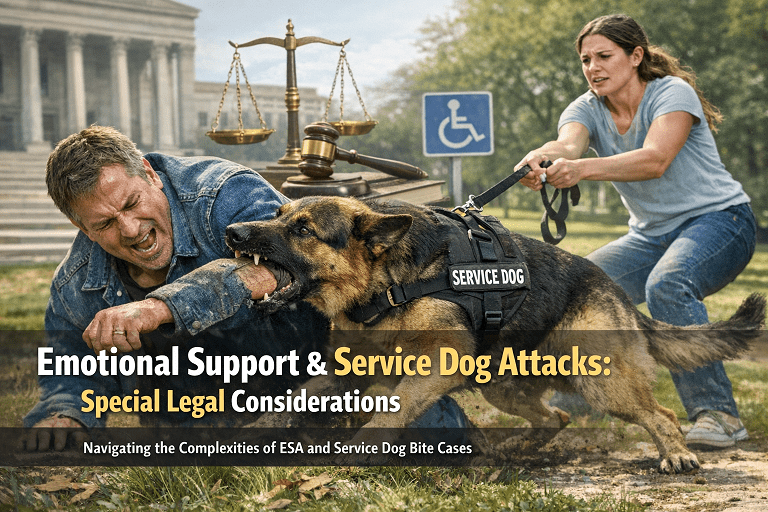
When a dog designated as a service animal or emotional support animal (ESA) attacks someone, the legal landscape becomes significantly more complex than a typical dog bite case. These situations involve the intersection of disability rights laws, animal liability statutes, and premises liability regulations, creating unique challenges for both victims and animal handlers.
Understanding the Legal Distinctions
The first critical element in these cases is recognizing that service animals and emotional support animals occupy different legal categories with vastly different protections and requirements.
Service animals, as defined under the Americans with Disabilities Act (ADA), are dogs that have been individually trained to perform specific tasks for people with disabilities. These tasks must be directly related to the handler’s disability, such as guiding individuals who are blind, alerting people who are deaf, pulling wheelchairs, or alerting and protecting someone having a seizure. The ADA provides robust protections for service animals, granting them access to virtually all public places, including restaurants, hotels, stores, and government buildings.
Emotional support animals, conversely, are not covered under the ADA’s public access provisions. These animals provide therapeutic benefit through companionship but do not require specialized training to perform disability-related tasks. ESAs receive limited protection primarily under the Fair Housing Act (FHA) and, until recently, the Air Carrier Access Act. They do not have the same public access rights as service animals.
This distinction becomes crucial when determining liability after an attack occurs, as the legal framework governing where the animal was legally permitted to be significantly impacts fault determination.
ADA Protections and Their Limitations
The ADA’s protections for service animals are not absolute, and this becomes particularly relevant following an attack. Under federal law, businesses and government entities may exclude service animals that are out of control if the handler cannot or does not regain control, or if the animal poses a direct threat to the health or safety of others.
Following an attack, a service dog may be permanently excluded from a specific establishment. However, this does not automatically strip the animal of its service animal status in other contexts. Each business or entity must make its own determination based on the specific circumstances and the direct threat standard.
The direct threat assessment must be individualized and based on objective evidence about the specific animal’s behavior, not on assumptions or stereotypes about particular breeds or types of animals. This requirement attempts to balance disability rights with public safety concerns.
Liability Framework for Service Dog Attacks
When a service dog attacks someone, multiple liability theories may apply. The handler of a service dog is generally held to the same standard of care as any other dog owner under state and local laws. Strict liability statutes, which hold dog owners responsible regardless of the animal’s prior behavior or the owner’s knowledge of aggression, typically apply equally to service dog handlers.
However, several complicating factors emerge. First, plaintiffs may face challenges if they or a third party provoked the service animal, as many jurisdictions recognize provocation as a defense in dog bite cases. The definition of provocation can be particularly nuanced with service animals, as these dogs work in public spaces where they encounter numerous stimuli that might not affect pet dogs.
Second, the question of where the attack occurred matters significantly. If a service dog attacks someone in a public accommodation where it has a legal right to be under the ADA, the analysis differs from an attack occurring on private property. The business or property owner generally cannot be held liable for a service dog attack unless they had actual knowledge of the specific animal’s dangerous propensities and failed to take reasonable action.
Third, handlers may argue that their disability affected their ability to control the animal, though courts have generally rejected this as a complete defense to liability. The ADA requires that service animals be under the handler’s control at all times, typically through a leash, harness, or tether, unless these devices interfere with the service animal’s work or the person’s disability prevents their use.
Emotional Support Animal Attacks and Housing Law Implications
Emotional support animal attacks present distinct considerations, particularly when they occur in housing contexts where the FHA provides protections. Under the FHA, housing providers must make reasonable accommodations for ESAs, even in properties with no-pet policies, provided the person has a disability-related need for the animal.
When an ESA attacks someone in a housing setting, the victim may have claims against both the animal’s owner and potentially the landlord or housing provider. Landlords are not automatically liable for tenant-owned animal attacks, but liability may attach if the landlord had actual knowledge of the specific animal’s vicious propensities and failed to take reasonable steps to protect other residents.
Following an ESA attack, housing providers face difficult decisions. They may be able to deny further accommodation for that specific animal if it poses a direct threat to others’ health or safety, but they must still consider whether another animal could provide the necessary accommodation. This determination requires careful documentation and often legal consultation to avoid Fair Housing Act violations while protecting other residents.
The housing provider’s previous knowledge is crucial. If management received prior complaints about the ESA’s aggressive behavior and took no action, liability is more likely. Conversely, if the attack was the first indication of dangerous propensities, the housing provider’s liability exposure decreases significantly.
Insurance Considerations
Insurance coverage adds another layer of complexity to these cases. Homeowners and renters insurance policies typically cover dog bite liability, but questions arise about whether coverage applies when the animal serves a disability-related function. Some insurance companies have attempted to deny coverage by arguing that service animals or ESAs fall outside standard policy language, though courts have generally rejected these arguments when the policies do not contain explicit exclusions.
Victims should be aware that handlers of service animals or ESAs may have limited insurance coverage or assets, potentially affecting recovery options. Some jurisdictions allow victims to pursue claims against homeowners associations or property management companies under certain circumstances, expanding the potential pool of defendants.
Evidentiary Challenges
Proving liability in service animal and ESA attack cases involves unique evidentiary issues. Plaintiffs may need to establish that the animal was actually a service animal or ESA at the time of the attack, as some handlers falsely claim this status to gain housing or public access benefits.
Documentation of the animal’s status may include letters from healthcare providers, training certifications, or testimony about the tasks the animal performs. However, the ADA explicitly prohibits requiring documentation as a condition of access, creating situations where the animal’s status may be disputed after an attack.
Defense attorneys may scrutinize whether the animal was properly trained or whether the handler was in control at the time of the attack. For service dogs, evidence that the animal was not performing legitimate disability-related tasks or was behaving in ways inconsistent with proper service animal training may be relevant to both liability and damages.
Balancing Rights and Safety
These cases fundamentally involve balancing disability rights against public safety and injury victims’ rights to compensation. Courts have generally held that disability protections do not create immunity from liability for injuries caused by service animals or ESAs. The ADA and FHA protect the right to have these animals in certain contexts, but they do not shield handlers from responsibility when the animals cause harm.
Victims of attacks by service animals or ESAs have the same rights to pursue compensation for medical expenses, lost wages, pain and suffering, and other damages as victims of attacks by pet dogs. The animal’s legal status may affect where it was permitted to be, but does not typically reduce the handler’s liability for injuries caused.