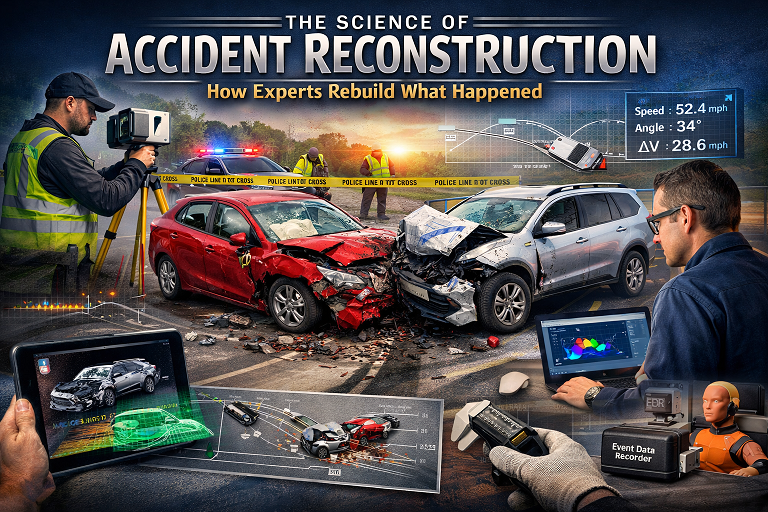
How Experts Rebuild What Happened
When a serious car accident occurs, the aftermath is often a chaotic tangle of crumpled metal, scattered debris, and conflicting witness accounts. Determining exactly what happened — who was going how fast, who had the right of way, and who bears legal responsibility — can be the difference between justice and injustice in a courtroom. This is where accident reconstruction comes in: a forensic discipline that blends physics, engineering, mathematics, and modern technology to rebuild a collision from the ground up.
Accident reconstruction is not guesswork. It is a methodical, science-driven process used by law enforcement agencies, insurance companies, attorneys, and engineering experts to establish the objective facts of a crash. In both civil litigation and criminal proceedings, reconstructionist findings frequently carry decisive weight, shaping verdicts, settlements, and policy changes. Understanding how this field works — and why it matters — is essential for anyone navigating the aftermath of a serious accident.
What Is Accident Reconstruction?
Accident reconstruction is the scientific process of analyzing physical, testimonial, and electronic evidence from a crash scene to determine how the collision occurred. Certified accident reconstructionists — often engineers, former law enforcement officers, or trained crash analysts — gather data from multiple sources and apply the laws of physics to work backward from the evidence to the events.
The field draws heavily from Newtonian mechanics. Concepts like conservation of momentum, kinetic energy, and friction coefficients are applied with mathematical precision to estimate pre-impact speed, direction of travel, and the sequence of collisions. Every physical artifact left behind — a skid mark, a gouge in the pavement, a shattered windshield — is treated as a data point in a broader equation.
Core Methods Used in Accident Reconstruction
Skid Mark and Tire Evidence Analysis
Skid marks are among the oldest and most reliable forms of crash evidence. When a driver applies the brakes suddenly, the tires lock up and leave characteristic marks on the road surface. By measuring the length and pattern of skid marks and applying a known drag factor — a coefficient that accounts for road surface material, condition, and slope — reconstructionists can calculate minimum pre-braking speed using the formula: v = √(2μgd), where μ is the drag factor, g is gravitational acceleration, and d is the skid distance.
Not all marks are classic skid marks. Yaw marks, which curve in an arc, indicate a vehicle sliding sideways and are used to determine the radius of curvature and, from that, the speed. Acceleration scuff marks, left by spinning tires, can identify the starting point of a vehicle’s movement. Even the absence of expected skid marks can be telling — suggesting the driver failed to brake at all, or that ABS (anti-lock braking systems) were active.
Vehicle Damage Analysis and Crush Measurements
The deformation a vehicle sustains during impact encodes information about the energy involved in the collision. Reconstructionists measure crush depth — how much the vehicle body has been pushed inward — at multiple points along the damage profile. Using standardized stiffness coefficients derived from crash test data for specific vehicle models, they apply engineering models such as the Campbell method to convert crush measurements into an equivalent change in velocity, known as delta-V.
Delta-V is a critical value. It represents the total change in speed a vehicle experienced during impact and is closely correlated with the forces experienced by the occupants. This information not only helps establish pre-crash speeds but also contributes to injury causation analyses and occupant protection assessments.
Event Data Recorders (Black Boxes)
Modern vehicles are equipped with Event Data Recorders (EDRs), sometimes called vehicular black boxes, embedded within the airbag control module or a dedicated crash data module. In the seconds before and during a crash, EDRs continuously overwrite data — but upon detecting a significant impact, they lock in a snapshot. This snapshot typically includes vehicle speed, throttle position, brake application status, steering angle, and whether occupants were wearing seatbelts.
EDR data is downloaded using specialized tools such as the Bosch CDR (Crash Data Retrieval) system and is often among the most persuasive evidence in a reconstruction. Because it comes directly from the vehicle’s own sensors, it can either corroborate or directly contradict a driver’s account of events. Courts increasingly recognize EDR data as reliable scientific evidence, making its extraction and interpretation a cornerstone of modern reconstruction work.
3D Laser Scanning and Photogrammetry
The days of investigators measuring skid marks with tape measures and sketching crash scenes on paper are largely behind us. Today, three-dimensional laser scanners — known as LiDAR (Light Detection and Ranging) scanners — are deployed at crash scenes to capture millions of data points per second, generating a precise, georeferenced point cloud of the entire environment.
From this point cloud, reconstructionists can build a complete 3D model of the scene, including road geometry, sight-line obstructions, debris fields, and vehicle rest positions. Photogrammetry — the science of deriving measurements from photographs — complements this by allowing reconstruction from drone footage, traffic camera images, or witness phone photos. These models can be rotated, zoomed, and reviewed from any angle, offering a level of spatial clarity that flat diagrams simply cannot match.
Computer Simulations and Dynamic Modeling
Once the physical evidence has been gathered and analyzed, reconstructionists often turn to specialized simulation software to model the crash dynamically. Programs such as PC-Crash, HVE (Human-Vehicle-Environment), and SIMON allow analysts to input vehicle parameters, road geometry, and calculated speeds, then run a physics-based simulation of the collision sequence. These simulations can be run iteratively — adjusting variables until the simulated outcome matches the documented physical evidence.
These animations are not merely illustrative. When grounded in validated data and presented by qualified experts, crash simulations can be admitted as scientific evidence in court proceedings. They allow judges and juries to visualize the mechanics of a crash in ways that transcend the limitations of written reports or static diagrams, making complex physics accessible to non-technical audiences.
Additional Investigative Tools
Beyond the core methods above, reconstructionists draw from an ever-expanding toolkit. Traffic surveillance cameras and dashcam footage, when available, can provide direct visual evidence of pre-impact events. GPS data from navigation systems or fleet telematics can establish vehicle routes and speeds in the minutes before a crash. Cell phone records — including timestamps of calls, texts, or data transmissions — can be subpoenaed to determine whether driver distraction was a factor.
Pedestrian and bicycle accidents introduce additional methodologies, including the throw-distance formula to estimate impact speed from how far a pedestrian was propelled, and biomechanical analysis to assess injury causation. In truck and commercial vehicle crashes, Hours of Service logs and Electronic Logging Device (ELD) data can reveal driver fatigue, while load manifests help establish weight and stopping distance parameters.
Why Accident Reconstruction Matters
The importance of accident reconstruction extends far beyond the courtroom. At the individual level, it provides crash victims and their families with objective answers about what happened — replacing uncertainty and conflicting narratives with documented, defensible facts. For defendants, it can be equally vital: reconstruction evidence has exonerated drivers who were incorrectly blamed for accidents caused by road defects, mechanical failures, or the actions of other parties.
At the systemic level, reconstruction findings feed into road safety engineering. When a pattern of accidents occurs at a particular intersection, reconstruction reports can identify design flaws — inadequate sight lines, poor signage, dangerous pavement conditions — that inform infrastructure improvements. Automakers likewise use reconstructed crash data to evaluate real-world performance of safety systems and refine future vehicle designs.
How Reconstruction Affects Fault Determinations
Fault — or legal liability — in an accident case is determined through the lens of negligence: who failed to exercise the duty of care that a reasonable person would have applied? Accident reconstruction feeds directly into this determination by establishing the objective facts against which a driver’s conduct can be measured.
If reconstruction evidence establishes that Driver A was traveling 72 mph in a 45 mph zone at the moment of impact, the argument for negligence becomes mathematically grounded. If it demonstrates that Driver B had more than adequate stopping distance but left no pre-impact skid marks, it may suggest B was distracted or impaired. In cases involving multiple vehicles, reconstruction can apportion degrees of fault consistent with comparative negligence frameworks used in most jurisdictions.
Reconstruction evidence can also implicate parties beyond the drivers themselves. If analysis reveals that a vehicle’s brakes failed due to a manufacturing defect, product liability claims against the automaker become viable. If road geometry created an unreasonably dangerous condition, government entities responsible for road maintenance may share liability. Reconstruction thus expands the scope of accountability beyond the immediate parties at the scene.
In courtrooms, the reconstructionist typically testifies as an expert witness. Under standards derived from the Daubert standard — governing the admissibility of expert testimony in federal and many state courts — testimony must be based on sufficient facts, employ reliable methods, and be the product of properly applied principles. A well-prepared reconstruction withstands this scrutiny because it is grounded in peer-reviewed physics, validated software, and documented methodology.
Limitations and Challenges
Accident reconstruction is powerful, but it is not infallible. The quality of a reconstruction is only as good as the quality of the evidence available. Scene contamination — vehicles moved before documentation, rain washing away skid marks, debris cleared prematurely — can degrade the evidentiary foundation. Reconstruction also involves inputs and assumptions that experienced opposing experts may contest; ranges of uncertainty exist around nearly every calculated value.
This is why it is critical for reconstruction work to be initiated as early as possible after an accident. Evidence is perishable: surveillance footage is overwritten, paint transfers are weathered away, and witness memories fade. Parties involved in serious crashes — whether victims, defendants, or their legal representatives — benefit enormously from engaging qualified reconstruction professionals promptly.
Accident reconstruction represents the intersection of science and justice. By applying physics, engineering, and cutting-edge technology to the physical remnants of a crash, experts can rebuild what happened with a degree of precision that witnesses, memories, and assumptions cannot match. From skid mark calculations and crush measurements to 3D laser scans and computer simulations, each method adds a layer of clarity to what is often an initially confusing picture.
For accident victims, this science can mean the difference between being heard and being dismissed. For the legal system, it means decisions rooted in evidence rather than conjecture. And for society at large, it provides the data needed to build safer roads, design better vehicles, and hold negligent parties accountable — ultimately making the roads safer for everyone.