Personal Injury Information, Guides, News, Tools & Resources
Injuries at Self-Storage Facilities
Published by
Personal Injury Insights
on
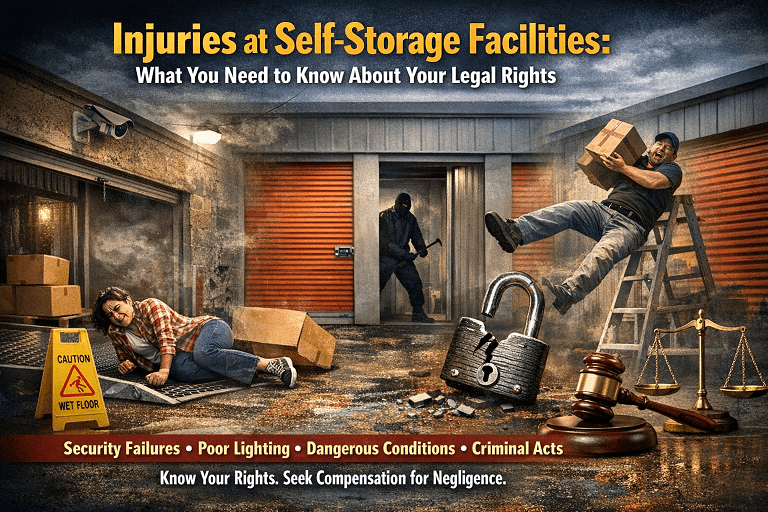
Millions of Americans rent self-storage units every year, trusting that the facility they choose will be reasonably safe. Whether you are moving between homes, storing seasonal equipment, or clearing out a loved one’s belongings, the last thing on your mind is the possibility of suffering a serious injury on the property. But self-storage facilities carry real and often underappreciated hazards. Security failures, unsafe loading areas, poor lighting, and access control problems create environments where accidents and criminal acts can harm innocent renters, visitors, and employees. When negligence on the part of a facility operator contributes to those injuries, victims may have the right to pursue compensation.
The Scope of the Problem
Self-storage is a booming industry. There are now more self-storage facilities in the United States than McDonald’s and Starbucks locations combined, with tens of thousands of properties spread across urban, suburban, and rural communities. This rapid growth has not always been matched by investment in safety infrastructure. Many facilities operate with minimal staffing, outdated security equipment, and aging physical structures. The result is a category of commercial property where preventable injuries happen with troubling regularity.
Injuries at self-storage facilities fall into two broad categories: physical accidents caused by dangerous conditions on the property, and harm resulting from inadequate security that allows criminal activity to occur. Both categories can give rise to premises liability claims when the facility owner or operator knew — or should have known — about the dangerous condition and failed to take reasonable steps to correct it.
Security Failures and Criminal Activity
One of the most serious risks at self-storage facilities stems from inadequate security. These properties typically operate with limited on-site staff, particularly in the evenings and overnight hours. When a facility fails to maintain functioning security cameras, relies on broken gate systems, or neglects to monitor who enters and exits the property, it creates opportunities for criminal actors to operate on the premises.
Assault, robbery, sexual assault, and other violent crimes have occurred at self-storage facilities across the country. Victims are often in vulnerable positions — isolated in a narrow corridor between rows of units, unaware that someone has tailgated through a gate behind them, or operating under the mistaken belief that the facility’s security systems are working as advertised. In cases where the operator knew the area had a history of criminal incidents but failed to increase lighting, repair access gates, or add security patrols, the facility may bear legal responsibility for the resulting harm under the theory of negligent security.
A key legal question in these cases is whether the crime was foreseeable. Prior incidents on or near the property, neighborhood crime statistics, and evidence that management was warned of security problems all bear on this analysis. An experienced premises liability attorney can investigate these factors and determine whether negligent security contributed to a client’s injuries.
Poor Lighting and Its Consequences
Inadequate lighting is one of the most frequently cited hazards at self-storage facilities, and for good reason — its effects cut across both accident and crime categories. From a physical safety standpoint, dimly lit corridors, stairwells, and loading areas make it far more difficult for renters to see trip hazards, uneven pavement, protruding equipment, or other obstacles. Falls that might be avoided in adequate light become serious incidents resulting in broken bones, head injuries, torn ligaments, and spinal trauma.
Lighting failures also directly enable criminal activity. Dark corners, unlit parking areas, and poorly illuminated entry points give bad actors cover to wait for victims, disable cameras, or tamper with access systems without being seen. Industry safety standards and basic common sense both call for well-lit exterior and interior spaces at storage facilities, yet many operators allow burned-out fixtures to remain unrepaired for extended periods. When a documented lighting failure creates conditions that contribute to an injury, the facility operator’s failure to maintain the property can support a negligence claim.
Unsafe Loading Areas
Loading areas are among the most physically hazardous zones at any self-storage property. Renters are typically working with dollies, hand trucks, heavy boxes, and bulky furniture items — often without any assistance from facility staff. Operators have a duty to ensure that these areas are reasonably safe for the people using them.
Common loading area hazards include cracked or uneven pavement that catches wheels and causes trips and falls, loading docks without adequate markings or barriers, overhead doors that malfunction and strike people or property, improperly maintained ramps with no non-slip surface or adequate handrails, and drainage problems that allow standing water or ice to accumulate. Heavy items dropped or fallen due to equipment failures can cause crush injuries. Forklifts or powered vehicles operated negligently on shared loading areas have caused severe and even fatal injuries.
Facility operators are responsible for conducting regular inspections of loading areas and correcting known hazards in a timely manner. Documentation showing that a dangerous condition existed before an injury occurred — and that staff were aware of it — is often central to establishing liability in these cases.
Access Control Issues
Access control systems serve a dual purpose at self-storage facilities: they are meant to protect renters’ stored property and to keep the premises safe from unauthorized individuals. When these systems fail, both categories of harm can result.
Gate malfunctions are a common source of physical injuries. Automated gates that close too quickly, fail to detect a person in the path of the gate, or malfunction unpredictably have caused broken bones, lacerations, and blunt force trauma to renters attempting to enter or exit the property. Some facilities use rolling steel doors on individual units that require proper maintenance to function safely; a door that falls or closes unexpectedly can cause catastrophic injury.
Beyond physical injury, access control failures can allow unauthorized individuals onto the property, setting the stage for the criminal incidents described above. Tailgating — when an unauthorized person follows a legitimate renter through an access gate — is a well-known vulnerability that responsible facility operators are expected to address through design, signage, and monitoring. A facility that ignores repeated tailgating incidents or allows gate systems to fall into disrepair faces potential liability when those failures contribute to harm.
Pursuing a Premises Liability Claim
If you have been injured at a self-storage facility, the legal framework that applies to your situation is generally premises liability law. To succeed in a claim, an injured person typically must establish that the facility owed them a duty of care, that the facility breached that duty by allowing or creating an unreasonably dangerous condition, that the breach caused the injury, and that the injury resulted in compensable damages.
Evidence is critical in these cases. Incident reports, security camera footage, maintenance records, prior complaint logs, and expert testimony about industry safety standards can all play a role in proving what the facility operator knew and when. Because evidence can be lost or destroyed quickly, it is important to consult with an attorney as soon as possible after an injury.
If you or someone you love has been injured at a self-storage facility, take these steps immediately: seek medical attention even if injuries initially seem minor, report the incident to facility management and request a written incident report, photograph the scene and any hazardous conditions while you are still on the property, collect the names and contact information of any witnesses, and preserve any communications with the facility including rental agreements, email correspondence, and payment records. Then contact a premises liability attorney experienced in storage facility injuries to evaluate your case before the statute of limitations in your state expires.
Storage facility operators profit from the convenience they offer renters. That profit comes with a legal and moral obligation to maintain safe, secure, well-lit, and properly managed facilities. When they fall short of that obligation and people are hurt as a result, the law provides a path to accountability.
Personal Injury Insights, is your trusted FREE resource for comprehensive, reliable, and easy-to-understand information on personal injury law.
Our mission is to empower individuals with the knowledge they need to make informed decisions about their personal injury cases and connect with the right legal support when necessary.
We cover a wide range of topics but this website does not provide legal advice and does not create an attorney-client relationship. The information provided is for general informational purposes only and should not be relied upon as legal advice. For specific legal guidance, please consult a qualified attorney in your jurisdiction.