
Proving a Hit-and-Run You Can’t Identify
The screech of tires, the sickening crunch of metal, and then silence as taillights disappear into the distance. Hit-and-run accidents leave victims dealing with injuries, vehicle damage, and the frustrating reality that the responsible driver has vanished. When you can’t identify the at-fault party, these incidents become what insurance companies call “phantom vehicle” accidents. Understanding how to document these cases and navigate the recovery process can make the difference between receiving compensation and being left to shoulder the financial burden alone.
Understanding Phantom Vehicle Accidents
A phantom vehicle accident occurs when another driver causes a collision or forces you off the road and then flees the scene before you can obtain their identifying information. These cases present unique challenges because traditional insurance claims rely on identifying the at-fault party and their insurance carrier. Without a license plate number, vehicle description, or driver information, victims face an uphill battle in proving what happened and recovering damages.
Phantom vehicle accidents can take several forms. The most straightforward involves direct contact where another vehicle strikes yours and the driver immediately leaves. More complex scenarios include situations where a vehicle cuts you off, causing you to swerve and crash without actual contact, or cases where debris from another vehicle causes your accident. Each type presents different evidentiary challenges, but all require careful documentation to support your claim.
Immediate Steps at the Scene
The moments immediately following a phantom vehicle accident are critical for building your case. Your first priority must always be safety and medical attention, but if you’re able, certain actions taken at the scene can significantly strengthen your position later.
Call 911 immediately, even if your injuries seem minor. A police report creates an official record of the incident and establishes the timeline. When speaking with the dispatcher and responding officers, provide as many details as possible about the phantom vehicle. Even partial information matters. Did you notice the color, make, or model? Was it a sedan, truck, or SUV? Did you catch any numbers or letters from the license plate? The direction the vehicle traveled? Any distinctive features like bumper stickers, damage, or aftermarket modifications?
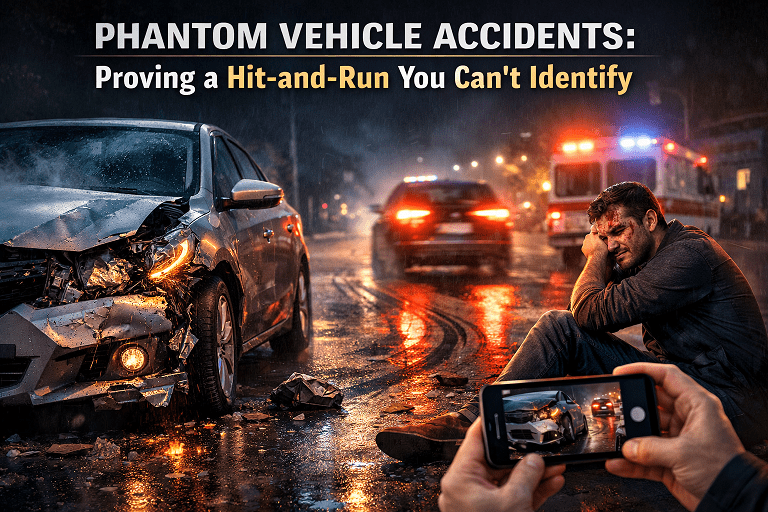
Time is your enemy in hit-and-run cases. Memories fade, witnesses disperse, and physical evidence deteriorates. If you’re physically able, use your smartphone to photograph everything. Capture images of all vehicle damage from multiple angles, skid marks on the roadway, debris from either vehicle, your surroundings including street signs and landmarks, traffic signals and their positions, and weather and lighting conditions. These photographs create a visual record that can corroborate your account and help accident reconstruction experts if needed.
Witness Information Is Gold
Witnesses can transform a phantom vehicle case from a dead end to a recoverable claim. Independent third parties who saw the accident provide credible testimony that supports your version of events. When another driver or pedestrian stops to help, get their contact information immediately. Don’t assume the police will gather this information adequately. Obtain full names, phone numbers, email addresses, and home addresses if possible.
Ask witnesses what they saw and if they noticed details about the fleeing vehicle you might have missed. Someone watching from a different angle may have caught a license plate number or observed the phantom driver’s behavior before the collision. Request that witnesses remain at the scene until police arrive so their statements become part of the official report.
In today’s connected world, witnesses may have captured the incident on dashcams or smartphones. Politely ask if anyone recorded video or took photos, and request copies of any footage. If someone is reluctant to share immediately, get their contact information so you can follow up or have your attorney make a formal request.
The Police Report Foundation
The police report serves as the foundation for phantom vehicle claims. Officers investigating hit-and-runs follow specific protocols that create an official record of the incident. Ensure that the responding officer documents the accident as a hit-and-run or phantom vehicle incident specifically. This classification matters for insurance purposes.
Provide the officer with every detail you remember, no matter how insignificant it seems. The report should include your description of the phantom vehicle, the sequence of events leading to the collision, statements from any witnesses, notation of physical evidence at the scene, and your injuries and vehicle damage. Request the report number before leaving the scene and obtain a copy as soon as it becomes available, typically within a few days to a week depending on your jurisdiction.
Review the police report carefully when you receive it. Officers are human and sometimes omit important details or make errors. If you notice inaccuracies or missing information, contact the investigating officer promptly to request amendments or additions to the report.
Gathering Additional Evidence
Beyond the immediate scene documentation, additional evidence gathering strengthens your case. Surveillance cameras have become ubiquitous, installed on businesses, residences, traffic signals, and public transportation. The area where your accident occurred may have cameras that captured the phantom vehicle or the collision itself.
Act quickly to identify and preserve this footage. Surveillance systems typically overwrite recordings after a set period, sometimes as brief as 24 to 72 hours. Visit businesses near the accident location and ask about their camera systems. Gas stations, convenience stores, retail shops, restaurants, banks, and apartment complexes often have exterior cameras. Make formal requests for footage preservation, preferably in writing, and provide the date, time, and specific location of your accident.
Traffic cameras operated by city or state departments of transportation may have captured the incident. Contact the appropriate government agency to request footage. Public records laws often govern these requests, so be prepared to submit formal documentation.
Return to the accident scene when possible, preferably at the same time of day and day of the week as your accident. You may discover witnesses you missed initially, such as regular commuters, business employees who work consistent shifts, or residents who were home at the time. Leave your contact information at nearby businesses and ask them to post a notice requesting witnesses.
Medical Documentation Matters
Seeking immediate medical attention serves dual purposes in phantom vehicle cases. Obviously, your health and safety come first, but medical records also establish the causation link between the accident and your injuries. Insurance companies scrutinize phantom vehicle claims carefully, and gaps in medical treatment or delayed care provide ammunition for denial.
Visit an emergency room or urgent care facility the same day as your accident, even if you feel fine. Adrenaline and shock can mask pain and injuries that become apparent hours or days later. Inform medical providers that you were in a hit-and-run accident and describe all symptoms, including those that seem minor. Headaches, neck stiffness, back pain, and psychological distress all warrant documentation.
Follow all treatment recommendations and attend all scheduled appointments. Maintain a personal injury journal documenting your pain levels, limitations on daily activities, work missed, and emotional impact. This contemporaneous record supports your damages claim and provides details you might forget months later when settlement negotiations or litigation occur.
Insurance Coverage for Phantom Vehicles
Most people assume that if they can’t identify the at-fault driver, they have no recourse for compensation. However, several insurance coverage types may apply to phantom vehicle accidents. Understanding your policy and how to properly file claims determines whether you recover damages or pay out of pocket.
Uninsured motorist coverage exists precisely for situations like phantom vehicle accidents. This coverage treats the unknown fleeing driver as an uninsured motorist and compensates you for injuries and, in some states, property damage. Most states require insurance companies to offer uninsured motorist coverage, though not all mandate that you purchase it. Review your policy declarations page to determine if you have this coverage and at what limits.
Underinsured motorist coverage may also apply, depending on how your state treats phantom vehicle cases. Collision coverage pays for vehicle damage regardless of fault, subject to your deductible. If you have this coverage, it provides a path to repairing your vehicle even without identifying the other driver. Medical payments coverage or personal injury protection covers medical expenses after accidents regardless of fault. These coverages provide immediate access to treatment funds while you pursue other compensation avenues.
Filing Your Insurance Claim
Filing a phantom vehicle claim requires careful attention to policy requirements and deadlines. Insurance policies contain specific provisions addressing hit-and-run accidents, and failing to comply with these terms can result in claim denial regardless of the merits.
Notify your insurance company immediately, ideally within 24 hours of the accident. Most policies require prompt notification, and delays raise red flags that encourage denial. When reporting the claim, provide a detailed account of the accident consistent with what you told police. Mention any witnesses, evidence, and documentation you’ve gathered. Be truthful and accurate, but don’t speculate or admit fault for anything.
Many insurance policies contain specific requirements for phantom vehicle claims beyond standard accident claims. Common provisions require physical contact between vehicles, independent witness corroboration, police reports filed within a certain timeframe, and cooperation with the insurance company’s investigation. Read your policy carefully or have an attorney review these requirements. A technicality like requiring contact between vehicles can doom claims where a phantom driver forced you off the road without touching your car.
The Investigation Process
Insurance companies investigate phantom vehicle claims extensively because of fraud concerns. Be prepared for a thorough process that may feel intrusive or accusatory. Adjusters may request recorded statements, authorization to access medical records, permission to inspect your vehicle, documentation of your whereabouts before and after the accident, and in some cases, examination under oath.
Cooperate with reasonable investigation requests, but understand your rights. You’re not required to provide unlimited access to your entire life. Recorded statements should be accurate and limited to the accident itself. Consider consulting an attorney before giving a recorded statement, especially if the adjuster’s questions seem designed to undermine your claim.
The insurance company may hire private investigators or accident reconstruction experts. Don’t let this intimidate you if your account is truthful. These investigations sometimes uncover evidence that supports your claim, such as surveillance footage you didn’t know existed or witnesses you couldn’t locate.
When Claims Get Denied
Insurance companies deny phantom vehicle claims at higher rates than standard accident claims. Common denial reasons include lack of physical evidence supporting your account, absence of independent witnesses, failure to meet policy requirements like reporting deadlines, suspicion of fraud or staged accidents, and insufficient proof that another vehicle caused your damages.
If your claim is denied, don’t accept the decision as final. You have options. Request a detailed written explanation of the denial citing specific policy provisions. Review your policy to determine if the cited reasons are valid. Gather additional evidence that addresses the insurance company’s concerns. Consider hiring an attorney who specializes in hit-and-run and uninsured motorist claims.
Many states provide appeal processes within insurance companies before you must pursue litigation. Take advantage of these procedures, providing additional documentation and arguments addressing the denial reasons. If internal appeals fail, you may need to file a lawsuit against your own insurance company for breach of contract or bad faith, depending on the circumstances.
Legal Representation Considerations
Phantom vehicle cases involve complex insurance policy interpretation, investigation requirements, and evidentiary challenges that make legal representation valuable. Attorneys experienced in hit-and-run accidents understand the tactics insurance companies use to deny claims and know how to build cases that overcome skepticism.
Most personal injury attorneys work on contingency fees, meaning they only get paid if you recover compensation. Initial consultations are typically free, allowing you to explore your options without financial risk. An attorney can handle communication with insurance companies, gather evidence you may not be able to access, hire expert witnesses if needed, negotiate settlements, and litigate if necessary.
Consider consulting an attorney early in the process, especially if your injuries are significant, the insurance company seems resistant to your claim, policy requirements are complex, or you’re unfamiliar with insurance claim procedures. Even if you don’t hire representation immediately, understanding your legal options provides leverage in negotiations.
Prevention and Protection
While you can’t control other drivers’ decisions to flee accident scenes, you can take steps to protect yourself in case you become a phantom vehicle victim. Install a dashcam in your vehicle that records continuously while driving. Modern dashcams are affordable and provide objective evidence of accidents that no verbal statement can match. Some models include rear-facing cameras and parking mode that records even when your car is unattended.
Review your insurance policy to ensure you have adequate uninsured motorist coverage. Many people accept minimum coverage to save on premiums, not realizing that phantom vehicle accidents fall under this protection. Consider increasing your limits to match your liability coverage, providing full protection if you’re hit by an uninsured or unidentified driver.
Keep detailed documentation of your insurance policy, registration, and proof of insurance in accessible locations. After an accident, you’ll want this information readily available. Maintain a simple emergency kit in your vehicle including a disposable camera or ensuring your phone is charged, a notebook and pen for taking notes, and emergency contact numbers.
The trauma of a hit-and-run accident extends beyond physical injuries and property damage. The violation of someone fleeing the scene creates feelings of helplessness and injustice. Understanding your rights, knowing how to document these incidents properly, and recognizing the insurance coverage available to you transforms that helplessness into action. While phantom vehicle cases present unique challenges, victims who act quickly, gather comprehensive evidence, and understand their insurance policies can successfully recover compensation even when the at-fault driver disappears into the night.


