
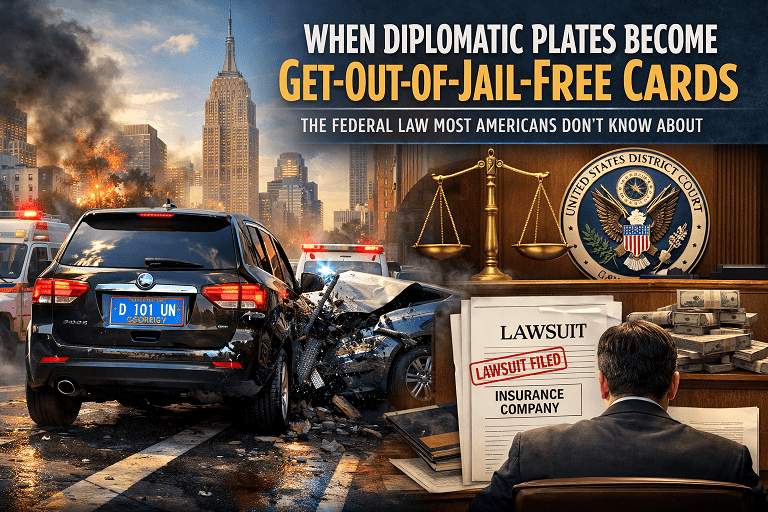
When Diplomatic Plates Become Get-Out-Of-Jail-Free Cards: The Federal Law Most Americans Don’t Know About
How a 1978 law creates a secret pathway to sue foreign governments—and why a Queens resident just used it to bypass diplomatic immunity
The Crash That Changed Everything
On a typical September afternoon in 2025, somewhere in the gridlock of Midtown Manhattan, a chain-reaction collision involving multiple vehicles unfolded. One of those vehicles bore diplomatic license plates registered to the Georgia Mission to the United Nations. For most accident victims in America, the next steps would be straightforward: exchange insurance information, file a police report, contact a personal injury attorney, and pursue compensation through the civil courts.
But when diplomatic immunity enters the equation, those ordinary pathways to justice slam shut. Or do they?
On January 22, 2026—just days ago—a Queens resident filed a lawsuit in federal court that illuminates a legal mechanism most Americans have never heard of, even though it’s been on the books for nearly half a century. The case demonstrates how injured parties can pursue compensation from diplomatic vehicle accidents by targeting someone unexpected: not the foreign diplomat, not the foreign government, but their insurance company directly.
This lawsuit isn’t just another personal injury case. It’s a window into a parallel legal universe where federal statutes override centuries-old international customs, where Pennsylvania insurance companies find themselves defending foreign missions, and where ordinary citizens can—against all odds—hold immune diplomats financially accountable for their actions.
The Diplomatic Immunity Problem: A Brief History
Diplomatic immunity isn’t a modern invention. Its roots stretch back to ancient civilizations, where messengers traveling between warring kingdoms needed protection from arrest, harm, or detention. The principle was simple: if envoys couldn’t travel safely, diplomacy itself would be impossible.
By 1708, Britain codified diplomatic immunity into law after Russian Ambassador Andrey Matveyev was arrested for debt in London, nearly triggering an international incident with Tsar Peter the Great. The United States followed suit in 1790 with its own diplomatic immunity statute. For centuries, this system worked well enough when diplomatic missions were small and interactions with local populations were limited.
But the twentieth century changed everything.
As governments expanded their international presence and the United Nations established its headquarters in New York City, the number of people claiming diplomatic immunity exploded. By the 1970s, diplomats in cities like New York and Washington, D.C. were involved in thousands of incidents annually—from unpaid parking tickets to drunk driving accidents—all while enjoying complete immunity from prosecution or civil liability.
The Human Cost
The stories are heartbreaking and infuriating in equal measure:
In 1974, a Washington, D.C. physician named Dr. Arthur Rosenbaum and his wife, both doctors, were struck by an uninsured Panamanian diplomat who ran a red light. Dr. Rosenbaum’s wife was rendered quadriplegic, requiring 24-hour nursing care for the rest of her life. Her medical expenses exceeded $200,000 within two years, with annual nursing costs estimated at $50,000. Despite the secretary’s diplomatic immunity, they couldn’t recover a single dollar—even though the diplomat had valid insurance coverage.
In 1997, Georgian Ambassador Gueorgui Makharadze, driving three times the speed limit while legally drunk, caused a five-car pileup in Washington that killed 16-year-old Joviana Waltrick and injured four others. Initially, Makharadze claimed diplomatic immunity and couldn’t be touched by U.S. law enforcement. Only after massive public outrage did Georgia waive his immunity, allowing prosecution.
These cases, and hundreds like them, exposed a fundamental injustice: victims of diplomatic negligence had no legal recourse whatsoever. The diplomat couldn’t be sued. Their home country couldn’t be sued due to sovereign immunity. Even when insurance existed, immunity prevented victims from making claims against it.
Congress Steps In: The 1978 Diplomatic Relations Act
Public pressure finally forced action. In 1978, Congress passed the Diplomatic Relations Act, a watershed piece of legislation that fundamentally altered the landscape of diplomatic accountability in the United States.
The law did three revolutionary things:
First, it required all foreign missions, diplomats, and their families to carry liability insurance on any motor vehicles, vessels, or aircraft operated in the United States. No longer could diplomats drive uninsured and leave victims with no source of compensation.
Second, and far more significantly, it created a direct legal pathway for injured parties to sue insurers in federal court—completely bypassing the diplomat and the foreign government.
Third, it stripped away the “amount in controversy” requirement that normally governs federal jurisdiction. Whether your damages are $5,000 or $5 million, federal courts have exclusive jurisdiction over these cases under 28 U.S.C. § 1364.
This was legal innovation at its finest: Congress couldn’t eliminate diplomatic immunity without violating international treaties, but it could create an end-run around it by targeting the one party without immunity—the insurance company.
How the Direct Action Provision Actually Works
The mechanics of 28 U.S.C. § 1364 are deceptively simple but remarkably powerful.
Under normal circumstances, when you’re injured in a car accident, you sue the driver. If the driver has insurance, the insurance company defends them and potentially pays out on their behalf. But the insurance company isn’t the defendant—the driver is.
The Diplomatic Relations Act flips this on its head.
When a diplomat or foreign mission employee causes an accident, the injured party can file suit directly against the insurance company in federal district court. The diplomat doesn’t have to be named as a defendant. The foreign government doesn’t have to be involved. The lawsuit proceeds against the insurer alone.
This matters enormously because:
- The insurer has no diplomatic immunity. It’s a private company, typically based in the United States, with no special protections under international law.
- The case proceeds in federal court under federal jurisdiction, where judges are experienced in handling complex jurisdictional issues and international law questions.
- There is no jury trial. A federal judge tries the case and enters judgment, which some attorneys view as more predictable than jury verdicts in high-stakes cases.
- The statute provides exclusive federal jurisdiction, meaning state courts can’t hear these cases even if they wanted to.
The January 2026 Queens Case: A Modern Application
The lawsuit filed on January 22, 2026, in the United States District Court for the Southern District of New York perfectly illustrates this mechanism in action.
According to reports, the case stems from a September 2025 chain-reaction collision in Midtown Manhattan. The complaint names several defendants:
- Erie Insurance Company—the auto insurer for the diplomatic vehicle
- The Georgia Mission to the United Nations—the owner of the diplomatic vehicle
- The driver of the diplomatic vehicle (identified as “Zhou”)
- The operator of a second vehicle involved in the chain reaction
- The owner of that second vehicle
But here’s the critical strategic move: The lawsuit invokes both 28 U.S.C. § 1364 (the direct action provision) and the Foreign Sovereign Immunities Act of 1976.
The Foreign Sovereign Immunities Act Connection
While the Diplomatic Relations Act handles the insurance angle, the Foreign Sovereign Immunities Act (FSIA) provides the jurisdictional foundation for suing the foreign government itself.
Under the FSIA, foreign states are presumptively immune from U.S. jurisdiction. However, Congress carved out specific exceptions, and one of the most commonly invoked is the “noncommercial tort exception.”
This exception strips foreign states of immunity in cases where money damages are sought for personal injury, death, or property damage occurring in the United States and caused by tortious acts of that foreign state or its officials while acting within the scope of employment.
Congress specifically designed this exception with “run-of-the-mill domestic torts” in mind—particularly traffic accidents caused by foreign government employees. If a diplomat or mission employee causes a car crash while on official business (or even while driving a mission-owned vehicle), the noncommercial tort exception brings the case within U.S. court jurisdiction.
By combining the FSIA’s noncommercial tort exception with the Diplomatic Relations Act’s direct action provision, the Queens plaintiff has constructed a two-pronged legal attack:
- The FSIA establishes that the Georgia Mission can be held liable because this was an ordinary traffic accident occurring in the United States
- The Diplomatic Relations Act provides the mechanism to sue Erie Insurance directly, regardless of whether the Georgia Mission or its driver cooperates
This is sophisticated litigation strategy at work—using federal statutes in tandem to create accountability where diplomatic immunity would otherwise make it impossible.
Why This Matters for Every American
If you live or drive in New York City, Washington, D.C., or any city with a significant diplomatic presence, the odds of encountering a diplomatic vehicle are higher than you might think.
Consider these statistics:
- New York City, as host to UN Headquarters, has one of the world’s largest concentrations of diplomatic personnel
- In the 1990s, diplomats in New York owed more than $6 million in unpaid parking tickets alone
- Seventeen felonies were committed by foreign diplomats in the United States in 1995, according to State Department records
- Eight diplomats were expelled from the U.S. in 1996 for repeated drunk driving violations
Most people assume diplomatic immunity creates an impenetrable legal shield. But the 1978 Diplomatic Relations Act fundamentally changed that calculus—at least for civil liability arising from vehicle accidents.
What You Should Do If Hit by a Diplomatic Vehicle
If you’re ever involved in an accident with a diplomatic vehicle, time is critical. Here’s what personal injury attorneys who handle these cases recommend:
1. Call the police immediately, even if injuries seem minor. A police report is essential documentation.
2. Photograph the diplomatic license plate. Get clear photos showing the entire plate number. Without this, you may have no way to identify the insurer later.
3. Do NOT try to settle at the scene. Diplomats may offer cash payments or make promises they have no obligation to keep.
4. Contact an attorney experienced in diplomatic immunity cases within 24-48 hours. These cases require specialized knowledge of federal jurisdiction and international law.
5. Obtain the tag number and contact the State Department. The U.S. Department of State maintains records matching diplomatic vehicle tags to their insurers.
The most crucial step is getting that license plate number. Without it, identifying the insurance company becomes nearly impossible, and your legal options evaporate.
The Insurance Industry’s Unique Exposure
For insurance companies, diplomatic accounts represent a peculiar risk profile.
Unlike standard auto liability policies, where the insurer stands behind the policyholder, diplomatic vehicle policies create direct exposure. The Diplomatic Relations Act’s direct action provision means insurers can find themselves as the primary defendant from day one.
This creates several unusual dynamics:
Higher underwriting scrutiny: Insurers covering diplomatic missions must price policies knowing they’ll be sued directly if an accident occurs, without the usual defenses available when representing individual policyholders.
No ability to control the insured: Diplomats can’t be deposed, interrogated, or required to cooperate with the defense. If a diplomat refuses to provide a statement or participate in the case, the insurer must defend without their cooperation.
Federal court jurisdiction: These cases proceed exclusively in federal district court, which may be more or less favorable to insurers depending on the jurisdiction and judge assigned.
Potential conflicts of interest: When both the mission and the insurer are named as defendants (as in the Queens case), the insurer may face competing interests—defending the mission while also protecting its own financial exposure.
Pennsylvania-based Erie Insurance—named in the January 2026 lawsuit—now faces exactly this situation. Despite being headquartered over 200 miles from Manhattan, Erie finds itself defending a case involving a foreign government, a diplomatic driver, and a chain-reaction collision in one of America’s most congested traffic environments.
The Broader Context: Diplomatic Accountability in 2026
The Queens lawsuit arrives at a moment when diplomatic immunity remains hotly debated worldwide.
In 2019, Anne Sacoolas, wife of a U.S. diplomat in the United Kingdom, struck and killed 19-year-old motorcyclist Harry Dunn while driving on the wrong side of a rural British road. She claimed diplomatic immunity and fled to the United States, sparking international outrage. Harry Dunn’s parents met with President Trump, launched a global media campaign, and eventually secured a civil settlement—but Sacoolas never faced criminal prosecution.
These high-profile cases fuel public perception that diplomatic immunity allows the powerful to act with impunity. But cases like the Queens lawsuit demonstrate that at least in the civil liability context—and at least for vehicle accidents—Congress has created mechanisms for accountability.
Still, significant gaps remain:
Criminal accountability: The Diplomatic Relations Act only addresses civil liability. Diplomats who commit crimes—even serious ones like drunk driving manslaughter—often escape prosecution unless their home country waives immunity.
Non-vehicle torts: The direct action provision only applies to “motor vehicles, vessels, or aircraft.” Diplomats who commit other torts (assault, fraud, property damage unrelated to vehicles) still enjoy broad immunity.
Enforcement challenges: Even when victims win judgments against insurers, collecting can be complex if the insurer contests coverage or the policy limits are inadequate.
Limited deterrent effect: Because diplomats themselves face no personal liability (the insurer pays), there’s little individual deterrent to dangerous behavior beyond potential recall by their home country.
What Makes This Case Different
While direct action lawsuits against diplomatic vehicle insurers aren’t new—they’ve been filed regularly since 1978—the January 2026 Queens case has several notable features:
Timing: Filed just four months after the September 2025 accident, this complaint moves quickly compared to typical personal injury litigation timelines.
Multi-defendant strategy: By naming not just the insurer and the Georgia Mission, but also the other driver and vehicle owner involved in the chain reaction, the plaintiff preserves multiple avenues for recovery.
Federal jurisdiction: The case proceeds in the Southern District of New York, a federal court with extensive experience handling complex international law matters given New York’s role as host to the UN.
Insurance company exposure: Erie Insurance, despite being a regional carrier based in Pennsylvania, now faces direct federal litigation over an accident involving foreign sovereign entities—a reminder that diplomatic vehicle coverage can expose even smaller insurers to complex federal litigation.
Most importantly, this case exemplifies how federal statutory law can create accountability mechanisms that override traditional immunity doctrines. It’s a testament to Congress’s power to craft creative legislative solutions to complex international law problems.
The Future of Diplomatic Accountability
As global interconnection intensifies and diplomatic populations grow, the tension between immunity and accountability will only sharpen.
Some policy proposals circulating among legal scholars and advocates include:
Expanding the direct action provision to cover all diplomatic torts, not just vehicle accidents
Creating mandatory minimum insurance requirements with policy limits high enough to cover catastrophic injuries
Establishing a federal victim compensation fund for cases where insurance is inadequate or unavailable
Requiring criminal prosecution for serious offenses regardless of diplomatic status, with immunity waiver as a condition of diplomatic accreditation
Reciprocal immunity agreements that condition full immunity on a diplomat’s home country providing reciprocal protections to U.S. diplomats abroad
None of these proposals has gained significant legislative traction, but each represents potential paths toward greater accountability without abandoning the diplomatic immunity framework that remains essential to international relations.
Knowledge as Power
For most Americans, diplomatic immunity feels like an arcane topic—something that exists in spy novels and international intrigue, not in daily life. But for the Queens resident who filed suit on January 22, 2026, it became intensely personal when a diplomatic vehicle was involved in an accident that caused injury.
What makes this case instructive isn’t just the legal mechanics it demonstrates, but the broader principle it illustrates: seemingly absolute legal protections often have exceptions, and knowing those exceptions can mean the difference between justice and helplessness.
The 1978 Diplomatic Relations Act represented Congress at its best—identifying a clear problem (victims of diplomatic vehicle accidents had no recourse), crafting a creative solution (direct action against insurers), and implementing it through careful statutory language that respects international obligations while protecting American citizens.
Nearly 50 years later, this law continues serving its purpose, providing a pathway to compensation that most people don’t know exists until they desperately need it.
If there’s one takeaway from the January 2026 Queens case, it’s this: diplomatic immunity isn’t the impenetrable shield most people imagine. When diplomats cause car accidents, federal law provides mechanisms for accountability—you just need to know where to look.
And now you do.
Key Takeaways
✓ The 1978 Diplomatic Relations Act allows injured parties to sue insurance companies directly when diplomatic vehicles cause accidents
✓ 28 U.S.C. § 1364 provides exclusive federal jurisdiction for these cases, bypassing traditional diplomatic immunity
✓ The Foreign Sovereign Immunities Act strips immunity for ordinary torts like traffic accidents occurring in the United States
✓ Documentation is critical—photograph diplomatic license plates immediately after any accident
✓ These cases proceed in federal court without juries, with federal judges deciding liability and damages
✓ Insurance companies face unique exposure when covering diplomatic vehicles, as they can be sued directly
✓ The January 2026 Queens lawsuit demonstrates how these legal mechanisms work in practice, just months after a September 2025 Manhattan collision
The next time you see diplomatic plates on the road, remember: immunity has its limits, and Congress has ensured that when those vehicles cause harm, victims aren’t left without recourse.


