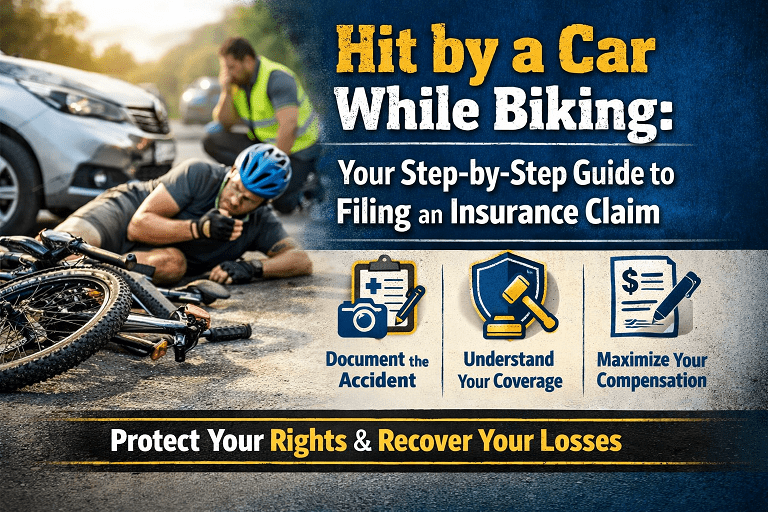
Your Step-by-Step Guide to Filing an Insurance Claim
Getting hit by a car while biking is a traumatic experience that can leave you injured, shaken, and uncertain about what to do next. Beyond the immediate medical concerns, you’ll likely face a complex insurance claims process that can feel overwhelming when you’re trying to recover. Understanding how to navigate personal injury protection coverage, third-party claims, and the documentation requirements can make the difference between receiving fair compensation and being left to shoulder the financial burden yourself.
This comprehensive guide walks you through every step of filing an insurance claim after a bicycle accident, helping you protect your rights and maximize your recovery.
Immediate Steps at the Accident Scene
Before diving into insurance claims, the actions you take immediately after the accident lay the foundation for your entire case. If you’re physically able, call 911 to report the accident and request medical assistance. Even if you don’t feel seriously injured, adrenaline can mask pain and symptoms that may appear hours or days later.
Get the driver’s information, including their name, contact details, insurance company, and policy number. Take photos of the accident scene from multiple angles, capturing vehicle damage, your bicycle, road conditions, traffic signals, and any visible injuries. If there are witnesses, collect their contact information as well. The police report generated from this incident will become a crucial piece of documentation for your claim.
Do not admit fault or apologize at the scene, even if you think you may have contributed to the accident. Stick to factual statements when speaking with the driver or police. Anything you say can potentially be used against you during the claims process.
Understanding Your Insurance Coverage Options
After a bicycle accident, you typically have two main avenues for filing an insurance claim: your own personal injury protection coverage and a third-party claim against the driver’s liability insurance.
Personal Injury Protection (PIP) Coverage
Personal injury protection, commonly called PIP or no-fault insurance, is coverage that pays for your medical expenses and lost wages regardless of who caused the accident. Not all states require PIP coverage, and the specifics vary significantly by location. States with PIP laws include Florida, Michigan, New York, New Jersey, Pennsylvania, and others.
If you live in a PIP state and have auto insurance, your policy likely includes this coverage even though you were on a bicycle rather than in a car when the accident occurred. PIP typically covers medical bills, rehabilitation costs, lost income, and sometimes essential services you can’t perform due to injuries, such as childcare or housekeeping.
The advantage of PIP is that it provides quick payment without needing to prove the driver was at fault. You simply submit your medical bills and wage loss documentation to your own insurance company. However, PIP has limitations. Coverage caps are often relatively low, ranging from $10,000 to $50,000 depending on your policy and state requirements. Once you exhaust your PIP benefits, you’ll need to pursue other avenues for additional compensation.
To file a PIP claim, contact your auto insurance company as soon as possible after the accident. Most policies require notification within a specific timeframe, often 30 days. Your insurer will provide claim forms that need to be completed by you and your medical providers. Keep copies of everything you submit.
Third-Party Liability Claims
A third-party claim is filed against the at-fault driver’s auto liability insurance. Unlike PIP, which pays regardless of fault, a liability claim requires proving that the driver was negligent and that their negligence caused your injuries and damages.
Third-party claims typically offer more comprehensive compensation, including medical expenses, lost wages, property damage to your bicycle, pain and suffering, and other non-economic damages. There’s generally no predetermined cap on liability claims, though policy limits will restrict the maximum payout from the insurance company.
The downside is that liability claims take longer to resolve and require more substantial evidence. The driver’s insurance company will investigate the accident, review the police report, examine your medical records, and may even dispute that their insured was at fault.
Documentation: Building Your Case
Thorough documentation is the backbone of a successful insurance claim. The burden of proof falls on you to demonstrate the extent of your injuries and losses.
Medical Documentation
Seek medical attention immediately after the accident, even for seemingly minor injuries. Delayed treatment creates gaps in your medical records that insurance companies exploit to argue your injuries weren’t serious or weren’t caused by the accident. Emergency room visits, follow-up appointments, physical therapy sessions, and specialist consultations should all be documented.
Request copies of all medical records, including doctor’s notes, diagnostic test results, treatment plans, and prescriptions. Keep a detailed journal documenting your pain levels, limitations in daily activities, and how the injuries impact your quality of life. This narrative evidence supplements clinical records and helps establish pain and suffering damages.
Financial Documentation
For lost wage claims, you’ll need documentation from your employer verifying your work schedule and pay rate. If you’re self-employed, gather tax returns, bank statements, and client invoices showing your typical income. Don’t overlook smaller financial impacts like transportation costs to medical appointments, prescription copays, or the need to hire help for tasks you can no longer perform.
Obtain repair estimates or replacement costs for your damaged bicycle and any other property, such as a helmet, clothing, or electronic devices. Receipts and photos of the damaged items strengthen these claims.
Accident Documentation
The police report is a critical document that provides an official account of the accident. Obtain a copy from the law enforcement agency that responded. This report typically includes the officer’s assessment of fault, witness statements, and citations issued.
Supplement the police report with your own evidence. Organize the photos you took at the scene. If you didn’t capture enough images immediately after the accident, return to the location to photograph road conditions, sight lines, and any relevant traffic control devices. Create a written statement describing exactly how the accident occurred while the details are fresh in your memory.
Filing Your Insurance Claim: Step-by-Step Process
Step 1: Notify the Relevant Insurance Companies
Contact your own auto insurance company to file a PIP claim if applicable. Simultaneously, notify the at-fault driver’s insurance company that you intend to file a liability claim. Get the claim number and the name of your assigned adjuster for each claim.
Step 2: Complete Claim Forms Accurately
Insurance companies will send you various forms to complete. Fill these out carefully and honestly. Don’t minimize your injuries or leave sections blank. If you’re unsure how to answer something, consult with a personal injury attorney before submitting.
Step 3: Submit Your Documentation Package
Compile all your documentation into an organized package. Include the police report, medical records and bills, wage loss verification, property damage estimates, photos, and any other supporting evidence. Send this via certified mail or through the insurer’s online portal so you have proof of submission.
Step 4: Maintain Ongoing Communication
Keep detailed records of all communication with insurance adjusters. Note the date, time, and content of phone calls. Follow up verbal conversations with written summaries sent via email. If an adjuster requests additional information, provide it promptly.
Be cautious about giving recorded statements without legal representation. Insurance adjusters may use these statements to find inconsistencies or admissions they can use to minimize your claim.
Step 5: Review Settlement Offers Carefully
Insurance companies often make initial settlement offers that are significantly lower than your claim’s true value. They’re hoping you’ll accept quick payment without fully understanding your damages. Don’t feel pressured to accept the first offer.
Calculate the full extent of your damages, including future medical expenses if you’ll need ongoing treatment. Consider non-economic damages like pain and suffering, which are typically calculated as a multiplier of your medical expenses depending on injury severity.
Common Pitfalls to Avoid
Many bicycle accident victims unknowingly damage their claims by making preventable mistakes. Avoid discussing the accident on social media, as insurance companies routinely monitor claimants’ online presence for contradictory information. A photo of you at a social event could be twisted to suggest your injuries aren’t as severe as claimed.
Don’t sign medical authorization forms that give the insurance company unlimited access to your entire medical history. They’re looking for pre-existing conditions they can blame for your current symptoms. Provide only the records directly related to the accident.
Never accept a settlement without understanding what you’re giving up. Most settlements include a release clause preventing you from seeking additional compensation later, even if complications arise.
When to Hire a Personal Injury Attorney
While you can handle simple claims independently, certain situations warrant professional legal representation. If you’ve suffered severe injuries, face permanent disability, or your medical bills exceed available insurance coverage, an attorney can help maximize your recovery.
Complex cases involving disputed liability, multiple parties, or uninsured motorists benefit from legal expertise. Attorneys work on contingency fees, meaning they only get paid if you receive compensation, typically taking 33-40% of the settlement. For significant claims, their negotiation skills and legal knowledge often result in substantially higher settlements that more than offset their fees.
Dealing with Uninsured or Underinsured Motorists
If the driver who hit you lacks insurance or doesn’t have enough coverage to pay for your damages, you’re not necessarily out of options. Check whether your own auto insurance policy includes uninsured motorist (UM) or underinsured motorist (UIM) coverage. These provisions allow you to file a claim against your own policy when the at-fault driver’s insurance is insufficient.
UM/UIM claims follow similar procedures to third-party claims but are filed with your own insurer. You’ll still need to prove the other driver was at fault and document your damages thoroughly.
Understanding State-Specific Laws
Bicycle accident claims are governed by state law, and requirements vary considerably. Some states follow pure comparative negligence rules, allowing you to recover damages even if you were partially at fault, with your compensation reduced by your percentage of fault. Other states use modified comparative negligence, barring recovery if you’re 50% or 51% or more at fault.
Statutes of limitations also vary by state, typically ranging from one to six years. Missing this deadline means forfeiting your right to file a claim entirely. Research your state’s specific requirements or consult with a local attorney to ensure compliance.
The Settlement Process Timeline
Understanding typical timelines helps set realistic expectations. Simple PIP claims with clear documentation may resolve within a few weeks to a couple of months. Complex third-party liability claims can take six months to several years, especially if negotiations stall and litigation becomes necessary.
The process moves faster when you’ve reached maximum medical improvement, meaning your condition has stabilized and doctors can assess permanent impacts. Settling before this point risks undervaluing your claim if complications develop later.
Moving Forward After Your Claim
Filing an insurance claim after being hit by a car while biking is rarely simple, but understanding the process empowers you to advocate for yourself effectively. Start by seeking medical treatment and gathering comprehensive documentation. Know your coverage options through both PIP and third-party claims. Communicate carefully with insurance adjusters and don’t rush into settlements without fully understanding your damages.
While the claims process can feel daunting when you’re recovering from injuries, taking systematic steps and protecting your rights positions you for the best possible outcome. Whether you handle the claim independently or work with an attorney, thorough preparation and persistent follow-through are your greatest assets in securing fair compensation for your bicycle accident injuries.