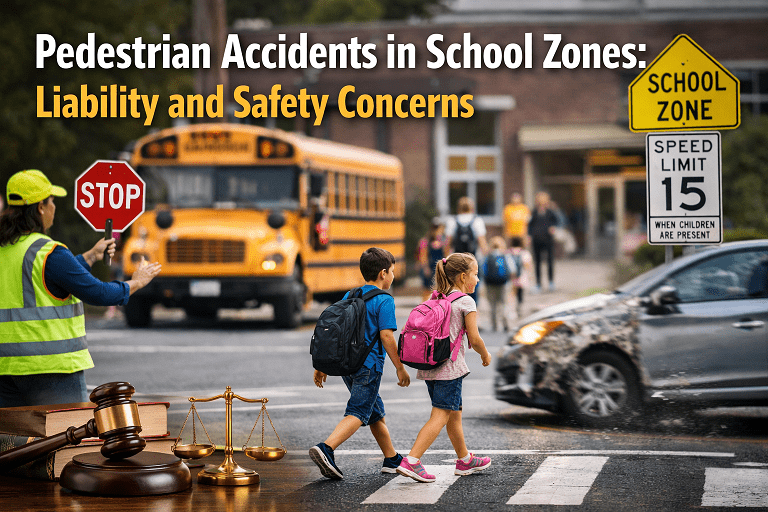
Liability and Safety Concerns
School zones represent some of the most critical areas for pedestrian safety in our communities. Every school day, millions of children walk, bike, or cross streets near educational facilities, creating concentrated periods of vulnerability during drop-off and dismissal times. When accidents occur in these designated safety zones, the legal and liability implications extend far beyond typical pedestrian accident cases, often involving multiple parties including drivers, schools, municipalities, and crossing guards.
Understanding the unique legal landscape surrounding school zone pedestrian accidents is essential for parents, educators, and anyone who has been affected by these preventable tragedies.
The Heightened Duty of Care in School Zones
School zones are subject to enhanced legal protections precisely because children are present and often lack the judgment and physical capabilities of adult pedestrians. Courts recognize that children are inherently less predictable, may dart into traffic unexpectedly, and cannot always accurately judge vehicle speed and distance. This recognition creates a heightened duty of care for all parties responsible for school zone safety.
Drivers passing through school zones must exercise extraordinary caution. Most jurisdictions impose reduced speed limits during school hours, typically ranging from 15 to 25 miles per hour. These restrictions aren’t merely suggestions—they’re legally enforceable standards that, when violated, can establish negligence per se in accident cases. This legal doctrine means that violating a safety statute designed to protect a specific class of people (in this case, children) automatically establishes the breach of duty element in a negligence claim.
Beyond individual driver responsibility, municipalities, school districts, and private entities all share duties to maintain safe conditions around schools. When they fail in these obligations and a child is injured, liability may extend to these institutional defendants who often have deeper financial resources than individual motorists.
Crossing Guard Negligence: When Protectors Become Liable Parties
Crossing guards serve as the human safety net at some of our most vulnerable intersections. Whether employed by school districts, municipalities, or private contractors, these individuals are tasked with stopping traffic and safely guiding children across roadways. When crossing guards fail in their duties, catastrophic injuries can result.
Crossing guard negligence can take several forms. The most obvious involves simply failing to perform their core function—stopping traffic before allowing children to cross. This might occur when a guard is distracted by their phone, engaged in conversation, or has temporarily left their post. Even brief lapses in attention during critical moments can prove devastating when a child steps into an intersection believing they have been given safe passage.
More subtle forms of crossing guard negligence include giving premature signals for children to cross before traffic has fully stopped, failing to make eye contact with approaching drivers to ensure acknowledgment, or inadequately assessing traffic flow before entering the intersection. Some cases involve crossing guards working at intersections where sight lines are obstructed, yet failing to take additional precautionary measures to account for reduced visibility.
Liability for crossing guard negligence typically falls on the employing entity rather than the individual guard. Under the legal doctrine of respondeat superior, employers are held responsible for the negligent acts of employees performed within the scope of their employment. This means injured families typically pursue claims against the school district or municipality rather than the crossing guard personally.
However, establishing liability requires proving that the crossing guard’s actions fell below the standard of care expected of a reasonably prudent crossing guard under similar circumstances. This often necessitates expert testimony regarding proper crossing guard procedures, training standards, and industry best practices. Documentation of the guard’s training, work history, and any prior incidents becomes crucial evidence in these cases.
Some jurisdictions provide governmental immunity protections for crossing guards employed by public entities, though most states have created exceptions to sovereign immunity for negligent acts that cause bodily injury. Navigating these immunity defenses requires experienced legal counsel familiar with local governmental liability laws.
Speeding Violations During School Hours: Enhanced Penalties and Liability
Speed limit reductions in school zones exist because physics is unforgiving—the difference between a vehicle traveling 25 mph versus 35 mph can mean the difference between survivable injuries and death for a child pedestrian. Studies consistently show that pedestrians struck by vehicles traveling 20 mph have a 95% survival rate, while those struck at 40 mph have only a 15% survival chance.
When drivers exceed posted school zone speed limits and strike pedestrians, they face both criminal penalties and civil liability. Many states impose enhanced fines and penalties for speeding in school zones, sometimes doubling or tripling standard traffic violation consequences. Repeat offenders may face license suspension, mandatory court appearances, and in egregious cases, reckless driving charges.
From a civil liability perspective, speeding in a school zone provides particularly strong evidence of negligence. The violation of a statute specifically designed to protect children establishes negligence per se in most jurisdictions, shifting the burden of proof and making it significantly easier for plaintiffs to prevail in personal injury lawsuits.
Proving speeding violations in pedestrian accident cases may involve multiple forms of evidence. Witness testimony from teachers, parents, or other motorists can establish that the defendant was driving at excessive speed. Physical evidence from the accident scene, including skid marks, vehicle damage patterns, and point of impact, can be analyzed by accident reconstruction experts to calculate vehicle speed at the time of collision.
Many school zones now feature automated speed enforcement cameras that capture violations photographically. While the admissibility of such evidence varies by jurisdiction, these systems can provide objective documentation of speeding violations. Additionally, some vehicles’ event data recorders (black boxes) store speed information from moments before a collision, offering potentially irrefutable evidence of the driver’s velocity.
In cases where speeding is combined with other negligent behaviors—such as distracted driving, driving under the influence, or aggressive driving—punitive damages may become available in addition to compensatory damages. Punitive damages are designed to punish particularly egregious conduct and deter similar behavior in the future.
Inadequate Signage and Traffic Control Devices
School zones require clear, visible signage to alert drivers that they are entering an area requiring heightened caution and reduced speed. When signage is missing, obscured, faded, or improperly placed, drivers may be unaware of their location in a school zone, traveling at dangerous speeds without realizing children are present.
Municipalities and departments of transportation bear responsibility for installing and maintaining appropriate school zone signage and traffic control devices. This includes not only speed limit signs but also flashing beacons, painted crosswalks, “school zone ahead” warnings, and pedestrian crossing signals.
The Manual on Uniform Traffic Control Devices (MUTCD), published by the Federal Highway Administration, establishes national standards for school zone signage. While compliance with MUTCD guidelines isn’t always legally mandatory at the state level, deviation from these nationally recognized standards can constitute evidence of negligence when accidents occur.
Common signage deficiencies that contribute to school zone accidents include faded or weathered signs that are difficult to read, signs placed too close to the actual school zone to give drivers adequate warning, vegetation or other obstructions that block sight lines to critical signage, and flashing beacon systems that malfunction or fail to activate during school hours.
When inadequate signage contributes to a pedestrian accident, liability may fall on the governmental entity responsible for traffic control in that area. Establishing municipal liability requires demonstrating that the entity had actual or constructive notice of the deficient condition and failed to remedy it within a reasonable timeframe.
This notice requirement means that prior complaints, work orders, or inspection reports documenting signage problems become critical evidence. If parents, teachers, or community members had previously reported visibility issues with school zone signs and the municipality failed to address these concerns, this strengthens the case for governmental liability.
Some cases involve not just inadequate maintenance of existing signage but failure to install appropriate traffic control devices in the first place. If traffic studies or school safety assessments recommended additional signage or signals that were never implemented, this can demonstrate a conscious decision to prioritize budget considerations over child safety—potentially opening the door to punitive damages claims.
Municipality Liability for Poor Traffic Control Measures
Beyond signage, municipalities bear broader responsibility for implementing comprehensive traffic control measures around schools. This includes roadway design, intersection configuration, traffic light timing, crosswalk placement, and physical traffic calming devices like speed bumps and curb extensions.
Many school zone accidents occur at intersections where inadequate traffic control creates dangerous conditions. Intersections near schools should ideally feature crossing guards, clearly marked crosswalks, pedestrian countdown signals, and potentially leading pedestrian intervals that give students a head start before vehicles receive a green light.
When municipalities fail to implement evidence-based traffic calming measures despite known dangers, they may be held liable for resulting injuries. Establishing this liability often requires demonstrating that the entity knew or should have known about hazardous conditions yet failed to take reasonable corrective action.
Traffic studies, accident history reports, and community complaints all provide evidence of notice. If multiple near-misses or previous accidents occurred at a particular school zone intersection, yet the municipality took no action to improve safety measures, this can establish the knowledge and deliberate indifference necessary for liability.
School zones in residential areas sometimes lack adequate infrastructure entirely—no marked crosswalks, no reduced speed limit signs, no flashing beacons—despite significant student pedestrian traffic. In these situations, municipalities may argue that budgetary constraints prevent implementation of ideal safety measures at every location. However, courts generally reject pure financial concerns as justification for failing to protect child safety in known high-risk areas.
Expert testimony from traffic engineers becomes invaluable in municipal liability cases. These professionals can testify regarding industry standards for school zone traffic control, analyze whether implemented measures meet those standards, and opine on whether additional safety measures would likely have prevented the accident in question.
Some jurisdictions have codified specific requirements for school zone traffic control in municipal codes or state statutes. Violation of these mandatory provisions can establish negligence per se, making governmental liability claims significantly stronger.
Comparative Negligence and Child Pedestrians
Even in school zone accident cases, defendants may raise comparative negligence defenses, arguing that the injured child’s own actions contributed to the accident. Children darting into traffic without looking, crossing outside designated crosswalks, or ignoring crossing guard instructions may be assigned partial fault.
However, courts apply modified standards when evaluating child negligence. Children are not held to the same standard of care as adults; instead, the standard is what a reasonably careful child of similar age, intelligence, and experience would do under similar circumstances. Very young children (typically under seven) are often considered incapable of contributory negligence as a matter of law.
The more egregious the defendant’s conduct—particularly in cases involving excessive speeding or crossing guard negligence—the less likely comparative negligence defenses will succeed in reducing damages significantly. Even if a child is found partially at fault, defendants who violated school zone traffic laws or failed in their safety duties will typically bear the majority of liability.
Pursuing Compensation in School Zone Pedestrian Accidents
School zone pedestrian accidents often result in severe injuries including traumatic brain injuries, spinal cord damage, broken bones, and in the worst cases, fatalities. The medical expenses, rehabilitation costs, and long-term care needs for seriously injured children can be substantial, making adequate compensation critical for families.
Potential defendants in these cases include the driver who struck the child, the municipality responsible for roadway safety and traffic control, the school district if crossing guard negligence was involved, and potentially contractors hired to provide traffic control services. Many cases involve multiple defendants, each bearing partial responsibility for the accident.
Compensation may include economic damages for medical bills, future medical care, therapy and rehabilitation, modified living accommodations if permanent disability results, and loss of future earning capacity. Non-economic damages compensate for pain and suffering, emotional distress, loss of enjoyment of life, and in cases of permanent injury, diminished quality of life.
When governmental entities are defendants, damage caps may apply under state tort claims acts, potentially limiting recovery even in cases of catastrophic injury. Understanding these limitations is essential for setting realistic expectations and pursuing all available insurance coverage.
The Importance of Immediate Action
School zone pedestrian accident cases require prompt investigation while evidence remains fresh. Witness memories fade, surveillance footage may be overwritten, and physical evidence can be altered or destroyed. Families should consult with experienced personal injury attorneys as soon as possible following an accident.
Early investigation allows attorneys to preserve critical evidence including traffic camera footage, school surveillance videos, crossing guard work schedules and training records, municipal traffic studies and safety assessments, driver cell phone records, and vehicle event data recorders.
Many governmental entities have shortened notice requirements for filing claims, sometimes as brief as 60 to 90 days. Failing to provide proper notice within statutory deadlines can forfeit the right to pursue compensation entirely, making immediate legal consultation essential.
School zones should be sanctuaries where our most vulnerable pedestrians can safely navigate their daily routines. When accidents occur in these protected areas, they often result from preventable failures by those entrusted with child safety. Whether through crossing guard negligence, driver recklessness, inadequate signage, or municipal indifference to known hazards, these failures demand accountability.
Understanding the complex liability landscape in school zone pedestrian accidents empowers families to pursue justice and helps communities identify and address systemic safety deficiencies. No family should have to endure the tragedy of a preventable school zone accident, and holding negligent parties accountable serves both individual justice and broader public safety interests.